

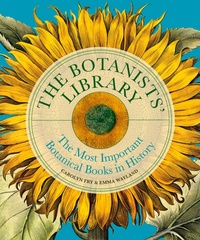
The Botanists' Library
The most important botanical books in history
Published on 5. November 2024
272 pages
978-0-7112-9495-0 (ISBN)
Description

Discover a vast treasure trove of botanical knowledge in The Botanist's Library, a superbly illustrated collection of 300+ seminal books and illustrations from throughout history.
From the earliest manuscripts penned by visionary naturalists to the modern tomes that continue to shape our understanding of the plant kingdom, this book is a testament to the tireless dedication of the world's greatest botanists. Its compelling narrative and visual journey make it a must-have addition to the library of anyone fascinated by the beauty and complexity of the plant kingdom.
This complete guide traces the development of botanical science through era-defining publications, covering:
Historia Plantarum, the first history of botany, written between c. 350 BC and c. 287 BC in which Theophrastus described plants by their uses, and attempted a biological classification based on how plants reproduced to the authors of the herbals of the 16th century
Brunfels, Fuchs, Bock and Mattioli, who regarded plants as the vehicles of medicinal virtues
The golden age of the 18th- and 19th-century flower hunters who travelled to every corner of the world in search of new and exotic plants
Today's most significant works of botanical reference
Each chapter delves into the pages of a seminal work, unveiling the insights, controversies, and stories behind the books that have shaped our understanding of the plant world. Whether you are a seasoned botanist, a budding enthusiast, or simply someone with an insatiable curiosity about the natural world, The Botanist's Library offers a comprehensive reference that will enrich your understanding of botany and its evolution.
From the earliest manuscripts penned by visionary naturalists to the modern tomes that continue to shape our understanding of the plant kingdom, this book is a testament to the tireless dedication of the world's greatest botanists. Its compelling narrative and visual journey make it a must-have addition to the library of anyone fascinated by the beauty and complexity of the plant kingdom.
This complete guide traces the development of botanical science through era-defining publications, covering:
Historia Plantarum, the first history of botany, written between c. 350 BC and c. 287 BC in which Theophrastus described plants by their uses, and attempted a biological classification based on how plants reproduced to the authors of the herbals of the 16th century
Brunfels, Fuchs, Bock and Mattioli, who regarded plants as the vehicles of medicinal virtues
The golden age of the 18th- and 19th-century flower hunters who travelled to every corner of the world in search of new and exotic plants
Today's most significant works of botanical reference
Each chapter delves into the pages of a seminal work, unveiling the insights, controversies, and stories behind the books that have shaped our understanding of the plant world. Whether you are a seasoned botanist, a budding enthusiast, or simply someone with an insatiable curiosity about the natural world, The Botanist's Library offers a comprehensive reference that will enrich your understanding of botany and its evolution.
More details
Series
Language
English
Place of publication
London
United Kingdom
Publishing group
Quarto Publishing PLC
Product notice
Reflowable
ISBN-13
978-0-7112-9495-0 (9780711294950)
Copyright in bibliographic data and cover images is held by Nielsen Book Services Limited or by the publishers or by their respective licensors: all rights reserved.
Schweitzer Classification
Other editions
Additional editions
Book
11/2024
Ivy Press
€35.00
Available immediately
Persons
Carolyn Fry is a journalist and author specialising in science, environment and botanical exploration. She has written/co-authored 11 books including Seeds: Safeguarding our Future (winner of the 2016 Garden Media Guild Environmental Award); Plants: from Roots to Riches (tie-in to the 24-part Radio 4 series of the same name); and The Plant Hunters: The Adventures of the World's Greatest Botanical Explorers. A former Editor of Geographical, magazine of the Royal Geographical Society, Carolyn has contributed news stories and articles to multiple magazines and national newspapers. Her work has taken her to many far-flung places, including Oman to track humpback whales from a traditional sailing dhow; Zambia, to follow in explorer David Livingstone's footsteps; Antarctica, to visit the world's most remote post office; and Argentina, to dig for dinosaurs. Carolyn lives on the south coast of the UK.
Emma Wayland is a journalist, writer and editor. Her postgraduate research at Imperial College, London, and in the Department of History and Philosophy of Science, Cambridge, concerned how Victorian gardeners made use of new scientific ideas. She was the Independent on Sunday's gardening columnist for ten years, and for the last 15 years she has been part of the team of tour guides at Kew interpreting the gardens for visitors. She wrote Darwin's Dogs (2009) and has been a co-author of two Kew titles, Plants: from Roots to Riches (2015) and Plant Words (2022).
EMMA WAYLAND is a journalist, writer and editor. Her postgraduate research at Imperial College, London, and in the Department of History and Philosophy of Science, Cambridge, concerned how Victorian gardeners made use of new scientific ideas. She was the Independent on Sunday's gardening columnist for ten years, and for the last 15 years she has been part of the team of tour guides at Kew interpreting the gardens for visitors. She wrote Darwin's Dogs (2009) and has been a co-author of two Kew titles, Plants: from Roots to Riches (2015) and Plant Words (2022).
Emma Wayland is a journalist, writer and editor. Her postgraduate research at Imperial College, London, and in the Department of History and Philosophy of Science, Cambridge, concerned how Victorian gardeners made use of new scientific ideas. She was the Independent on Sunday's gardening columnist for ten years, and for the last 15 years she has been part of the team of tour guides at Kew interpreting the gardens for visitors. She wrote Darwin's Dogs (2009) and has been a co-author of two Kew titles, Plants: from Roots to Riches (2015) and Plant Words (2022).
EMMA WAYLAND is a journalist, writer and editor. Her postgraduate research at Imperial College, London, and in the Department of History and Philosophy of Science, Cambridge, concerned how Victorian gardeners made use of new scientific ideas. She was the Independent on Sunday's gardening columnist for ten years, and for the last 15 years she has been part of the team of tour guides at Kew interpreting the gardens for visitors. She wrote Darwin's Dogs (2009) and has been a co-author of two Kew titles, Plants: from Roots to Riches (2015) and Plant Words (2022).
Content
Introduction
1. Early texts show emerging knowledge of plants (ancient times-1450)
2. The coming of print (1450-1600)
3. Botanists strive to know and classify more plants (1600-1750)
4. The global and the local (1750-1830)
5. Botany becomes a science (1830-1950)
6. The modern Botanists' Library takes shape (1950-present day)
Index
