

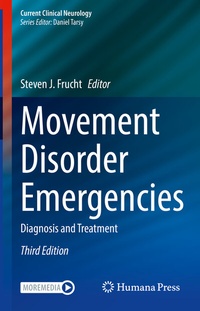
Movement Disorder Emergencies
Description

More details
Other editions
Additional editions
Person
Content
Part I. Practical Approach to the Patient with a Movement Disorder Emergency.-
Chapter 1. Practical Approach to Management of the Movement Disorders Patient in the Hospital and Intensive Care Unit
.-
Chapter 2. Neuro-Ophthalmologic Evaluation in Movement Disorders
.-
Chapter 3. Movement Disorder Emergencies of the Upper Aerodigestive Tract
.- Part II. Hyperacute Movement Disorder Emergencies.-
Chapter 4. Acute Parkinsonism
.-
Chapter 5. Parkinsonism-Hyperpyrexia Syndrome in Parkinson's Disease
.-
Chapter 6. Neuroleptic Malignant Syndrome
.-
Chapter 7.Malignant Catatonia
.-
Chapter 8. Serotonin Syndrome.- Chapter 9. Acute Spinal Rigidity
.-
Chapter 10. Status Dystonicus
.-
Chapter 11. Posthypoxic Myoclonus and Its Management
.- Part III. Acute Movement Disorder Emergencies .-
Chapter 12. Tic Emergencies
.-
Chapter 13. Coprolalia and Malignant Phonic Tics
.-
Chapter 14.Hemiballism-Hemichorea
.-
Chapter 15. Sydenham's Chorea, PANDAS, and Other Post-streptococcal Neurological Disorders
.-
Chapter 16. Anti-NMDA Receptor Encephalitis and Other Autoimmune and Paraneoplastic Movement Disorders
.-
Chapter 17. Psychosis and Parkinson's Disease
.-
Chapter 18. Perioperative Emergencies Associated with Deep Brain Stimulation
.- Part IV. Emergencies of Recognition: Pitfalls in Diagnosis.-
Chapter 19. Startle Disorders.- Chapter 20. Pseudodystonic Emergencies
.-
Chapter 21. Functional Movement Disorders
.-
Chapter 22. Tardive and Neuroleptic-induced Emergencies
.-
Chapter 23. Abductor Paresis in Shy-Drager Disease
.-
Chapter 24. Dopa-responsive Dystonia and Related Disorders
.-
Chapter 25. Wilson's Disease
.-
Chapter 26. Wilson Disease Presented as Opsoclonus-Myoclonus Syndrome
.-
Chapter 27. X-Linked Adrenoleukodystophy: Addisonian Crisis in a Patient with Spastic Paraparesis-Ataxia Syndrome
.-
Chapter 28. Whipple's Disease
.- Part V. Practical Risks in the Clinic: Pitfalls in Management.-
Chapter 29. Emergencies in Huntington's Disease
.-
Chapter 30. Genetics and Genetic Counseling-Related Issues
.-
Chapter 31. Driving in Parkinson's Disease
.-
Chapter 32. Suicide Risk in Parkinson's Disease.
