

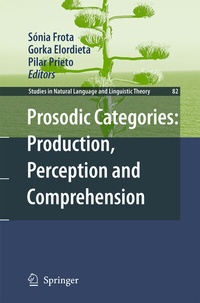
Prosodic Categories: Production, Perception and Comprehension
Description

The relationship between intonation and pragmatics in speech production
Sentence modality prosody characterization
The role of pitch in quantity-based sound systems
Consonant-conditioned tone depression phonology across languages
The encoding of intonational contrasts in both intonational and tonal languages
Featuring new data and ground-breaking results, the papers draw on empirical approaches that analyze production, perception and comprehension experiments such as the prepared speech paradigm and semantic scaling tasks. These are discussed in a variety of languages, some underrepresented in the literature (such as French and Estonian) while others, such as Shekgalagari, are examined in this way for the first time. This collection of cutting-edge material will be of interest to a broad range of language researchers.
More details
Other editions
Additional editions
Content
Introduction .- 1. Phonological trochaic grouping in language planning and language change .- 2. Order effects in production and comprehension of prosodic boundaries .- 3. Semantically-independent but contextually-dependent interpretation of contrastive accent .- 4. The developmental path of phonological focus-marking in Dutch .- 5.A phonetic study of intonation and focus in N l e ? kepmxcin (Thompson River Salish) .- 6.The alignment of accentual peaks in the expression of focus in Korean .- 7. The perception of negative bias in Bari Italian questions .- 8. From Tones to Tunes: Effects of the f 0 prenuclear region in the perception of Neapolitan statements and questions .- 9. The role of pitch cue in the perception of the Estonian long quantity .- 10. All Depressors are not alike: A comparison of Shanghai Chinese and Zulu .- 11. Tonal and Non-Tonal Intonation in Shekgalagari
