

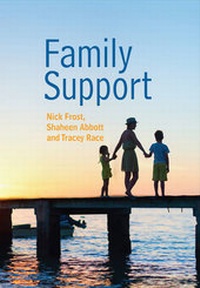
Family Support
Description

Reviews / Votes
"The authors offer a highly accessible account of the key features of family support and a very timely reminder of its importance to families and those working with them. Excellent and highly recommended." Brigid Featherstone, The Open University "For all professionals with an interest in best practice, this book delivers in terms of 'understanding and doing' Family Support in the real world. The reader is brought from policy contexts to direct work practices in a most informative fashion and with ease." Pat Dolan, National University of IrelandMore details
Other editions
Additional editions
Persons
Content
Introduction
The idea of 'prevention' has been an essential element of child welfare practice since its Victorian origins (Stedman Jones 1976): what has changed over the years has been the way the aim of 'preventing' the emergence of social and family problems has been conceptualized in policy and then put into practice. These changes are reflected in family support 'projects' aimed at preventing family breakdown and related social problems; such projects include the Victorian National Society for the Prevention of Cruelty to Children (NSPCC), the post-Second World War Family Service Units, the New Labour Sure Start initiative and the contemporary 'Troubled Families' programme. Such initiatives reflect changing ideologies about, and approaches to, family support. These ideologies are also reflected in shifting terminology - from 'prevention' through to contemporary debates about 'family support, 'early intervention' and 'early help'. These important conceptual issues will be discussed and dissected in the opening chapters of this book and will inform the rest of our policy and practice analysis.
Surprisingly little has been written about 'family support', especially in the form of texts suitable for students and/or books which focus on how to actually plan, organize and deliver family support. One aim of this book is to address this gap by producing a readable, accessible and practical text aimed at outlining and explaining current theory, policy, research and practice relating to 'family support'. We aim to make a contribution to the rehabilitation of 'family support' as a concept and as a practice: we want to argue strongly in favour of the crucial role of family support which in recent years has been displaced by the predominant safeguarding and child protection agenda (see Featherstone, White and Morris 2014).
This book is made up of chapters which can be read independently, but which as a whole are intended to provide a comprehensive overview of family support theory, policy, practice and research. One aim of the book is to help future and current child welfare professionals extend their use of theory and research to inform their practice within a changing and complex multi-agency context.
The book is designed for all those professionals involved in child welfare and safeguarding education and training at undergraduate and postgraduate levels, as well as at more experienced practitioners progressing towards post-qualifying awards or those in practice who want to inform their family support practice. In recent years, there has been a growth in degree-level programmes with titles such as Child and Family Studies, or indeed Family Support Studies, for which this may be a core book. We also hope that the book will be of interest to academics, researchers and policy makers alike.
Whilst this book is part of a series aimed primarily at social workers we contend that family support is essentially multi-disciplinary or indeed trans-disciplinary. Social workers do have a key role: we hope they can apply some of the approaches discussed here in all their work, including safeguarding and looked-after children work (Frost and Parton 2009). The role of family support has however been displaced from social work to a myriad of other settings and professions and para-professionals, so we hope the book is of interest, for example, to youth workers, play workers, community health staff, children centre staff and many others.
The book stresses the existence of a continuum in relation to family support practice - from universal family support through to the targeted safeguarding of vulnerable children and young people. This continuum reflects that, while all families require some sort of support in raising their children, some identified families will be recognized as families with 'children in need' or as 'troubled families', while a smaller number will receive family support as part of a child protection plan. The book draws on restorative practices - those that are high on support but are also authoritative in providing clear limits and boundaries (see http://www.irrp.edu/).
The eight features of family support outlined below have underpinned our analysis in this book.
- Family support offers inclusive and engaging practices based on the idea of offering support to families and children who feel they require it. Family support is therefore strongly suggestive of partnership, engagement and consent.
- Such support can be offered early in the life of the child or early in the emergence of the identified challenge facing the family. It is important that family support services can be relevant to all children and young people, and not only to younger children.
- Family support is a proactive process which engages with the parent(s) and/or young person in a process of change. Implicit in the term 'family support' is the suggestion of bringing about change within the family network.
- Family support attempts to prevent the emergence, or worsening, of family challenges.
- Family support is necessarily based in a theory of change. Any family support intervention should aim to result in some desirable change, and it draws on a belief that change is achievable.
- Family support draws on a diverse 'tool kit' of skills and approaches. It attempts to develop and encourage local, informal support networks.
- Family support aims to generate wider social change and benefits. Such results may lead to a saving in public expenditure, a decrease in social problems, an improvement in the quality of family life or a reduction in measurable outcomes, such as the number of children coming into care.
- Family support works with children and young people in partnership and encourages and develops their resilience.
These eight principles will inform core arguments and practice suggestions made throughout this book.
We strongly support the deployment of the term 'family support'. Writing in 2006, Dolan, Canavan and Pinkerton argued that: 'Family support has become a major strategic orientation in services for children and families. It now occupies a significant place within the array of care and welfare interventions' (2006: 11). At the time of writing this book (2015), we are concerned that this 'strategic orientation' is becoming lost as we are concerned about the predominant use of the terms 'early help', and in particular 'early intervention', as they tend to:
- devalue the 'support' element of family support;
- draw on a restrictive model of research that suggests that all interventions can be measured;
- promote early intervention which is particularly authoritarian in nature;
- promote short-term, time-limited programmes, as opposed to ongoing responsive support;
- emphasize 'early' years programmes as opposed to support through the whole of childhood.
The book draws on international research and other data to inform our argument: inevitably, given our geographical base, the reader may observe that much of the material is drawn from England. It is difficult to accurately reflect the variations of policy and legislation across the United Kingdom, where England, Scotland, Wales and Northern Ireland all have differing degrees of devolution (see our Resources section for guidance on this). As a result, child welfare and family support differ across the four jurisdictions: we have attempted to provide examples from all four nations. In general, however, we would argue that, once local detail is placed to one side, most of the material has implications across regional and national boundaries.
The structure of the book
This volume is divided into three parts. In Part I, Understanding Family Support, we address three different contextual elements:
- social history, political context and theories of 'family support';
- the contemporary political context;
- the challenges of researching and measuring 'family support'.
In chapter 1, the social history, context of and definitions and theories of 'family support' are explored. Family support has a long history which dates back, at least in the United Kingdom, to Victorian times. The roots of family support, for example, can be found in the early work of the National Society for the Prevention of Cruelty to Children (NSPCC). As we will discuss, the early SPCC inspectors utilized court proceedings and sometimes removed children, but their predominant approach was to reform family life (Ferguson 2004). Further historical roots are explored before we move to examine the definitions of both 'family' and 'support'. Both 'family' and 'support' are explored as contested and complex concepts, which must underpin our understanding of this area of practice. Differing theoretical approaches to 'family' are explored, presented and analysed. A technique for understanding family support will be developed, based on the primary, secondary, tertiary and quaternary framework devised in the 1970s by Hardiker et al.
Chapter 2 explores the broader context of family support work. All forms of child welfare practice have political and ideological elements, and this is certainly the case in relation to family support, which is inseparable from key political debates about...
