

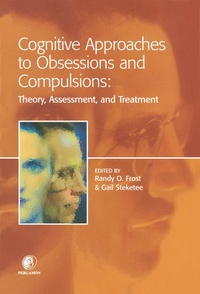
Cognitive Approaches to Obsessions and Compulsions
Theory, Assessment, and Treatment
Published on 31. May 2002
530 pages
978-0-08-050218-2 (ISBN)
Description

Cognitive Approaches to Obsessions and Compulsions
More details
Other editions
Additional editions
Randy O. Frost | Gail Steketee
Cognitive Approaches to Obsessions and Compulsions
Theory, Assessment, and Treatment
Book
05/2002
Pergamon
€134.99
Article exhausted; check different version
Content
- Front Cover
- COGNITIVE APPROACHES TO OBSESSIONS AND COMPULSIONS THEORY, ASSESSMENT, AND TREATMENT
- Copyright Page
- Contents
- Contributors
- Preface
- Chapter 1. Cognition in Obsessive Compulsive Disorder: An Overview
- Section A: Domains of Beliefs in Obsessive Disorder: An Overview
- Chapter 2. Importance of Thoughts
- Chapter 3. The Need to Control Thoughts
- Chapter 4. Responsibility
- Chapter 5. Overestimation of Threat and Intolerance of Uncertainty in Obsessive Compulsive Disorder
- Chapter 6. Perfectionism in Obsessive Compulsive Disorder
- Commentary on Cognitive Domains Section
- Section B: Measurement of Cognition in Obsessive Compulsive Disorder
- Chapter 7. Development and Validation of Instruments for Measuring Intrusions and Beliefs in Obsessive Compulsive Disorder
- Chapter 8. Experimental Methods for Studying Cognition
- Chapter 9. Information Processing in Obsessive Compulsive Disorder
- Chapter 10. Insight: Its Conceptualization and Assessment
- Commentary on Cognitive Approaches to Obsessive Compulsive Disorder: Critical Issues and Future Directions in Measurement
- Section C: Cognition in Disorders Related to Obsessive Compulsive Disorder
- Chapter 11. Cognitive Theory of Body Dysmorphic Disorder
- Chapter 12. Eating Disorders and Obsessive Compulsive Disorder
- Chapter 13. A Cognitive Perspective on Obsessive Compulsive Disorder and Depression: Distinct and Related Features
- Chapter 14. Obsessive Compulsive Disorder and Schizophrenia: A Cognitive Perspective of Shared Pathology
- Chapter 15. Cognitions in Compulsive Hoarding
- Commentary on Obsessive Compulsive Spectrum and Related Disorders
- Section D: Cognition in Selected OCD Populations
- Chapter 16. Cognitive Aspects of Obsessive Compulsive Disorder in Children
- Chapter 17. Cognitive Processes and Obsessive Compulsive Disorder in Older Adults
- Chapter 18. Cognition in Subclinical Obsessive Compulsive Disorder
- Chapter 19. Cognitions in Individuals with Severe or Treatment Resistant Obsessive Compulsive Disorder
- Chapter 20. Obsessive Compulsive Disorder Cognitions Across Cultures
- Commentary on Special Populations
- Section E: Therapy Effects on Cognition
- Chapter 21. Cognitive Changes in Patients with Obsessive Compulsive Rituals Treated with Exposure in vivo and Response Prevention
- Chapter 22. Cognitive Effects of Cognitive-Behavior Therapy for Obsessive Compulsive Disorder
- Chapter 23. Group Cognitive Behavioral Therapy for Obsessive Compulsive Disorder
- Chapter 24. Medication Effects on Obsessions and Compulsions
- Commentary on Therapy Effects on Cognition
- Commentary on Treatment
- Chapter 25. Studying Cognition in Obsessive Compulsive Disorder: Where to From Here?
- Appendices
- Appendix A: Obsessional Beliefs Questionnaire and Scoring Information
- Appendix B: Interpretation of Intrusions Inventory and Scoring Information
- Author Index
- Subject Index
