

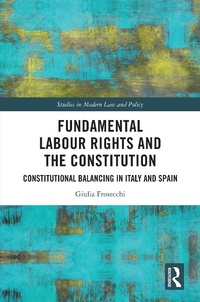
Fundamental Labour Rights and the Constitution
Constitutional Balancing in Italy and Spain
1st Edition
Published on 5. July 2023
210 pages
978-1-000-90251-8 (ISBN)
Description

The book reflects on constitutional balancing from the perspective of fundamental labour rights. It draws on neo-constitutional theories and builds on the assumption that fundamental labour rights, understood as rights aimed at protecting workers during their working life or after retirement, are the normative expression of founding values and can be balanced against equally axiological constitutional principles. The balancing of constitutional labour rights can be conducted by various institutional actors and by applying different techniques. This volume reviews the theoretical debates on judicial balancing and the approaches adopted by the Court of Justice of the European Union and the European Court of Human Rights, to proceed with a closer assessment of Italian and Spanish judicial traditions. In particular, it addresses the main profiles of the case law of the Italian and Spanish Constitutional Courts on labour and social law reforms adopted in the aftermath of the 2008 crisis, where balancing takes place between labour rights and economic principles. The analysis is focused on four main aspects: the fundamental labour rights in the balance; the role of the Courts; the technique applied by the Judges; and the constitutional interests subject to the balancing. It ultimately reveals that the axiological nature of fundamental labour rights is preserved and the economic and financial contingencies confirm their factual character, although they are occasionally recognised a prominent role in the ratio decidendi. The book will be a valuable resource for academics and researchers working in the areas of labour law, social security law, legal theory and constitutional law.
More details
Series
Edition
1. Auflage
Language
English
Place of publication
London
United Kingdom
Publishing group
Taylor & Francis Ltd
Target group
College/higher education
ISBN-13
978-1-000-90251-8 (9781000902518)
Copyright in bibliographic data and cover images is held by Nielsen Book Services Limited or by the publishers or by their respective licensors: all rights reserved.
Schweitzer Classification
Other editions
Additional editions
Giulia Frosecchi
Fundamental Labour Rights and the Constitution
Constitutional Balancing in Italy and Spain
Book
12/2024
1st Edition
Routledge
€65.10
Shipment within 15-20 days
Giulia Frosecchi
Fundamental Labour Rights and the Constitution
Constitutional Balancing in Italy and Spain
Book
07/2023
1st Edition
Routledge
€206.20
Shipment within 15-20 days
Person
Giulia Frosecchi is researcher and lecturer of labour law and European social law at the University of Florence, Italy.
Content
List of abbreviations
Introduction: From the EU crisis to constitutional balancing
1 Constitutional balancing of fundamental labour rights
1.1 Introduction
1.2 Constitutional balancing as a method and its theoretical justifications
1.2.1 Against constitutional balancing
1.2.2 The balancing actors
1.2.3 The axiological nature of fundamental labour rights
1.3 Balancing technique(s)
1.3.1 The proportionality test, a critique
1.4 Balancing in fundamental social rights' adjudication and the essential content dilemma
1.4.1 Italian and Spanish insights on the notion of essential content
1.5 Conclusions
2 Constitutional balancing techniques in the world: A glimpse
2.1 Introduction
2.2 A worldwide panoramic of constitutional balancing
2.3 Balancing in supranational courts
2.3.1 The CJEU way of balancing: a labour reading
2.3.2 The ECtHR way of balancing: a labour reading
2.3.3 On reasonableness
2.3.4 Around values, balancing and proportionality in supranational courts
2.4 A reappraisal of constitutional balancing in Italy and Spain
2.4.1 Balancing in the Italian constitutional case law
2.4.2 Applied balancing in the Spanish constitutional case law and the principle of proportionality
2.4.3 Financial and economic factors in the Constitutional Courts' case law
2.5 Conclusions
3 Italian and Spanish post-crisis case law and "its" fundamental labour rights
3.1 Introduction
3.2 The relevant Italian post-crisis case law
3.2.1 Public employees' wage reduction before the Court
3.2.2 Retirement benefits revaluation and the modulation of the Court
3.2.3 On compensation for unjustified dismissal
3.3 The relevant Spanish post-crisis case law
3.3.1 The first and comprehensive judgment on the 2012 labour reform
3.3.2 The second and consistent judgment, one year later
3.4 Fundamental labour rights in the balance
3.4.1 The right to work
3.4.2 The right to collective bargaining
3.4.3 The right to a sufficient and proportionate remuneration and the principle of adequacy of pensions in the Italian case law
3.5 Conclusions
4 Constitutional balancing in the Italian and Spanish post-crisis case law
4.1 Introduction
4.2 The role of the Courts
4.3 The technique applied to supervise the legislator's balancing
4.3.1 The principle of reasonableness that permeates the Italian constitutional post-crisis case law
4.3.2 The stone guest of the Spanish constitutional post-crisis case law: the principle of proportionality
4.4 The terms balanced
4.4.1 The Italian post-crisis case law and the public financial contingencies
4.4.2 The Spanish post-crisis case law and the overriding fight against unemployment
4.4.3 The economic crisis argument, in the balance?
4.4.4 An uncontroversial axiological term: the freedom to conduct a business
4.5 Conclusions
Conclusions
Bibliography
Index
Introduction: From the EU crisis to constitutional balancing
1 Constitutional balancing of fundamental labour rights
1.1 Introduction
1.2 Constitutional balancing as a method and its theoretical justifications
1.2.1 Against constitutional balancing
1.2.2 The balancing actors
1.2.3 The axiological nature of fundamental labour rights
1.3 Balancing technique(s)
1.3.1 The proportionality test, a critique
1.4 Balancing in fundamental social rights' adjudication and the essential content dilemma
1.4.1 Italian and Spanish insights on the notion of essential content
1.5 Conclusions
2 Constitutional balancing techniques in the world: A glimpse
2.1 Introduction
2.2 A worldwide panoramic of constitutional balancing
2.3 Balancing in supranational courts
2.3.1 The CJEU way of balancing: a labour reading
2.3.2 The ECtHR way of balancing: a labour reading
2.3.3 On reasonableness
2.3.4 Around values, balancing and proportionality in supranational courts
2.4 A reappraisal of constitutional balancing in Italy and Spain
2.4.1 Balancing in the Italian constitutional case law
2.4.2 Applied balancing in the Spanish constitutional case law and the principle of proportionality
2.4.3 Financial and economic factors in the Constitutional Courts' case law
2.5 Conclusions
3 Italian and Spanish post-crisis case law and "its" fundamental labour rights
3.1 Introduction
3.2 The relevant Italian post-crisis case law
3.2.1 Public employees' wage reduction before the Court
3.2.2 Retirement benefits revaluation and the modulation of the Court
3.2.3 On compensation for unjustified dismissal
3.3 The relevant Spanish post-crisis case law
3.3.1 The first and comprehensive judgment on the 2012 labour reform
3.3.2 The second and consistent judgment, one year later
3.4 Fundamental labour rights in the balance
3.4.1 The right to work
3.4.2 The right to collective bargaining
3.4.3 The right to a sufficient and proportionate remuneration and the principle of adequacy of pensions in the Italian case law
3.5 Conclusions
4 Constitutional balancing in the Italian and Spanish post-crisis case law
4.1 Introduction
4.2 The role of the Courts
4.3 The technique applied to supervise the legislator's balancing
4.3.1 The principle of reasonableness that permeates the Italian constitutional post-crisis case law
4.3.2 The stone guest of the Spanish constitutional post-crisis case law: the principle of proportionality
4.4 The terms balanced
4.4.1 The Italian post-crisis case law and the public financial contingencies
4.4.2 The Spanish post-crisis case law and the overriding fight against unemployment
4.4.3 The economic crisis argument, in the balance?
4.4.4 An uncontroversial axiological term: the freedom to conduct a business
4.5 Conclusions
Conclusions
Bibliography
Index
