

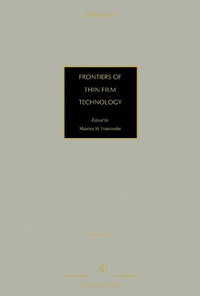
Frontiers of Thin Film Technology
Academic Press
Published on 7. November 2000
476 pages
978-0-08-054294-2 (ISBN)
Description

Frontiers of Thin Film Technology, Volume 28 focuses on recent developments in those technologies that are critical to the successful growth, fabrication, and characterization of newly emerging solid-state thin film device architectures. Volume 28 is a condensed sampler of the Handbook for use by professional scientists, engineers, and students involved in the materials, design, fabrication, diagnostics, and measurement aspects of these important new devices.
More details
Other editions
Additional editions
Maurice H. Francombe
Frontiers of Thin Film Technology: Volume 28
Book
11/2000
Academic Press
€186.01
Withdrawn from sale
Persons
Content
- Front Cover
- Thin Films: Frontiers of Thin Film Technology
- Copyright Page
- Contents
- List of Contributions
- Preface
- Chapter 1. Epitaxial Film Growth and Characterization
- 1.1. Introduction
- 1.2. Epitaxial Deposition Techniques
- 1.3. Materials Characterization
- 1.4. Future Directions
- References
- Chapter 2. Field Effect Transistors: FETs and HEMTs
- 2.1. Introduction
- 2.2. HEMT Device Operation and Design
- 2.3. Scaling Issues in Ultrahigh-speed HEMTs
- 2.4. Low-Noise HEMT Design
- 2.5. Power HEMT Design
- 2.6. Material Systems for HEMT Devices
- 2.7. AIGaAs/InGaAs/GaAs Pseudomorphic HEMT (GaAs pHEMT)
- 2.8. AIInAs/GaInAs/InP (InP HEMT)
- 2.9. Conclusion
- References
- Chapter 3. Antimony-Based Infrared Materials and Devices
- 3.1. Introduction
- 3.2. Overview of Materials and Electronic Properties
- 3.3. Mechanisms Limiting the Performance of Sources and Detectors
- 3.4. Infrared Emitters
- 3.5. Infrared Detectors
- 3.6. Conclusions
- References
- Chapter 4. HgCdTe Infrared Detectors
- 4.1. Introduction
- 4.2. HgCdTe Material Properties and Background
- 4.3. HgCdTe Growth
- 4.4. Native Defects and Impurity Doping Behavior
- 4.5. Photovoltaic Detectors
- 4.6. Recent Progress in Focal Plane Arrays (FPAs)
- 4.7. Conclusions
- References
- Chapter 5. Synthesis and Characterization of Superconducting Thin Films
- 5.1. Synthesis
- 5.2. Thin Film Characterization Techniques
- 5.3. Summary
- References
- Chapter 6. Fabrication of Superconducting Devices and Circuits
- 6.1. Introduction
- 6.2. Nb Circuit Process
- 6.3. NbN Circuit Process
- 6.4. HTS Circuit Process
- 6.5. Summary
- References
- Chapter 7. Microwave Magnetic Film Devices
- 7.1. Introduction to Applications of Magnetic Films in Microwave Devices
- 7.2. Current Approaches to Fabricate Ferrite Films
- 7.3. Ferrite Film Progress
- 7.4. Monolithic Integration of Ferrite Film Devices with Semiconductors
- References
- Chapter 8. Ferroelectric Thin Films: Preparation and Characterization
- 8.1. Introduction
- 8.2. Growth Processes of Ferroelectric Thin Films
- 8.3. Processing of Ferroelectric Thin Films
- 8.4. Compound Phase Formation
- 8.5. Electrical Properties
- 8.6. Process-Property Correlation: Low-Energy Oxygen Ion Beam Bombardment Effect
- 8.7. Microstructure-Dependent Electrical Properties
- 8.8. Summary
- References
- Chapter 9. Integration Aspects of Advanced Ferroelectric Thin-Film Memories
- 9.1. Introduction
- 9.2. Design Considerations
- 9.3. Capacitor Formation
- 9.4. Electrode and Capacitor Patterning
- 9.5. Hydrogen-Containing Ambient
- 9.6. Impact of the Ferroelectric Processing on Silicon Devices
- 9.7. Equipment Issues
- 9.8. Summary and Outlook
- References
- Subject Index
- Recent Volumes In This Series
- Color Plate Section
