

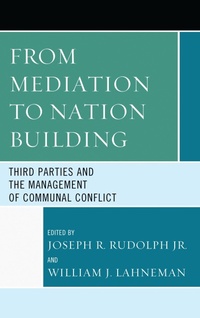
From Mediation to Nation-Building
Third Parties and the Management of Communal Conflict
Lexington Books (Publisher)
1st Edition
Published on 16. May 2013
534 pages
979-8-216-22380-1 (ISBN)
Description

The eruption in the early 1990s of highly visible humanitarian crises and exceedingly bloody civil wars in the Horn of Africa, imploding Yugoslavia, and Rwanda, set in motion a trend towards third party intervention in communal conflict in areas as far apart as the Balkans and East Timor. However haltingly and selectively, that trend towards extra-systemic means of managing ethnic and national conflict is still discernible, motivated as it was in the 1990s by the inability of in-house accommodation methods to resolve ethno-political conflicts peacefully and the tendency of such conflicts to spill into the international system in the form of massive refugee flows, regional instability, and failed states hosting criminal and terrorist elements. In its various forms, third party intervention has become a fixed part of the current international system
Our book examines the various forms in which that intervention occurs, from the least intrusive and costly forms of third party activity to the most intrusive and expensive endeavors. More specifically, organized in the form of overview essays followed by case studies that explore the utility and limitations, successes and failures of various forms of third party activity in managing conflict, the book begins by examining diplomatic intervention and then proceeds to cover, in turn, legal, economic, and military instruments of conflict management before concluding with a section on political tutelage arrangements and nation/capacity building operations.
The chapters themselves are authored by a mix of contributors drawn from relevant disciplines, both senior and younger scholars, academics and practitioners, and North Americans and Europeans. All treat a common theme but no attempt was made to solicit work from contributors with a common orientation towards the value of third party intervention. Nor were the authors straight-jacketed with heavy content guidelines from the editors. Their essays validate the value of this approach. Far from being chaotic in nature, they generally supplement one another, while offering opposing viewpoints on the overall topic; for example, our Italian contributor who specializes in non-government organizations offers a chapter illustrating their utility under certain conditions, whereas the chapter from an Afghan practitioner notes the downside of too much reliance on NGOs in nation-building operations. The essays also cover topics not often treated, and are written from the viewpoint of those on the ground. The chapter on creating a police force in post-Dayton Bosnia-Herzegovina, for example, reads much like a diary from the American colonel who was sent to Bosnia in early 1996 charged with that task.
Our book examines the various forms in which that intervention occurs, from the least intrusive and costly forms of third party activity to the most intrusive and expensive endeavors. More specifically, organized in the form of overview essays followed by case studies that explore the utility and limitations, successes and failures of various forms of third party activity in managing conflict, the book begins by examining diplomatic intervention and then proceeds to cover, in turn, legal, economic, and military instruments of conflict management before concluding with a section on political tutelage arrangements and nation/capacity building operations.
The chapters themselves are authored by a mix of contributors drawn from relevant disciplines, both senior and younger scholars, academics and practitioners, and North Americans and Europeans. All treat a common theme but no attempt was made to solicit work from contributors with a common orientation towards the value of third party intervention. Nor were the authors straight-jacketed with heavy content guidelines from the editors. Their essays validate the value of this approach. Far from being chaotic in nature, they generally supplement one another, while offering opposing viewpoints on the overall topic; for example, our Italian contributor who specializes in non-government organizations offers a chapter illustrating their utility under certain conditions, whereas the chapter from an Afghan practitioner notes the downside of too much reliance on NGOs in nation-building operations. The essays also cover topics not often treated, and are written from the viewpoint of those on the ground. The chapter on creating a police force in post-Dayton Bosnia-Herzegovina, for example, reads much like a diary from the American colonel who was sent to Bosnia in early 1996 charged with that task.
More details
Edition
1. Auflage
Language
English
Place of publication
United States
Publishing group
Bloomsbury Publishing Plc
Target group
Professional and scholarly
ISBN-13
979-8-216-22380-1 (9798216223801)
Copyright in bibliographic data and cover images is held by Nielsen Book Services Limited or by the publishers or by their respective licensors: all rights reserved.
Schweitzer Classification
Other editions
Additional editions
Joseph R. Rudolph Jr. | William J. Lahneman
From Mediation to Nation-Building
Third Parties and the Management of Communal Conflict
Book
03/2017
Lexington Books
€89.80
Shipment within 15-20 days
Persons
Joseph R. Rudolph, Jr., is a professor of Political Science at Towson University, has served as a Fulbright appointee to Czechoslovakia (1991-2) and Kosovo (2011-2), and has published in the field of ethnic and nationalist politics for more than 30 years. He has also frequently been a part of the democratization operations of the Organization for Security and Cooperation in Europe (OSCE) in areas of the former Yugoslavia since 1997. His more recent work includes The Encyclopedia of Modern Ethnic Conflicts (ed., 2003), Politics and Ethnicity: A Comparative Study (2006), and Hotspots in North America and Europe (2008).
William J. Lahneman is an associate professor of Political Science at Towson University, and a Senior Research Scholar at the Center for International and Security Studies at Maryland (CISSM) at the University of Maryland's School of Public Policy. He holds a Ph.D. in International Relations from the Johns Hopkins University's School of Advanced International Studies, an M.A. in National Security Affairs from the Naval Postgraduate School, and a B.S. from the U. S. Naval Academy. He has held academic positions as Associate Director for Programs at CISSM and as Associate Chair of the Political Science Department at the U.S. Naval Academy. A former U.S. Navy Commander with specializations in Surface Warfare, Strategic Planning, International Negotiations, and Nuclear Propulsion, his publications include Military Intervention: Cases in Context for the Twenty-first Century (ed., 2004) and Keeping U.S. Intelligence Effective: The Need for a Revolution in Intelligence Affairs (2011).
William J. Lahneman is an associate professor of Political Science at Towson University, and a Senior Research Scholar at the Center for International and Security Studies at Maryland (CISSM) at the University of Maryland's School of Public Policy. He holds a Ph.D. in International Relations from the Johns Hopkins University's School of Advanced International Studies, an M.A. in National Security Affairs from the Naval Postgraduate School, and a B.S. from the U. S. Naval Academy. He has held academic positions as Associate Director for Programs at CISSM and as Associate Chair of the Political Science Department at the U.S. Naval Academy. A former U.S. Navy Commander with specializations in Surface Warfare, Strategic Planning, International Negotiations, and Nuclear Propulsion, his publications include Military Intervention: Cases in Context for the Twenty-first Century (ed., 2004) and Keeping U.S. Intelligence Effective: The Need for a Revolution in Intelligence Affairs (2011).
Content
Dedication
Acknowledgments
Introduction: Communal Conflict and Third Party Intervention in a "Responsibility to Protect" World
Joseph R. Rudolph, Jr.
Part 1. Diplomacy
Chapter 2: "Peace Without Victory:" The Promise and Constraints of Third-Party Mediation in Civil Wars
Paul McCartney
Chapter 3: Ending the "Troubles": Brokering Peace in Northern Ireland
Elham Atashi
Chapter 4: Implementing the Liberal Peace: Observations from the Field
Linda S. Bishai
Chapter 5: Election Observers, Democratization, and Preventive Diplomacy
Joseph R. Rudolph, Jr.
Part 2. Legal Approaches
Chapter 6: International Law and Internal Conflicts
I.M. Lobo de Souza
Chapter 7: Turbulent Transition: From the UN Human Rights Commission to the Council
David P. Forsythe
Chapter 8: Transitional Justice in Divided Societies: Using Hybrid Courts to Manage Conflict
James DeShaw Rae
Part 3. Economic Measures
Chapter 9: Economic Instruments of Internal Conflict Resolution
Stephen D. Collins
Chapter 10: Externally Mandated Economic Liberalization and the Onset of Civil Conflict
Matthew Hoddie and Caroline Hartzell
Chapter 11: Conditional Conditionality: The European Union, International Justice, and the Democratic Transition in Serbia
Victor Peskin and Mieczyslaw P. Boduszynski
Chapter 12: The EU and Roma Rights
Neil Cruickshank
Part 4. Military Operations and Communal Conflict
Chapter 13: Military Intervention as a Tool of Conflict Resolution and Institution Building
William J. Lahneman
Chapter 14: Somalia: Intervention in Internal Conflict
David D. Laitin
Chapter 15: Intervention in Internal Conflict: Lessons from Bosniaand Kosovo
Steven L. Burg
Chapter 16: The Bosnian Intervention: Stabilization Without Guidelines
Brigid Myers Pavilonis
Chapter 17: Rebuilding a Democratic Iraqi Police Force: The Effects of the Militia on the Rebuilding Process
DiJon Jones
Chapter 18: Security Without Weapons: The Nonviolent Peace Force in Sri Lanka
M.S. Wallace
Part 5. Mentoring, Political Tutelage, and Nation-building as Tools
of Conflict Prevention and Management
Chapter 19: Third Party Nation-Building Today: Fifth Time Charmed?
Joseph R. Rudolph, Jr.
Chapter 20: Nation Building and Democratization in Afghanistan: The Need to Rethink the "Democratic Reconstruction Model"
Mohammad Ashraf
Chapter 21: International Intervention and Ethnic Tolerance in Bosnia-Herzegovina: Evidence from Public Opinion
Sam Whitt
Chapter 22: Wither Sovereignty? The Limits of Building States through International Administrations
Mateja Peter
Chapter 23: Bosnia Herzegovina and the Development of Democratic Policing
Donald R. Zoufal
Chapter 24: NGOs, Peace Support Activity, and the UNPREDEP Mission in Macedonia
Daniela Irrera
Part 6. Conclusion
Conclusions: Third Parties and the Management of Communal Conflict
William J. Lahneman
Bibliography
Index
About the Contributors
Acknowledgments
Introduction: Communal Conflict and Third Party Intervention in a "Responsibility to Protect" World
Joseph R. Rudolph, Jr.
Part 1. Diplomacy
Chapter 2: "Peace Without Victory:" The Promise and Constraints of Third-Party Mediation in Civil Wars
Paul McCartney
Chapter 3: Ending the "Troubles": Brokering Peace in Northern Ireland
Elham Atashi
Chapter 4: Implementing the Liberal Peace: Observations from the Field
Linda S. Bishai
Chapter 5: Election Observers, Democratization, and Preventive Diplomacy
Joseph R. Rudolph, Jr.
Part 2. Legal Approaches
Chapter 6: International Law and Internal Conflicts
I.M. Lobo de Souza
Chapter 7: Turbulent Transition: From the UN Human Rights Commission to the Council
David P. Forsythe
Chapter 8: Transitional Justice in Divided Societies: Using Hybrid Courts to Manage Conflict
James DeShaw Rae
Part 3. Economic Measures
Chapter 9: Economic Instruments of Internal Conflict Resolution
Stephen D. Collins
Chapter 10: Externally Mandated Economic Liberalization and the Onset of Civil Conflict
Matthew Hoddie and Caroline Hartzell
Chapter 11: Conditional Conditionality: The European Union, International Justice, and the Democratic Transition in Serbia
Victor Peskin and Mieczyslaw P. Boduszynski
Chapter 12: The EU and Roma Rights
Neil Cruickshank
Part 4. Military Operations and Communal Conflict
Chapter 13: Military Intervention as a Tool of Conflict Resolution and Institution Building
William J. Lahneman
Chapter 14: Somalia: Intervention in Internal Conflict
David D. Laitin
Chapter 15: Intervention in Internal Conflict: Lessons from Bosniaand Kosovo
Steven L. Burg
Chapter 16: The Bosnian Intervention: Stabilization Without Guidelines
Brigid Myers Pavilonis
Chapter 17: Rebuilding a Democratic Iraqi Police Force: The Effects of the Militia on the Rebuilding Process
DiJon Jones
Chapter 18: Security Without Weapons: The Nonviolent Peace Force in Sri Lanka
M.S. Wallace
Part 5. Mentoring, Political Tutelage, and Nation-building as Tools
of Conflict Prevention and Management
Chapter 19: Third Party Nation-Building Today: Fifth Time Charmed?
Joseph R. Rudolph, Jr.
Chapter 20: Nation Building and Democratization in Afghanistan: The Need to Rethink the "Democratic Reconstruction Model"
Mohammad Ashraf
Chapter 21: International Intervention and Ethnic Tolerance in Bosnia-Herzegovina: Evidence from Public Opinion
Sam Whitt
Chapter 22: Wither Sovereignty? The Limits of Building States through International Administrations
Mateja Peter
Chapter 23: Bosnia Herzegovina and the Development of Democratic Policing
Donald R. Zoufal
Chapter 24: NGOs, Peace Support Activity, and the UNPREDEP Mission in Macedonia
Daniela Irrera
Part 6. Conclusion
Conclusions: Third Parties and the Management of Communal Conflict
William J. Lahneman
Bibliography
Index
About the Contributors
