

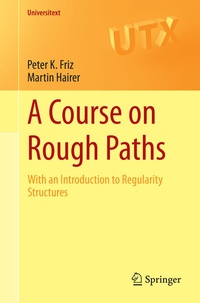
A Course on Rough Paths
Description

Lyons' rough path analysis has provided new insights in the analysis of stochastic differential equations and stochastic partial differential equations, such as the KPZ equation. This textbook presents the first thorough and easily accessible introduction to rough path analysis.
When applied to stochastic systems, rough path analysis provides a means to construct a pathwise solution theory which, in many respects, behaves much like the theory of deterministic differential equations and provides a clean break between analytical and probabilistic arguments. It provides a toolbox allowing to recover many classical results without using specific probabilistic properties such as predictability or the martingale property. The study of stochastic PDEs has recently led to a significant extension - the theory of regularity structures - and the last parts of this book are devoted to a gentle introduction.
Most of this course is written as an essentially self-contained textbook, with an emphasis on ideas and short arguments, rather than pushing for the strongest possible statements. A typical reader will have been exposed to upper undergraduate analysis courses and has some interest in stochastic analysis. For a large part of the text, little more than Itô integration against Brownian motion is required as background.
Reviews / Votes
"The book under review is a concise introduction to the theory of rough paths, their applications in stochastic analysis, and to recent extensions allowing to handle stochastic partial differential equations. . It is easy to base a graduate course on rough paths on this monograph. . a researcher who carefully works her way through all of the exercises will have a very good impression of the current state of the art in rough paths . ." (Nicolas Perkowski, zbMATH 1327.60013, 2016)
More details
Other editions
Additional editions
Persons
Peter K. Friz is presently a full professor at TU and WIAS Berlin, previous professional affiliations include Cambridge University, Merrill Lynch. He holds a PhD from the Courant Institute of New York University. PKF has made contributions to the understanding of the Navier-Stokes equation as dynamical system, pioneered new asymptotic techniques in financial mathematics and has written many influential papers on the applications of rough path theory to stochastic analysis, ranging from the interplay of rough paths with Malliavin calculus to a (rough-) pathwise view on non-linear SPDEs. Jointly with N. Victoir he authored a monograph on stochastic processes as rough paths.
Martin Hairer FRS is currently Regius Professor of Mathematics at the University of Warwick. He has mostly worked in the field of stochastic partial differential equations in particular, and in stochastic analysis and stochastic dynamics in general. He made fundamental advances in various directions such as the study of hypoelliptic and/or hypocoercive diffusions, the development of an ergodic theory for stochastic PDEs, the systematisation of the construction of Lyapunov functions for stochastic systems, the development of a general theory of ergodicity for non-Markovian systems, multiscale analysis techniques, etc. Most recently, he has worked on applying rough path techniques to the analysis of certain ill-posed stochastic PDEs and introduced the theory of regularity structures.
Martin Hairer won the Fields Medal 2014.
