

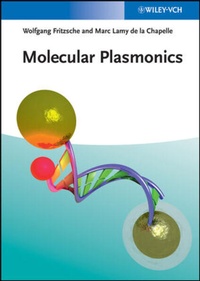
Molecular Plasmonics
1st Edition
Published on 22. July 2014
192 pages
978-3-527-64971-6 (ISBN)
Description

Adopting a novel approach, this book provides a unique "molecular perspective" on plasmonics, concisely presenting the fundamentals and applications in a way suitable for beginners entering this hot field as well as for experienced researchers and practitioners. It begins by introducing readers to the optical effects that occur at the nanoscale and particularly their modification in the presence of biomolecules, followed by a concise yet thorough overview of the different methods for the actual fabrication of nanooptical materials. Further chapters address the relevant nanooptics, as well as the various approaches to combining nanostructures and biomolecules to achieve certain desired functionalities for applications in the fields of probing, sensing and particle manipulation.
For analytical biologists, physical chemists, materials scientists and medicinal chemists.
For analytical biologists, physical chemists, materials scientists and medicinal chemists.
More details
Other editions
Additional editions
Wolfgang Fritzsche | Marc Lamy de la Chapelle
Molecular Plasmonics
Book
09/2014
1st Edition
Wiley-VCH
€105.00
Article exhausted; check different version
Persons
Wolfgang Fritzsche heads the Nano Biophotonics Department at the Leibniz Institute of Photonic Technology (IPHT) in Jena, Germany, since 2001. He did his PhD at the Max-Planck-Institute for Biophysical Chemistry in Göttingen, Germany and then worked as a postdoc at the Iowa State University, USA, on biological AFM and image processing before returning to Jena. His research interests are molecular plasmonics
and nanotechnology with a special focus on DNA-nanoparticle complexes and their integration into chip environments for bioanalytical
and nanophotonic applications. Wolfgang Fritzsche is the initiator and organizer of the bi-annual "Molecular Plasmonics" Symposia in Jena,
from the Society of Professional Hispanic Engineers.
Marc Lamy de la Chapelle is professor at the Paris 13 University at the Laboratory of Chemistry, Properties and Structure of the Biomaterials
and Therapeutics Agents (UMR 7244).
He got his PhD in science physics in 1998 at the University of Nantes on the study of carbon nanotubes by Raman spectroscopy. After two postdoc at the Office National d?Etude et de Recherche en Aéronautique in Paris and at the Tsinghua University in Beijing (China), he became associate professor at the Université de technologie de Troyes (UTT) in 2001. Since 2007, he is professor at the Paris 13 University. His research activities are focused on nanooptics and Raman spectroscopy. His research subject is the application of SERS and TERS to biological issues and more especially to the disease diagnosis.
He is head of the "spectroscopies of biomolecules and biological media" research team and he is director of the CNRS national research network on the Molecular Plasmonics and Enhanced Spectroscopies.
and nanotechnology with a special focus on DNA-nanoparticle complexes and their integration into chip environments for bioanalytical
and nanophotonic applications. Wolfgang Fritzsche is the initiator and organizer of the bi-annual "Molecular Plasmonics" Symposia in Jena,
from the Society of Professional Hispanic Engineers.
Marc Lamy de la Chapelle is professor at the Paris 13 University at the Laboratory of Chemistry, Properties and Structure of the Biomaterials
and Therapeutics Agents (UMR 7244).
He got his PhD in science physics in 1998 at the University of Nantes on the study of carbon nanotubes by Raman spectroscopy. After two postdoc at the Office National d?Etude et de Recherche en Aéronautique in Paris and at the Tsinghua University in Beijing (China), he became associate professor at the Université de technologie de Troyes (UTT) in 2001. Since 2007, he is professor at the Paris 13 University. His research activities are focused on nanooptics and Raman spectroscopy. His research subject is the application of SERS and TERS to biological issues and more especially to the disease diagnosis.
He is head of the "spectroscopies of biomolecules and biological media" research team and he is director of the CNRS national research network on the Molecular Plasmonics and Enhanced Spectroscopies.
Content
FOREWORD
INTRODUCTION
PLASMONIC EFFECTS
Electrical Conductivity in Metal
Optical Properties and Dielectric Constant
Plasmons
Volume Plasmons
Surface Plasmons and Applications in Life Sciences
Localized Surface Plasmon
Combinations of SPR and LSPR Approaches
Nanoholes
Enhanced Spectroscopies
NANOFABRICATION OF METAL STRUCTURES
Introduction
Nanofabrication Top-Down
Bottom-Up Approaches
Post-Processing, Combination, and Integration
THE MOLECULAR WORLD
Interaction and Forces between Molecules and Substrates
Self-Assembly Monolayer (SAM)
DNA
Peptides and Proteins
Bioassay Types and Formats
Nanomedicine: Cell-Nanoparticle Interaction
MEASUREMENT AND CHARACTERIZATION TECHNIQUES
Parameters of Interest
Far-Field Optical Techniques
Near-Field Optical Techniques
High-Resolution Microscopy
MOLECULAR PLASMONICS: LIFE SCIENCES APPLICATIONS
Marker
Sensor
Local Field Control by Plasmonic Nanostructures
Light-Induced Manipulation
MOLECULAR PLASMONICS FOR NANOOPTICS AND NANOTECHNOLOGY
Plasmonic Lithography
Nanopositioning for Nanooptics
Nanopostitioning for Ultrasensitive Bioanalytics
Integration of Molecular Constructs
Plasmonic Properties Control by Using Molecular Assembly
Index
INTRODUCTION
PLASMONIC EFFECTS
Electrical Conductivity in Metal
Optical Properties and Dielectric Constant
Plasmons
Volume Plasmons
Surface Plasmons and Applications in Life Sciences
Localized Surface Plasmon
Combinations of SPR and LSPR Approaches
Nanoholes
Enhanced Spectroscopies
NANOFABRICATION OF METAL STRUCTURES
Introduction
Nanofabrication Top-Down
Bottom-Up Approaches
Post-Processing, Combination, and Integration
THE MOLECULAR WORLD
Interaction and Forces between Molecules and Substrates
Self-Assembly Monolayer (SAM)
DNA
Peptides and Proteins
Bioassay Types and Formats
Nanomedicine: Cell-Nanoparticle Interaction
MEASUREMENT AND CHARACTERIZATION TECHNIQUES
Parameters of Interest
Far-Field Optical Techniques
Near-Field Optical Techniques
High-Resolution Microscopy
MOLECULAR PLASMONICS: LIFE SCIENCES APPLICATIONS
Marker
Sensor
Local Field Control by Plasmonic Nanostructures
Light-Induced Manipulation
MOLECULAR PLASMONICS FOR NANOOPTICS AND NANOTECHNOLOGY
Plasmonic Lithography
Nanopositioning for Nanooptics
Nanopostitioning for Ultrasensitive Bioanalytics
Integration of Molecular Constructs
Plasmonic Properties Control by Using Molecular Assembly
Index
