

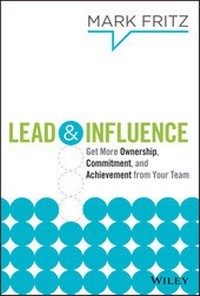
Lead & Influence
Description

* Explains how executives and managers can successfully lead across distances and cultures
* Author Mark Fritz is an international speaker focused on helping executives and managers successfully lead across distances and cultures . . . and still have a life
A leader's performance and quality of life is in direct proportion to the level of ownership their people to deliver the results. The more ownership your people take, the more success you and your organization will enjoy. Lead & Influence will show you how to empower your employees to own achievement, no matter the distance between you and them.
All prices
More details
Other editions
Additional editions
Person
MARK FRITZ coaches executives and managers on how to successfully lead across distances and cultures . . . and still have a life. For thirty years, as an executive at Eastman Kodak Company, he lived and worked across countries and cultures (in the US, Singapore, Egypt, Italy, the Netherlands, Japan, and the UK). An international speaker, Mark also provides one-on-one business culture coaching to executives who are moving between regions of the world. Mark is an Associate Professor at IE Business School in Madrid, teaching the contents from this book in various formats across the school's master's programs. The school also enlists Mark to coach all of their Global Executive MBA students.
Content
Foreword Victor Vale xiii
Preface xv
Acknowledgments xix
PART I MIND-SET OF ACHIEVEMENT AND COLLABORATION 1
1 Thinking and Discussing in Outcomes versus Activities 3
2 The Ultimate Outcome Is Success (And the Why behind It) 21
3 Creating the Environment for Effective Collaboration 35
PART II LEADING YOURSELF (PERSONAL OWNERSHIP) 51
4 Everything Starts with You Understanding You 53
5 Strengthening Your Character and Focus (Your Foundation) 63
6 Keeping Your Perspective and Balancing Your Stress 75
PART III INFLUENCING OTHERS (ENABLING PERSONAL OWNERSHIP) 83
7 Investing in Your Key People (Th e Extension of You) 85
8 Delegating Outcomes and Asking Open Questions 101
9 Getting Others to Th ink, Feel, and Do (The Outcome of Communication) 111
PART IV DRIVING PERFORMANCE (ENABLING TEAM OWNERSHIP) 125
10 Defining and Reinforcing the Principles and Outcomes 127
11 Creating Positive Peer Pressure and Interdependence 137
12 Playing the Game of Positive Politics (Stakeholder Relationships) 145
PART V AND FINALLY . . . 159
Follow-Up 1: Growing with Others' Life Experiences 160
Follow-Up 2: More of, Same as, Less of (The Power in Being Specific) 164
Follow-Up 3: Daily and Weekly Reflection Guide 167
Appendix 171
Resources 177
About the Author 179
Index 181
Chapter 1
Thinking and Discussing in Outcomes versus Activities
There’s a great story I like to tell that highlights the power of encouraging your people to take an outcomes-over-activities mind-set to their work. Many years ago, General W. L. “Bill” Creech took over the Tactical Air Command (TAC) in the US Air Force, which, at that time, was a team of more than 100,000 people across the world. Their job was to repair and maintain the airplanes.
When General Creech took over, the team was organized by function and computer notifications directed workers to aircraft in need of repair and maintenance. Believing in the power of teamwork, he reorganized the entire staff into teams and assigned these newly formed small teams specific airplanes to maintain. The teams focused on keeping their planes flying and shared best practices with one another. The result was that all the teams’ performance increased dramatically. After the team restructuring was completed, General Creech visited his teams throughout the world and asked his staff how they liked this new way of working. On one occasion, a team member replied with a question back to the general:
“When is the last time you washed a rental car?”That may sound like a strange response, but it indicated that the teams were now taking real ownership for ensuring the planes were safely flying—they were owning the outcome, a stark difference from their attitude before the restructuring. Before the restructuring they were focused on their own individual activities and not on the outcome—the plane safely flying.
Before: The teams were activity-focused, focused on whatever their individual tasks were for that day. Now: The teams are outcome-focused, asking the overarching question, is the plane flying?Being outcomes-focused, versus activity-focused, makes a huge difference. When staff focus on the activities, their focus is on staying busy. There is no force driving them to do anything differently than they did the day before. But when staff are focused on outcomes, their focus is on achievement—and with an achievement focus, they are motivated to look for better ways to reach the achievement faster.
It’s no surprise then that successful leaders think and communicate using the language of achievement. They bring an outcomes mind-set to everything they do and focus on instilling that mind-set in their people, too.
Here are a couple of comparisons between the language of achievement versus the language of activity:
Language of Achievement Language of Activity Talk in . . . Talk in . . . Outputs Inputs Deliverables Tasks Decisions Discussions Milestones To-do listsA leader of a global virtual team noticed the power of the language of achievement with her team. She began every conversation she had with her team, both one on one and as a group, with the outcome that needed to be achieved and the date it was needed by. Then they discussed how they would tackle the activities and meet the milestones. They always finished the conversation by reconfirming the outcome and key dates. She found that by always bookending the conversation, starting and ending with what needed to be achieved—the outcome—she was constantly reinforcing the achievement in her team member’s minds.
Ownership for Achievement (Outcomes)
The general’s team member comment about rental cars indicated that the teams now took ownership for the outcome (the plane flying), and they helped their fellow team members fix the plane faster. After all, if the plane had five problems and only four have been fixed, it’s still not flying! With a focus on the outcome, the team members pitched in to help one another efficiently fix problems as they arose. In fact, they painted their team names on the side of the airplanes, which signaled real ownership.
Outcomes drive ownership, and ownership drives commitment.
The general did two things that are absolutely crucial for a successful team, especially when you are leading across distances and cultures:
1. He injected positive competition (peer pressure) into the group. He made team performance visible to everyone and fueled competition among the teams by tracking which teams could repair the planes the fastest and with the best quality. He had a strong quality and performance focus and instilled that focus in everyone in the teams. The importance of this positive competition and peer pressure is discussed further in Chapter 11. But suffice it to say, every successful team has some element of competition within it. 2. He had teams share best practices (continuous improvement). The general drove the teams to share their best practices with the other teams so that the good things people were doing could be replicated across the entire organization. This best practice sharing drove better overall quality, performance, and pride throughout.The general knew the importance of posing and answering the question, Would you rather your people own or rent their jobs? You’ll see a big difference in their behavior depending on which of these they choose. There’s also big difference based on whether people own what they are doing or own what you ask them to achieve.
Would you rather your people own an activity or own an outcome? This is another crucial distinction. When your people own only the activities and you discuss only these with them, you are speaking in the language of busyness. When you can compel them to own, and therefore talk about, outcomes, everyone is speaking the language of achievement.
That doesn’t mean activities are never discussed. But smart managers always frame these activities’ discussions with what needs to be achieved—the outcomes that those activities create.
Outcomes Are Both Visible Results and Visible Experiences
Consider the example of the teams repairing airplanes; the obvious visible result is the successful flying of the planes. But the visible experience or experiences might be the way the team interacts with the pilot. This is important in two particular situations: the team wants to get the right information from the pilot to fix any problems with the plane, and the team wants the pilot to be confident that the plane is in top working order and that all problems have been fixed.
The same applies to your team. You have both visible results you are focusing on achieving and targets for the experiences you want others to have (to feel) in achieving those results. You have both internal experiences (team experiences) and external experiences (for example, those involving customers, vendors, and partners).
Think about the experiences in your own life, such as flying somewhere. The result for you is getting from point A to point B. Your experience, on the other hand, is determined by the effectiveness of the service and how the airline personnel treat you—the things that affect how you feel about that airline. An experience creates a strong impact, because it is the feeling that stays with you long after you have forgotten the details of the flight.
A customer services group has both visible results and experiences. It must successfully process all customer orders while also successfully resolving every customer problem. From the customers’ perspective, their experiences—their interaction with the customer service representative and how it made them think about the representative and the company—is what they will remember. To be successful, it is key that customer service representatives focus on the experience as well as the result.
So ask yourself, and ask your team: What are the most important experiences that we deliver? Sometimes, the outcomes that drive the largest influence with others are the visible experiences, because the successful outcome is always engaging people’s feelings. Sometimes, however, the most important things aren’t visible.
A Clear Direction and Pace
Successful leaders are focused on direction and pace. They know clearly where they want to take the team (the direction or goals) and want to get there as fast as they can (the pace). These leaders create a sense of urgency that drives the pace their people’s work. Direction and pace are the most important criteria they use to decide whether to say yes or no to new initiatives or projects.
Successful leaders ask themselves, “Is this taking us in the right direction at the right pace?” These two elements determine the leader’s focus and therefore the team’s focus as well.
When the direction is clear, the entire team feels the same sense of urgency; everyone takes more action and is clear on what they must do. In fact, clarity is probably the most important word in any language. Think about it: when you are not clear on something, it stops you from taking action. And if, as a leader, you are not clear on something, you will not...
