

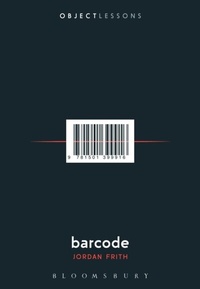
Barcode
1st Edition
Published on 2. November 2023
152 pages
978-1-5013-9993-0 (ISBN)
Description

Object Lessons is a series of short, beautifully designed books about the hidden lives of ordinary things.
Barcodes are about as ordinary as an object can be. Billions of them are scanned each day and they impact everything from how we shop to how we travel to how the global economy is managed. But few people likely give them more than a second thought. In a way, the barcode's ordinariness is the ultimate symbol of its success.
However, behind the mundanity of the barcode lies an important history. Barcodes bridged the gap between physical objects and digital databases and paved the way for the contemporary Internet of Things, the idea to connect all devices to the web. They were highly controversial at points, protested by consumer groups and labor unions, and used as a symbol of dystopian capitalism and surveillance in science fiction and art installations. This book tells the story of the barcode's complicated history and examines how an object so crucial to so many parts of our lives became more ignored and more ordinary as it spread throughout the world.
Object Lessons is published in partnership with an essay series in The Atlantic.
Barcodes are about as ordinary as an object can be. Billions of them are scanned each day and they impact everything from how we shop to how we travel to how the global economy is managed. But few people likely give them more than a second thought. In a way, the barcode's ordinariness is the ultimate symbol of its success.
However, behind the mundanity of the barcode lies an important history. Barcodes bridged the gap between physical objects and digital databases and paved the way for the contemporary Internet of Things, the idea to connect all devices to the web. They were highly controversial at points, protested by consumer groups and labor unions, and used as a symbol of dystopian capitalism and surveillance in science fiction and art installations. This book tells the story of the barcode's complicated history and examines how an object so crucial to so many parts of our lives became more ignored and more ordinary as it spread throughout the world.
Object Lessons is published in partnership with an essay series in The Atlantic.
Reviews / Votes
Jordan Frith's engaging storytelling and analysis makes Barcode a page-turner. He transforms the technical into the human, bringing lively cultural, political, and social analysis to something most of us overlook every day. But beware: After reading this book, you'll want to talk about barcodes all the time. * Torie Bosch, Editor, First Opinion, STAT *More details
Series
Edition
1. Auflage
Language
English
Place of publication
New York
United States
Publishing group
Bloomsbury Publishing PLC (Digital)
Target group
Professional and scholarly
ISBN-13
978-1-5013-9993-0 (9781501399930)
Copyright in bibliographic data and cover images is held by Nielsen Book Services Limited or by the publishers or by their respective licensors: all rights reserved.
Schweitzer Classification
Other editions
Additional editions
Person
Jordan Frith is Pearce Professor of Professional Communication, Clemson University, USA. He is the author of five books, including A Billion Little Pieces: RFID and Infrastructures of Identification (2019) and Smartphones as Locative Media (2015).
Content
1. The little black lines that changed the world
2. How we almost ended up with a bullseye barcode
3. An early bridge between the digital and the physical
4. Consumer protests, labor rights, and automation
5. President Bush and the barcode
6. Barcodes and the Bible
7. The cultural imaginary of the barcode
8. The long and winding road of the QR Code
9. Barcodes and fifty years of misplaced eulogies
Notes
Index
2. How we almost ended up with a bullseye barcode
3. An early bridge between the digital and the physical
4. Consumer protests, labor rights, and automation
5. President Bush and the barcode
6. Barcodes and the Bible
7. The cultural imaginary of the barcode
8. The long and winding road of the QR Code
9. Barcodes and fifty years of misplaced eulogies
Notes
Index
