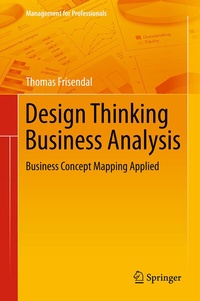
Design Thinking Business Analysis
Description

This book undertakes to marry the concepts of "Concept Mapping" with a "Design Thinking" approach in the context of business analysis. While in the past a lot of attention has been paid to the business process side, this book now focusses information quality and valuation, master data and hierarchy management, business rules automation and business semantics as examples for business innovation opportunities. The book shows how to take "Business Concept Maps" further as information models for new IT paradigms. In a way this books redefines and extends business analysis towards solutions that can be described as business synthesis or business development. Business modellers, analysts and controllers, as well as enterprise information architects, will benefit from the intuitive modelling and designing approach presented in this book. The pragmatic and agile methods presented can be directly applied to improve the way organizations manage their business concepts and their relationships.
"This book is a great contribution to the information management community. It combines a theoretical foundation with practical methods for dealing with important problems. This is rare and very useful. Conceptual models that communicate business reality effectively require some degree of creative imagination. As such, they combine the results of business analysis with communication design, as is extensively covered in this book."
Dr. Malcolm Chisholm, President at AskGet.com Inc.
"Truly understanding business requirements has always been a major stumbling block in business intelligence (BI) projects. In this book, Thomas Frisendal introduces a powerful technique-business concept mapping-that creates a virtual mind-meld between business users and business analysts. Frisendal does a wonderful explaining and demonstrating how this tool can improve the outcome of BI and other development projects ."
Wayne Eckerson, executive director,BI Leadership Forum
Reviews / Votes
From the reviews:
"The book focuses on business concept mapping, with illustrated examples of business concept mapping that seem to suggest that business concept mapping is best suited as a front-end information modeling tool for data warehouse development. . The book is aimed at business and IT professionals, who would find business concept mapping cleaner and easier than UML object diagrams." (Don Chand, Computing Reviews, June, 2013)More details
Other editions
Additional editions