

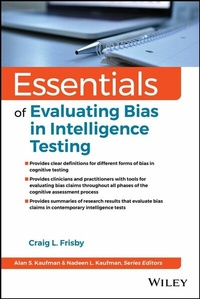
Essentials of Evaluating Bias in Intelligence Testing
Description

Thorough overview of the history, viewpoints, and research findings of bias in intelligence testing
Essentials of Evaluating Bias in Intelligence Testing delivers a comprehensive overview of potential biases that can come to light when making use of IQ tests across demographics, detailing where bias can work its way into IQ test selection, standardization, content, administration/scoring, and interpretation and providing key foundational knowledge on what IQ test bias is versus what it is not as well as the history of bias claims in recent decades.
Research findings are included throughout the book to provide key context. Some of the topics discussed in this book include:
- The Larry P. v. Wilson Riles trial decision of 1979, which prohibited the use of IQ tests for placing Black students in special education programs, and its carryover to today
- The heritability of IQ scores, the "nature/nurture" issue, and the role of IQ in the stratification of subpopulation groups in society
- Implicit assumptions within claims of standardization bias, including that all population subgroups must display equal mean scores and that racial/ethnic groups are internally homogeneous
Essentials of Evaluating Bias in Intelligence Testing is an essential read for educators, academics, and administrators seeking to understand the full picture on IQ testing and its validity or lack thereof across different demographics.
More details
Other editions
Additional editions
Person
CRAIG L. FRISBY is Associate Professor Emeritus in School Psychology from the University of Missouri, Columbia. In the past, he has served as an Associate Editor for School Psychology Review, the official journal of the National Association of School Psychologists, and Associate Editor for Psychological Assessment, a journal published by the American Psychological Association. He currently serves as Associate Editor for the Journal of Open Inquiry in the Behavioral Sciences. He is the author of "Meeting the Psychoeducational Needs of Minority Students: Data-based Guidelines for School Psychologists and other School Personnel" and Co-editor of "Cultural Competence in Applied Psychology: An Evaluation of Current Status and Future Directions" and "Ideological and Political Bias in Psychology: Nature, Scope and Solutions". He currently serves as a member of the American Institutes for Research Test Screening Committee for Response to Intervention.
Content
Preface vii
Acknowledgments ix
One Introduction and Overview 1
Two Sources of Bias Claims in Intelligence Testing: A Brief History 7
Three Bias and IQ Test Selection 27
Four Bias and IQ Test Standardization 75
Five Bias and IQ Test Content 99
Six Bias and IQ Test Administration/Scoring 135
Seven Bias and IQ Test Interpretation 183
Eight IQ Test Bias- What It Is and What It Is Not 243
Nine Select IQ Test Bias Studies Since 1980 315
Ten Glossary of Essential Terms 337
Appendix A Test Abbreviations 355
References 359
Index 387
