

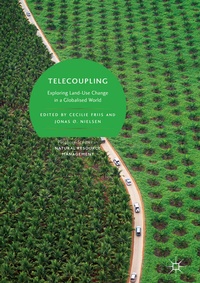
Telecoupling
Description

More details
Other editions
Additional editions
Persons
Jonas Ø. Nielsen is Professor of Integrative Geography at the Geography Department and Research Group Leader at the IRI THESys at the Humboldt-Universität zu Berlin, Germany. He is on the Scientific Steering Committee of the Global Land Programme and the Coordinator of a Horizon 2020 funded Innovative Training Network on telecoupling.
Content
1 Global Land-Use Change through a Telecoupling Lens: An Introduction; Cecilie Friis and Jonas Ø. Nielsen.- Part I: Overview.- 2 What Is Telecoupling?; Jinguo Liu, Anna Herzberger, Kelly Kapsar, Andrew K. Carlson, and Thomas Connor.- 3 Telecoupling: A New Framework for Researching Land-Use Change in a Globalised World; Cecilie Friis.- 4 Explanations in Telecoupling Research; Patrick Meyfroidt.- Part II: Topics.- 5 Mapping Export-Oriented Crop Production;Christian Levers and Daniel Müller.- 6 Telecoupling and Consumption in Agri-Food Systems; Rachael Garrett and Ximena Rueda.- 7 Toolbox: Flow Analysis-Social Metabolism in the Analysis of Telecoupling; Anke Schaffartzik and Thomas Kastner.- 8 Trade and Land-Use Telecouplings; Javier Godar and Toby Gardner.- 9 Governance for Sustainability in Telecoupled Systems; Edward Challies, Jens Newig, and Andrea Lenschow.- 10 Toolbox: Operationalising Telecoupling with Network Analysis; Jonathan W. Seaquist and Emma Li Johansson.- 11 Environmental Justice in Telecoupling Research; Esteve Corbera, Louise Marie Busck-Lumholt, Finn Mempel, and Beatriz Rodríguez-Labajos.- 12 Livelihoods through the Lens of Telecoupling; Yann le Polain de Waroux.- 13 Toolbox: Spatial Analysis and Modelling; Peter H. Verburg.- 14 Urban Telecouplings; Dagmar Haase.- 15 Conservation Telecouplings; Tobias Kuemmerle, Thomas Kastner, Patrick Meyfroidt, and Siyu Qin.- 16 Toolbox: Capturing and Understanding Telecoupling through Qualitative Research; Jonas Ø. Nielsen, Janine Hauer, and Cecilie Friis.- 17 Discursive Telecouplings; Joel Persson and Ole Mertz.- Part III: Agenda.- 18 Beyond Integration: Exploring the Interdisciplinary Potential of Telecoupling Research; Jonas Ø. Nielsen, Cecilie Friis, and Jörg Niewöhner.- 19 Co-producing Knowledge for Sustainable Development in Telecoupled Land Systems; Julie G. Zaehringer, Flurina Schneider, Andreas Heinimann, and Peter Messerli.
