

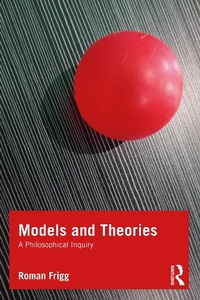
Models and Theories
A Philosophical Inquiry
Published on 28. June 2022
508 pages
978-1-000-60953-0 (ISBN)
Description

Models and theories are of central importance in science, and scientists spend substantial amounts of time building, testing, comparing and revising models and theories. It is therefore not surprising that the nature of scientific models and theories has been a widely debated topic within the philosophy of science for many years.
The product of two decades of research, this book provides an accessible yet critical introduction to the debates about models and theories within analytical philosophy of science since the 1920s. Roman Frigg surveys and discusses key topics and questions, including:
What are theories? What are models? And how do models and theories relate to each other?
The linguistic view of theories (also known as the syntactic view of theories), covering different articulations of the view, its use of models, the theory-observation divide and the theory-ladenness of observation, and the meaning of theoretical terms.
The model-theoretical view of theories (also known as the semantic view of theories), covering its analysis of the model-world relationship, the internal structure of a theory, and the ontology of models.
Scientific representation, discussing analogy, idealisation and different accounts of representation.
Modelling in scientific practice, examining how models relate to theories and what models are, classifying different kinds of models, and investigating how robustness analysis, perspectivism, and approaches committed to uncertainty-management deal with multi-model situations.
Models and Theories is the first comprehensive book-length treatment of the topic, making it essential reading for advanced undergraduates, researchers, and professional philosophers working in philosophy of science and philosophy of technology. It will also be of interest to philosophically minded readers working in physics, computer sciences and STEM fields more broadly.
The product of two decades of research, this book provides an accessible yet critical introduction to the debates about models and theories within analytical philosophy of science since the 1920s. Roman Frigg surveys and discusses key topics and questions, including:
What are theories? What are models? And how do models and theories relate to each other?
The linguistic view of theories (also known as the syntactic view of theories), covering different articulations of the view, its use of models, the theory-observation divide and the theory-ladenness of observation, and the meaning of theoretical terms.
The model-theoretical view of theories (also known as the semantic view of theories), covering its analysis of the model-world relationship, the internal structure of a theory, and the ontology of models.
Scientific representation, discussing analogy, idealisation and different accounts of representation.
Modelling in scientific practice, examining how models relate to theories and what models are, classifying different kinds of models, and investigating how robustness analysis, perspectivism, and approaches committed to uncertainty-management deal with multi-model situations.
Models and Theories is the first comprehensive book-length treatment of the topic, making it essential reading for advanced undergraduates, researchers, and professional philosophers working in philosophy of science and philosophy of technology. It will also be of interest to philosophically minded readers working in physics, computer sciences and STEM fields more broadly.
More details
Language
English
Place of publication
London
United Kingdom
Publishing group
Taylor & Francis Ltd
Target group
College/higher education
Illustrations
21 Line drawings, black and white; 21 Illustrations, black and white
File size
5,85 MB
ISBN-13
978-1-000-60953-0 (9781000609530)
Copyright in bibliographic data and cover images is held by Nielsen Book Services Limited or by the publishers or by their respective licensors: all rights reserved.
Schweitzer Classification
Other editions
Additional editions
Book
06/2022
1st Edition
Acumen Publishing Ltd
€63.40
Shipment within 3-4 weeks
Book
06/2022
1st Edition
Acumen Publishing Ltd
€208.30
Shipment within 3-4 weeks
Book
06/2022
Routledge
Unfortunately, price unknown
Available (delivery time upon request)
Person
Roman Frigg is Professor of Philosophy in the Department of Philosophy, Logic and Scientific Method at the London School of Economics and Political Science, UK. He is the winner of the Friedrich Wilhelm Bessel Research Award of the Alexander von Humboldt Foundation, and a permanent visiting professor in the Munich Centre for Mathematical Philosophy of the Ludwig-Maximilians-University Munich, Germany. His current work focuses on the nature of scientific models and theories, the foundations of statistical mechanics, and decision making under uncertainty.
Content
Preface, Introduction, Part 1, 1. Theory and Language, 2. Models in the Received View, 3. Delineating the Observable, 4. Framing the Theoretical, Part 2, 5. Thinking Through Structures, 6. Representing with Structures, 7. Family Ties, 8. Beyond Structures, Part 3, 9. Reconsidering Representation, 10. Analogy, 11. Abstraction, Approximation, Idealisation, 12. Limit Idealisations and Factor Exclusions, Part 4, 13. Challenging Subordination, 14. What Are Models?, 15. Taming Abundance, 16. The Model Muddle Envoi, Index
