

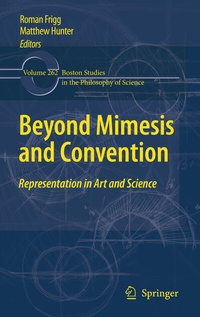
Beyond Mimesis and Convention
Description

Representation is a concern crucial to the sciences and the arts alike. Scientists devote substantial time to devising and exploring representations of all kinds. From photographs and computer-generated images to diagrams, charts, and graphs; from scale models to abstract theories, representations are ubiquitous in, and central to, science. Likewise, after spending much of the twentieth century in proverbial exile as abstraction and Formalist aesthetics reigned supreme, representation has returned with a vengeance to contemporary visual art. Representational photography, video and ever-evolving forms of new media now figure prominently in the globalized art world, while this "return of the real" has re-energized problems of representation in the traditional media of painting and sculpture. If it ever really left, representation in the arts is certainly back.
Central as they are to science and art, these representational concerns have been perceived as different in kind and asobjects of separate intellectual traditions. Scientific modeling and theorizing have been topics of heated debate in twentieth century philosophy of science in the analytic tradition, while representation of the real and ideal has never moved far from the core humanist concerns of historians of Western art. Yet, both of these traditions have recently arrived at a similar impasse. Thinking about representation has polarized into oppositions between mimesis and convention. Advocates of mimesis understand some notion of mimicry (or similarity, resemblance or imitation) as the core of representation: something represents something else if, and only if, the former mimics the latter in some relevant way. Such mimetic views stand in stark contrast to conventionalist accounts of representation, which see voluntary and arbitrary stipulation as the core of representation. Occasional exceptions only serve to prove the rule that mimesis and convention govern current thinking about representationin both analytic philosophy of science and studies of visual art.
This conjunction can hardly be dismissed as a matter of mere coincidence. In fact, researchers in philosophy of science and the history of art have increasingly found themselves trespassing into the domain of the other community, pilfering ideas and approaches to representation. Cognizant of the limitations of the accounts of representation available within the field, philosophers of science have begun to look outward toward the rich traditions of thinking about representation in the visual and literary arts. Simultaneously, scholars in art history and affiliated fields like visual studies have come to see images generated in scientific contexts as not merely interesting illustrations derived from "high art", but as sophisticated visualization techniques that dynamically challenge our received conceptions of representation and aesthetics.
"Beyond Mimesis and Convention: Representation in Art and Science" is motivated by the conviction that we students of the sciences and arts are best served by confronting our mutual impasse and by recognizing the shared concerns that have necessitated our covert acts of kleptomania. Drawing leading contributors from the philosophy of science, the philosophy of literature, art history and visual studies, our volume takes its brief from our title. That is, these essays aim to put the evidence of science and of art to work in thinking about representation by offering third (or fourth, or fifth) ways beyond mimesis and convention. In so doing, our contributors explore a range of topics-fictionalism, exemplification, neuroaesthetics, approximate truth-that build upon and depart from ongoing conversations in philosophy of science and studies of visual art in ways that will be of interest to both interpretive communities. To put these contributions into context, the remainder of this introduction aims to survey how our communities have discretely arrived at aplace wherein the perhaps-surprising collaboration between philosophy of science and art history has become not only salubrious, but a matter of necessity.
Reviews / Votes
From the reviews:
"The aim of the volume is explicitly stated as putting >>works of art and theories of science >to work< in a shared enterprise of thinking representation beyond mimesis and convention<< . . the collection take their inspiration from the theory of fiction and try to apply these inspirations to the study of scientific models. . the essays all make interesting and state-of-the-art contributions to their respective topics." (Tobias Klauk, Journal of Literary Theory, August, 2011)
"The aim of the book is to see what might be achieved by bringing the two impasse-stricken subjects together. . The collection . succeeds in displaying a variety of ways in which aesthetics can be applied to problems of representation in the philosophy of science. . this book will be a valuable point of reference." (Clive Cazeaux, British Journal of Aesthetics, Vol. 52 (2), April, 2012)
"The book . is a great example of interdisciplinary collaborative work, bringing togethercontributions by scholars of science and of art, around the topic of representation. . The result is a high-standard, remarkably edited book. . this rich and heterogeneous book clearly achieves the goal of showing the fruitfulness of an interdisciplinary approach to art and science . ." (Marion Vorms, Theoria, Vol. 75, 2012)
More details
Other editions
Additional editions
Content
Nancy Cartwright
How Fables and Parables Help Us Understand the Use of Models: A Short Survey of This Paper
Models of different kinds appear throughout the natural and social sciences serving a variety of different ends. This paper will discuss one particular kind of model whose purpose is opaque: the “highly idealized” model, prevalent in physics and economics but widely used elsewhere as well. Models of this kind study the behavior of stripped-down systems in unrealistic circumstances.
The models may study balls rolling down totally frictionless totally stable planes (Galileo 1914, 61–69), or laborers of only two kinds—old and young—concerned only with leisure and income (Pissarides 1992), or, as in Thomas Schelling’s famous model, black and white checkers moving according to artificial rules on a checkerboard, ending up in clumps of similar color (Cartwright 2009a, Schelling 2000). The objects and situations pictured in these models are very unlike real objects in the real world of interest to the sciences. Yet they are supposed to teach something, indeed something important, about that real world. How?
I am going to defend the use of descriptions of highly unrealistic situations to learn about real-life situations. That, I maintain, is just what Galileo did in his famous rolling-ball experiments. He honed his planes to make them as smooth as possible, and bolted them down, to learn about the effects of gravity acting on its own. Models I urge are often experiments in thought about what would happen in a real experiment like Galileo’s if only it could be conducted: What would happen were we able to create just the right artificial situation to see the feature under study acting all on its own, without any other causes interfering to mask its effect?
That however is not enough. Doing what Galileo did sounds a good thing. But Galileo’s results are still results about the behavior of balls rolling down totally frictionless planes. We don’t have any such planes and anyway what we really want to know is about canon balls and rocket ships. How do we get from a Galilean conclusion: “The pull of the earth induces an acceleration of 32 ft/sec/sec in balls rolling down totally frictionless totally stable planes”—to a result about cannonballs, teetering coffee cups or rocket ships?
I shall here repeat an earlier answer of mine, that these models are like fables, for instance like this fable that I shall discuss below: A marten eats the grouse; A fox throttles the marten; the tooth of the wolf, the fox. Moral: the weaker are always prey to the stronger. Like the characters in the fable, the objects in the model are highly special and do not in general resemble the ones we want to learn about. Just as I have never seen a frictionless plane or a worker interested only in leisure and income, I don’t think I have ever seen a marten, and seldom a wolf.
But the conclusion of the model, like the moral of the fable, can be drawn in a vocabulary abstract enough to describe the things we do want to learn about. For instance, we conclude from Galileo’s experiment, “The pull of the earth induces a downwards acceleration in massive objects of 32 ft/sec/sec”."
