

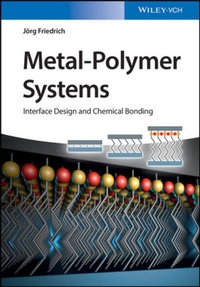
Metal-Polymer Systems
Interface Design and Chemical Bonding
1st Edition
Published on 13. September 2017
XII, 448 pages
978-3-527-67992-8 (ISBN)
Description

The result of decades of research by a pioneer in the field, this is the first book to deal exclusively with achieving high-performance metal-polymer composites by chemical bonding.
Covering both the academic and practical aspects, the author focuses on the chemistry of interfaces between metals and polymers with a particular emphasis on the chemical bonding between the different materials. He elucidates the various approaches to obtaining a stable interface, including, but not limited to, thermodynamically driven redox reactions, bond protection to prevent hydrolysis, the introduction of barrier layers, and stabilization by spacer molecules. Throughout, chemical bonding is promoted as a simple and economically viable alternative to adhesion based on reversible weak physical interaction.
Consequently, the text equips readers with the practical tools necessary for designing high-strength metal-polymer composites with such desired properties as resilience, flexibility, rigidity or degradation resistance.
Covering both the academic and practical aspects, the author focuses on the chemistry of interfaces between metals and polymers with a particular emphasis on the chemical bonding between the different materials. He elucidates the various approaches to obtaining a stable interface, including, but not limited to, thermodynamically driven redox reactions, bond protection to prevent hydrolysis, the introduction of barrier layers, and stabilization by spacer molecules. Throughout, chemical bonding is promoted as a simple and economically viable alternative to adhesion based on reversible weak physical interaction.
Consequently, the text equips readers with the practical tools necessary for designing high-strength metal-polymer composites with such desired properties as resilience, flexibility, rigidity or degradation resistance.
More details
Other editions
Additional editions
Software
12/2017
Wiley-VCH
€214.78
No shipping information available
Book
10/2017
1st Edition
Wiley-VCH
€169.00
Article exhausted; check different version
Person
Jörg Friedrich was the Department Head of Polymer Surfaces at the Federal Institute of Materials Research and Testing (BAM) in Berlin, Germany. He has obtained his academic degrees from Humboldt University Berlin, Academy of Sciences Berlin (AdW) and the Technical University of Berlin. He spent most of his career working for AdW before taking up his present appointment at BAM. Professor Friedrich has authored more than 300 scientific publications and has received numerous scientific awards. He is member of the editorial boards of four international journals.
Content
Adhesion and Diffusion
Description of Main Theories of Adhesion
Chemical Reactions at Interfaces
Design of Ideal Interfaces
Interactions at the Interface and at the Near-Interface Region
Realization of New Interface Designs
Particularities of Polyolefin Surfaces
Methods for Introducing Functional Groups onto Polyolefin Surfaces
Principal Problems with Functionalization of Polyolefins
Differences between Metals and Polymers as Substrate Materials
Characterization by Surface Energy
Thermodynamics
Work of Adhesion
Surface Modification
Preferred Functional Groups for Maximal Adhesion
Acid-Base Interactions and Use of Silanes
Introduction of Spacers
Fluoropolymers
Strongest and Most Durable Metal-Polymer Bonds
Adhesion Results of High-Strength and High Durable Composites
Adhesion Promotion for Carbon Fibres and Graphene
Electrospray Deposition of Adhesion Promoting Layers
Corrosion Inhibition
Description of Main Theories of Adhesion
Chemical Reactions at Interfaces
Design of Ideal Interfaces
Interactions at the Interface and at the Near-Interface Region
Realization of New Interface Designs
Particularities of Polyolefin Surfaces
Methods for Introducing Functional Groups onto Polyolefin Surfaces
Principal Problems with Functionalization of Polyolefins
Differences between Metals and Polymers as Substrate Materials
Characterization by Surface Energy
Thermodynamics
Work of Adhesion
Surface Modification
Preferred Functional Groups for Maximal Adhesion
Acid-Base Interactions and Use of Silanes
Introduction of Spacers
Fluoropolymers
Strongest and Most Durable Metal-Polymer Bonds
Adhesion Results of High-Strength and High Durable Composites
Adhesion Promotion for Carbon Fibres and Graphene
Electrospray Deposition of Adhesion Promoting Layers
Corrosion Inhibition
