

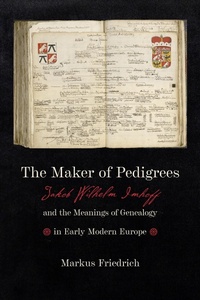
The Maker of Pedigrees
Jakob Wilhelm Imhoff and the Meanings of Genealogy in Early Modern Europe
Published on 4. April 2023
312 pages
978-1-4214-4580-9 (ISBN)
Description

A history of genealogical knowledge-making strategies in the early modern world.
In The Maker of Pedigrees, Markus Friedrich explores the complex and fascinating world of central European genealogy practices during the Baroque era. Drawing on archival material from a dozen European institutions, Friedrich reconstructs how knowledge about noble families was created, authenticated, circulated, and published. Jakob Wilhelm Imhoff, a wealthy and well-connected patrician from Nuremberg, built a European community of genealogists by assembling a transnational network of cooperators and informants. Friedrich uses Imhoff as a case study in how knowledge was produced and disseminated during the 17th and 18th centuries.
Family lineages were key instruments in defining dynasties, organizing international relations, and structuring social life. Yet in the early modern world, knowledge about genealogy was cumbersome to acquire, difficult to authenticate, and complex to publish. Genealogy's status as a source of power and identity became even more ambivalent as the 17th century wore on, as the field continued to fragment into a plurality of increasingly contradictory formats and approaches. Genealogy became a contested body of knowledge, as a heterogeneous set of actors-including aristocrats, antiquaries, and publishers-competed for authority. Imhoff was closely connected to all of the major genealogical cultures of his time, and he serves as a useful prism through which the complex field of genealogy can be studied in its bewildering richness.
In The Maker of Pedigrees, Markus Friedrich explores the complex and fascinating world of central European genealogy practices during the Baroque era. Drawing on archival material from a dozen European institutions, Friedrich reconstructs how knowledge about noble families was created, authenticated, circulated, and published. Jakob Wilhelm Imhoff, a wealthy and well-connected patrician from Nuremberg, built a European community of genealogists by assembling a transnational network of cooperators and informants. Friedrich uses Imhoff as a case study in how knowledge was produced and disseminated during the 17th and 18th centuries.
Family lineages were key instruments in defining dynasties, organizing international relations, and structuring social life. Yet in the early modern world, knowledge about genealogy was cumbersome to acquire, difficult to authenticate, and complex to publish. Genealogy's status as a source of power and identity became even more ambivalent as the 17th century wore on, as the field continued to fragment into a plurality of increasingly contradictory formats and approaches. Genealogy became a contested body of knowledge, as a heterogeneous set of actors-including aristocrats, antiquaries, and publishers-competed for authority. Imhoff was closely connected to all of the major genealogical cultures of his time, and he serves as a useful prism through which the complex field of genealogy can be studied in its bewildering richness.
More details
Series
Language
English
Place of publication
Baltimore
United States
Target group
Professional and scholarly
Illustrations
20 s/w Abbildungen
20 Illustrations, black and white
File size
16,72 MB
ISBN-13
978-1-4214-4580-9 (9781421445809)
DOI
10.56021/9781421445809
Copyright in bibliographic data and cover images is held by Nielsen Book Services Limited or by the publishers or by their respective licensors: all rights reserved.
Schweitzer Classification
Other editions
Additional editions
Markus Friedrich
The Maker of Pedigrees
Jakob Wilhelm Imhoff and the Meanings of Genealogy in Early Modern Europe
Book
04/2023
Johns Hopkins University Press
€62.00
Article not available at the moment
Person
Markus Friedrich (HAMBURG, DE) is a professor of early modern European history. He is the author of The Birth of the Archive: A History of Knowledge and The Jesuits: A History.
Content
Acknowledgments
Introduction
1. Genealogy circa 1700
2. A Patrician Genealogist and His City
3. Genealogy and the Nobility
4. The "Genealogical Brotherhood"
5. The Genealogist at Work
6. Publishing and Reading Genealogy
Conclusion
Abbreviations
Archival Sources
Bibliography
Notes
Index
Introduction
1. Genealogy circa 1700
2. A Patrician Genealogist and His City
3. Genealogy and the Nobility
4. The "Genealogical Brotherhood"
5. The Genealogist at Work
6. Publishing and Reading Genealogy
Conclusion
Abbreviations
Archival Sources
Bibliography
Notes
Index
