

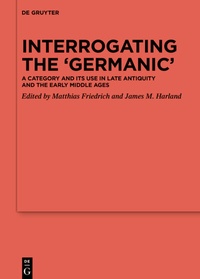
Interrogating the 'Germanic'
Description

Any reader of scholarship on the ancient and early medieval world will be familiar with the term 'Germanic', which is frequently used as a linguistic category, ethnonym, or descriptive identifier for a range of forms of cultural and literary material. But is the term meaningful, useful, or legitimate? The term, frequently applied to peoples, languages, and material culture found in non-Roman north-western and central Europe in classical antiquity, and to these phenomena in the western Roman Empire's successor states, is often treated as a legitimate, all-encompassing name for the culture of these regions. Its usage is sometimes intended to suggest a shared social identity or ethnic affinity among those who produce these phenomena. Yet, despite decades of critical commentary that have highlighted substantial problems, its dominance of scholarship appears not to have been challenged. This edited volume, which offers contributions ranging from literary and linguistic studies to archaeology, and which span from the first to the sixteenth centuries AD, examines why the term remains so pervasive despite its problems, offering a range of alternative interpretative perspectives on the late and post-Roman worlds.
Reviews / Votes
"Interrogating the 'Germanic' provides a starting point. It is not comprehensive, and does not offer a definitive answer as to what we should do with the term 'Germanic'. It is, however, one of the most important volumes published in the twenty-first century and should be read by all scholars working on the European early Middle Ages. It will, hopefully, lead to more careful enquiries into the past."
Richard Broome, in: sehepunkte. Rezensionsjournal für die Geschichtswissenschaften,
http://www.sehepunkte.de/2021/05/35088.html.
"Rather than attempting to create a one-size-fits-all rule going forward, the collective contributions acknowledge the problem's complexity and provide the reader with a variety of tools to find their own way through a thorny, and ever-relevant, question. This will be a useful volume for both specialists and those outside the field, and for those wanting a better understanding of interdisciplinary approaches."
Erica Buchberger, in: The English Historical Review, 2022
"Readers with a linguistic background can use these contributions to get a good sense of recent developments in adjacent fields-useful since the go-to linguistic textbooks on early Germanic languages frequently present a somewhat outdated picture of the state of the art in these disciplines."
George Walkden, in: Journal of Germanic Linguistics 34.4 (2022), p. 420-427
"This is an excellent collection of papers that contend with a complicated historiographical topic. For late Roman and early medieval scholars at any point in their careers, this text lays out information carefully and clearly, and helpfully, it provides a sense of the questions the discipline might be asking in the future."
Timothy Scott in: Journal of the Australian Early Medieval Association, 18 (2022), p. 227-229
More details
Other editions
Additional editions
Persons
Matthias Friedrich , University of Vienna, Austria; James Harland , University of Tübingen, Germany.
Content
- Intro
- Contents
- List of Contributors
- Introduction: The 'Germanic' and its Discontents
- The Marriage of Philology and Race: Constructing the 'Germanic'
- Rome and Its Created Northerners
- Re-inventing the 'Germanic' in the Early Modern Era: Omnes Germani sunt, contra fabulas quorundam
- The Balloon that Wouldn't Burst: A Genealogy of 'Germanic'
- What Can Cultural Anthropology Do for Medievalists? A Methodological Discussion of Ethnicity Applied to Late Antique and Early Medieval History
- From Rhetoric to Dialectic: The Becoming 'Germanic' of Visigothic (Legal-)Literature, and (Postulating) the End of a 'Truth'
- Sidonius Apollinaris's Use of the Term Barbarus: An Introduction
- A Habitus Barbarus in Sub-Roman Britain?
- A Farewell to Arms: Germanic Identity in Fifth-Century Britain
- Germanic or Slavic? Reconstructing the Transition from Late Antiquity to the Early Middle Ages in East Central Europe
- Linguistic Labels and Ethnic Identity
- (Proto-)Germanic Alliterative Verse: Linguistic Limits on a Cultural Phenomenon
- The Limits of Obligation and Friendship: Hrothgar, Beowulf, and the 'Germanic' Ideal
- Index
