

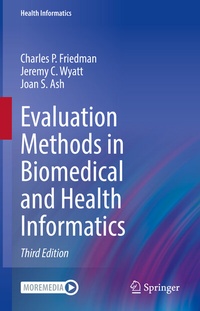
Evaluation Methods in Biomedical and Health Informatics
Description

This 3rd edition of Evaluation Methods in Biomedical and Health Informatics has been extensively revised and expanded. It builds on a solid foundation of evaluation theory to explain methods and techniques within health informatics, using many examples, real-world case studies and numerous self-tests with answers. Expanded to 20 rather than 12 chapters, new chapters have been added on qualitative methods, ethics, mixed methods, evidence-based informatics and how to conduct evaluation studies using routine, real-world data. Designed as a practical guide for masters and PhD students, informatics researchers and seasoned professionals seeking a comprehensive resource, this book describes health and biomedical information resource evaluation in a practical stepwise manner. Critiques and discussion of actual evaluation studies help to build the reader's knowledge of the judicious application of the techniques described.
As information and communications technologies take on increasingly central roles in self-care, healthcare, biomedical research and education, understanding how to design and carry out successful rigorous evaluation studies becomes more imperative. Evaluation Methods in Biomedical and Health Informatics is an unparalleled reference for a broad range of health information professionals and is usable as both a textbook to support formal courses and a reference book for researchers and practitioners. From those training for careers in informatics to on-site biomedical information systems staff, this is an invaluable guide to the successful evaluation of digital healthcare, eHealth, telemedicine, electronic health records and other clinical and non-clinical information systems.
More details
Other editions
Additional editions
Persons
Charles P. Friedman is the Josiah Macy Jr. Professor of Medical Education and Chair of the Department of Learning Health Sciences at the University of Michigan Medical School. Throughout his career, Dr. Friedman's primary academic interests have intertwined biomedical and health informatics with the processes of education and learning. He has taught evaluation methods to students and professionals for 40 years and has designed and conducted numerous evaluation studies.
Jeremy C. Wyatt is Professor of Digital Healthcare at the University of Southampton and an eminent medical informatician. In recent years he was responsible for developing a new program of digital healthcare research and for coordinating the activities of the Wessex Institute of Health Research. He has taught evaluation methods to Master & PhD students in London, Dundee and Leeds Universities and has published over 100 articles on evaluation methods in biomedical and health informatics.
Joan S. Ash is a Professor in the Department of Medical Informatics and Clinical Epidemiology, School of Medicine, Oregon Health & Science University, Portland, OR, USA. Her study team has evaluated the implementation of clinical systems at over 50 hospitals and outpatient settings across the US, primarily using applied ethnographic approaches. She has developed and taught courses and workshops in qualitative methods across the US and internationally.
