

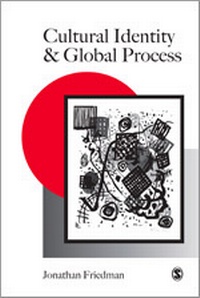
Cultural Identity and Global Process
1st Edition
Published on 5. October 1994
288 pages
978-1-84860-912-9 (ISBN)
Description

This fascinating book explores the interface between global processes, identity formation and the production of culture.
Examining ideas ranging from world systems theory to postmodernism, Jonathan Friedman investigates the relations between the global and the local, to show how cultural fragmentation and modernist homogenization are equally constitutive trends of global reality. With examples taken from a rich variety of theoretical sources, ethnographic accounts of historical eras, the analysis ranges across the cultural formations of ancient Greece, contemporary processes of Hawaiian cultural identification and Congolese beauty cults. Throughout, the author examines the interdependency of world market and local cultural transformations, and demonstrates the complex interrelations between globally structured social processes and the organization of identity.
Jonathan Friedman also documents the development and significance of a global perspective in an anthropology that illuminates a wide variety of domains from prehistory to world hegemony. In so doing, he interrogates the emergence of the concept of culture and suggests that anthropology itself is best understood within the trajectory of modernity.
Examining ideas ranging from world systems theory to postmodernism, Jonathan Friedman investigates the relations between the global and the local, to show how cultural fragmentation and modernist homogenization are equally constitutive trends of global reality. With examples taken from a rich variety of theoretical sources, ethnographic accounts of historical eras, the analysis ranges across the cultural formations of ancient Greece, contemporary processes of Hawaiian cultural identification and Congolese beauty cults. Throughout, the author examines the interdependency of world market and local cultural transformations, and demonstrates the complex interrelations between globally structured social processes and the organization of identity.
Jonathan Friedman also documents the development and significance of a global perspective in an anthropology that illuminates a wide variety of domains from prehistory to world hegemony. In so doing, he interrogates the emergence of the concept of culture and suggests that anthropology itself is best understood within the trajectory of modernity.
Reviews / Votes
`Friedman has produced a book of importance.... It features many tantalizing insights and observations in the author's attempt to comprehend the global constitution of the world and the "positional identities" - not least the identities of social scientists - within the global arena' - Theory, Culture & Society`Reading Friedman's work may require a recalibration of scale for some anthropologists. He writes with the historical scope of a Wallerstein, even a Braudel, and with the theoretical assurance reminiscent of the French structural Marxist school which his own early work critiqued so thoroughly. it was as a part of that extended critique that Friedman cut his analytic eyeteeth, attempting to mediate the Heisenberg-like uncertainties of constructing approaches that analyze both history and structure, Friedman's work can be thoroughly self-referential, and his theoretical universe seems all-encompassing, capable of digesting a vast panorama of historical data and cultural diversity and delivering it all to the reader in an analytically finished form.... these are the side effects of a profound and thoroughly convincing set of theses concerned with subjects of near obsession to many. In Cultural Identity and Global Process, Friedman's concerns are cultural globalization, global economic structures and local identities, and the significance of postmodernism in a modernist world.... strongest recommendation... really a must-read for graduate students - as an example of what one of the strongest minds in contemporary anthropology is writing about central issues in social science' - American Anthropologist
More details
Series
Language
English
Place of publication
London
United Kingdom
Target group
College/higher education
Professional and scholarly
ISBN-13
978-1-84860-912-9 (9781848609129)
Copyright in bibliographic data and cover images is held by Nielsen Book Services Limited or by the publishers or by their respective licensors: all rights reserved.
Schweitzer Classification
Other editions
Additional editions
Jonathan Friedman
Cultural Identity and Global Process
Book
10/1994
1st Edition
SAGE Publications Inc
€135.20
Shipment within 15-20 days
Person
Jonathan Friedman is Professor in the Department of Sociology, University of Lund. He is co-editor (with Scott Lash) of Modernity and Identity (Blackwell, 1990).
Content
Towards a Global Anthropology
General Historical and Culturally Specific Properties of Global Systems
Civilizational Cycles and the History of Primitivism
The Emergence of the Culture Concept in Anthropology
Culture, Identity and World Process
Culture Logics of the Global System
Globalization and Localization
History and the Politics of Identity
The Political Economy of Elegance
Narcissim, Roots and Postmodernity
Global System, Globalization and the Parameters of Modernity
Order and Disorder in Global Systems
General Historical and Culturally Specific Properties of Global Systems
Civilizational Cycles and the History of Primitivism
The Emergence of the Culture Concept in Anthropology
Culture, Identity and World Process
Culture Logics of the Global System
Globalization and Localization
History and the Politics of Identity
The Political Economy of Elegance
Narcissim, Roots and Postmodernity
Global System, Globalization and the Parameters of Modernity
Order and Disorder in Global Systems
