

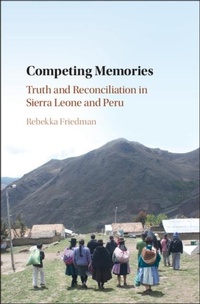
Competing Memories
Truth and Reconciliation in Sierra Leone and Peru
Published on 16. August 2017
978-1-316-95284-9 (ISBN)
Description

The aftermath of modern conflicts, deeply rooted in political, economic and social structures, leaves pervasive and often recurring legacies of violence. Addressing past injustice is therefore fundamental not only for societal well-being and peace, but also for future conflict prevention. In recent years, truth and reconciliation commissions have become important but contentious mechanisms for conflict resolution and reconciliation. This book fills a significant gap, examining the importance of context within transitional justice and peace-building. It lays out long-term and often unexpected indirect effects of formal and informal justice processes. Offering a novel conceptual understanding of 'procedural reconciliation' on the societal level, it features an in-depth study of commissions in Peru and Sierra Leone, providing a critical analysis of the contribution and challenges facing transitional justice in post-conflict societies. It will be of interest to scholars and students of comparative politics, international relations, human rights and conflict studies.
Reviews / Votes
'Rebekka Friedman's sophisticated theorization of procedural reconciliation is borne from extensive efforts to listen. She has paid close attention not only to the train of theorists who have sought to make sense out of political efforts to deal with violent pasts but also to scores of people who have undertaken these efforts and lived through these pasts in Peru and Sierra Leone. She then translates what she learns into a generous synthesis, one that draws from the best insights of the opposing perspectives of theorists and participants and weaves them together into one of the most conceptually mature books in this field's literature to date.' Daniel Philpott, Notre Dame, Indiana 'Dr Friedman's superb study of post-war transitional justice and reconciliation provides a nuanced analysis of how specific community social contexts affect transitional justice processes. This important study traces how individuals' experiences and informal processes at community and national levels can operate at odds with formal transitional justice processes. It is analytically sophisticated, but also encyclopaedic in its engagement with cases. This work will challenge conventional wisdom and will provoke controversy.' Will Reno, Northwestern University, Illinois 'The emphasis on reconciliation by the South African Truth and Reconciliation Commission began a new discourse integrating restorative justice with forgiveness as a critical element of national healing. Competing Memories breaks new ground by exploring how this emphasis on reconciliation has played itself out in both Sierra Leone and Peru, addressing the complex interplay between truth, justice and reconciliation. Friedman introduces 'procedural reconciliation' as an alternative framework, reinforcing common norms and procedures for dealing with conflict and addressing its legacies. It's a must read for those working in the field.' Yasmin Sooka, Central European University and Foundation for Human Rights in South Africa 'Competing Memories is an important and timely contribution to the field of transitional justice. The book offers thoughtful consideration of overlooked dimensions of transitional justice firmly rooted in two valuable case studies, Peru and Sierra Leone. Friedman is a keen observer of the local, and highlights the novel concept of procedural reconciliation in her reflection on truth and memory practices in the aftermath of atrocity. The book gives a fresh perspective on the complexity of post-conflict justice. Competing Memories is insightful and reflective. Highly recommended reading for the transitional justice practitioner and scholar alike.' Fionnuala Ni Aolain, University of Minnesota and Ulster University, Northern Ireland 'This book makes a critical intervention in post-conflict literature by defining the very real challenges that face truth commissions even after they have cleared standard bureaucratic hurdles. Just as 'procedural democracy' is seen by some as a necessary but insufficient ingredient for actual democracy, Friedman's work shows that 'procedural reconciliation' risks the same fate, and she offers an insightful contribution to the field of post-conflict scholarship.' Mneesha Gellman, Emerson College, BostonMore details
Language
English
Place of publication
Cambridge
United Kingdom
Publishing group
Cambridge University Press
Target group
Professional and scholarly
Illustrations
Worked examples or Exercises; 6 Halftones, black and white
File size
2,98 MB
ISBN-13
978-1-316-95284-9 (9781316952849)
Copyright in bibliographic data and cover images is held by Nielsen Book Services Limited or by the publishers or by their respective licensors: all rights reserved.
Schweitzer Classification
Other editions
Additional editions
Book
08/2017
Cambridge University Press
€129.10
Shipment within 15-20 days
Person
Rebekka Friedman is a lecturer of International Relations in the Department of War Studies at King's College London. Her teaching and research focus on the intersection of transitional justice, peace-building, reconciliation, memory and gender. She is a former editor of Millennium: Journal of International Studies.
Content
1. Justice and reconciliation in enduring conflicts; 2. Contextual variances, transitional justice and peace-building: a historical overview; 3. Procedural reconciliation; 4. Underdevelopment, peace-building, and marginilization: the establishment of a restorative agenda in Sierra Leone; 5. Localism and pragmatic solidarity in Sierra Leone; 6. The shining path and political violence: the establishment of a punitive human rights based approach; 7. Memory activism and the politics of the past; 8. Conclusions: context, transformation, and holism in transitional justice.
