

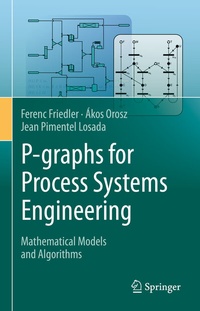
P-graphs for Process Systems Engineering
Description

This book discusses the P-graph framework for developing and understanding effective design tools for process systems engineering, and addresses the current state of its theory and applications. The book details the new philosophy of the axioms-based mathematical modelling of processing systems, the basic algorithms, areas of application, future directions, and the proofs of theorems and algorithms. Because of the rigorous foundation of the theory, the framework provides a firm basis for future research in mathematical modelling, optimization, and design of complex engineering systems. The various P-graph applications discussed include process network synthesis, reliability engineering, and systems resilience. The framework opens new avenues for research in complex systems including redundant operations for critical infrastructure, systems sustainability, and modelling tools for disaster engineering. Demonstration software is provided to facilitate the understanding of the theory. The book will be of interest to institutions, companies, and individuals performing research and R&D in process systems engineering.
More details
Other editions
Additional editions
Persons
Professor Ferenc Friedler graduated in mathematics in 1977, received CSc degree (1990) and Doctor of Science degree (1995) in process systems engineering. His main research activity is related to the developments of effective methods for the design and operation of complex engineering systems. Together with late Professor L.T. Fan, he is a co-founder of the P-graph framework that provides a theoretical basis for modelling a wide range of applications in process systems engineering. Supervised more than one hundred national and international R&D projects. Founder, chair, and co-chair of international scientific conferences and founder of academic organizations including university department, doctoral school, and faculty. He was the rector of University of Pannonia in Hungary from 2011 to 2015. Currently, he is a professor and scientific director at the Research Center of Vehicle Industry, Széchenyi István University, Gyor, Hungary. Honored with several awards including Knight's Cross Order of Merit of Hungary, 2003; Polinszky Prize, 2006; John von Neumann Prize, 2007; Leo Szilard Professorship, 2008; Dennis Gabor Prize, 2008; Széchenyi Prize, 2010; Bolyai Memorial Award, 2010; Egervary Memorial Award, 2010; Honorary doctorate, National Technical University Kharkiv, 2012.
Ákos Orosz received MSc degree at the University of Pannonia in computer science in 2015. During the studies, he specialized in computer programming, especially in optimization algorithms. He started the PhD studies in 2015 in the field of processing systems synthesis with the P-graph-based reliability assessment of processes. The research topics widened later, expanding to the synthesis of heat exchanger networks and water treatment networks, together with other novel applications of the P-graph framework. He became an assistant lecturer at the University of Pannonia in 2018.Jean Pimentel Losada, PhD student in the program of Chemical-Bio-and Environmental Engineering at the Budapest University of Technology and Economics (BME). His career as chemical engineer has focused on the synthesis, optimization, and control of chemical and biochemical processes. Received his MSc in chemical engineering from the National University of Colombia in 2020. Currently works in the research, optimization, and analysis of relevant industrial problems. He has performed key tasks in the field of process systems engineering (PSE), such as the algorithmic synthesis of processes by means of the P-graph framework, the modelling of reaction kinetic laws, the determination of parameters for thermodynamical models, the optimization of operations, and the modelling and simulation of units and process networks.
