

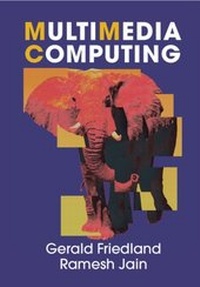
Multimedia Computing
1st Edition
Published on 28. July 2014
978-1-139-98925-1 (ISBN)
Description

Humans are the best functioning example of multimedia communication and computing - that is, we understand information and experiences through the unified perspective offered by our five senses. This innovative textbook presents emerging techniques in multimedia computing from an experiential perspective in which each medium - audio, images, text, and so on - is a strong component of the complete, integrated exchange of information or experience. The authors' goal is to present current techniques in computing and communication that will lead to the development of a unified and holistic approach to computing using heterogeneous data sources. Gerald Friedland and Ramesh Jain introduce the fundamentals of multimedia computing, describing the properties of perceptually encoded information, presenting common algorithms and concepts for handling it, and outlining the typical requirements for emerging applications that use multifarious information sources. Designed for advanced undergraduate and beginning graduate courses, the book will also serve as an introduction for engineers and researchers interested in understanding the elements of multimedia and their role in building specific applications.
Reviews / Votes
'This book fills a critical need in multimedia computing by offering a comprehensive, authoritative, and holistic review of key principles, state-of-the-art technologies, and open issues in this vibrant field. Authored by two renowned pioneers and educators, it will be a wonderful book for students and anyone interested in learning more about multimedia.' Shih-Fu Chang, Columbia University 'The multimedia field needed a textbook, and it is finally here. This is a comprehensive textbook covering a diverse set of topics in modern multimedia. Each chapter is very accessible; this book will be an excellent resource for beginning graduate students and for practitioners.' Mubarak Shah, University of Central Florida 'This is the long-awaited textbook on multimedia. The authors, both senior members of the multimedia community, have managed to produce a book that is useful not only to students and practitioners but also to many of us in the field. The book is comprehensive in its coverage of the subject, and it is structured in an easy-to-read way. I particularly like the fact that the exercises are meant to solicit the readers to think beyond the actual content of the book.' Nicu Sebe, University of Trento 'Teaching multimedia is challenging because it encompasses concepts and technology from many areas, including human perception, digital representation of continuous and discrete data and behavior, synchronization in space and time, and distributed real-time software/hardware systems. Applications range from multimedia authoring, analysis, and retrieval to interactive entertainment and distributed collaboration. Multimedia Computing covers a wide range of material suitable for a one- to two-semester introduction to multimedia. It covers the fundamentals of human perception that produce multimedia experiences through the systems and applications used to produce these experiences. Friedland and Jain do an excellent job of presenting enough details and enough guidance to further sources for students to understand the scope of the field and to learn more about topics of interest.' Lawrence A. Rowe, Professor Emeritus, University of California, Berkeley 'Multimedia Computing is indeed an excellent resource - a one-stop resource - for students, young researchers, and professionals. The authors have provided the basics from the physics concepts of sound and light to user interface design for multimedia systems. A must-read book.' B. Prabhakaran, University of Texas, DallasMore details
Language
English
Place of publication
Cambridge
United Kingdom
Publishing group
Cambridge University Press
Target group
Professional and scholarly
College/higher education
Illustrations
Worked examples or Exercises; 3 Tables, unspecified; 9 Plates, color; 29 Halftones, unspecified; 82 Line drawings, unspecified
File size
24588,65 MB
ISBN-13
978-1-139-98925-1 (9781139989251)
Copyright in bibliographic data and cover images is held by Nielsen Book Services Limited or by the publishers or by their respective licensors: all rights reserved.
Schweitzer Classification
Other editions
Additional editions
Gerald Friedland | Ramesh Jain
Multimedia Computing
Book
07/2014
Cambridge University Press
€125.60
Shipment within 15-20 days
Persons
Gerald Friedland is the Director of Audio and Multimedia Research at the International Computer Science Institute, a private lab affiliated with the University of California, Berkeley, where he is currently leading a group of multimedia researchers. Ramesh Jain is a Donald Bren Professor in Information and Computer Sciences at the University of California, Irvine, where he is doing research in EventWeb and Experiential Computing for developing and building social life networks.
Content
1. Introduction; 2. Multimedia: a definition; 3. Elements of multimedia computing; 4. Introduction to sensors; 5. Sound; 6. Light; 7. Multimedia documents; 8. Multimodal integration and synchronization; 9. Multimedia systems; 10. The human factor; 11. Fundamentals of compression; 12. Lossy compression; 13. Advanced perceptual compression; 14. Speech compression; 15. Multimedia information retrieval; 16. Signal processing primer; 17. Multimedia content analysis; 18. Content analysis systems; 19. Content and context; 20. Future topics.
