

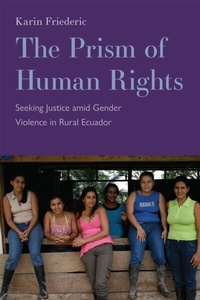
The Prism of Human Rights
Seeking Justice Amid Gender Violence in Rural Ecuador
1st Edition
Published on 11. August 2023
210 pages
978-1-9788-3535-1 (ISBN)
Description

Gender violence has been at the forefront of women's human rights struggles for decades, shaping political movements and NGO and government programs related to women's empowerment, community development, and public health. Drawing on over twenty years of research and activism in rural Ecuador, Karin Friederic provides a remarkably intimate view of what these rights-based programs actually achieve over the long term. The Prism of Human Rights brings us into the lives of women, men, and children who find themselves entangled in intimate partner violence, structural violence, political economic change, and a global cultural project in which "rights" are associated with modernity, development, and democratic states. She details the multiple forms of violence that rural women experience; shows the diverse ways they make sense of, endure, and combat this violence; and helps us understand how people are grappling with new ideas of gender, rights, and even of violence itself. Ultimately, Friederic demonstrates that rights-based interventions provide important openings for women seeking a life free of violence, but they also unwittingly expose "liberated" women to more extreme dynamics of structural violence. Thus, these interventions often reduce women's room to maneuver and encourage communities to hide violence in order to appear "modern" and "developed." This analysis of human rights in practice is essential for anyone seeking to promote justice in a culturally responsible manner, and for anyone who hopes to understand how the globalization of rights, legal institutions, and moral visions is transforming distant locales and often perpetuating violence in the process.
Reviews / Votes
"Karin Friederic's critical approach to human rights practice draws on a wealth of ethnographic data collected across decades of ethically and politically committed research. Her nuanced reading of the interactions between the state, the law, rights-based interventions and women's lives, in contexts of extreme gender-based violence, is a key contribution to understanding the limits and paradoxes of human rights. This is a hard but necessary lesson to advance a responsible fight for women's dignity." - Silvana Tapia Tapia (author of Feminism, Violence Against Women, and Law Reform: Decolonial Lessons from Ecuador) "Karin Friederic's critical approach to human rights practice draws on a wealth of ethnographic data collected across decades of ethically and politically committed research. Her nuanced reading of the interactions between the state, the law, rights-based interventions and women's lives, in contexts of extreme gender-based violence, is a key contribution to understanding the limits and paradoxes of human rights. This is a hard but necessary lesson to advance a responsible fight for women's dignity." - Silvana Tapia Tapia (author of Feminism, Violence Against Women, and Law Reform: Decolonial Lessons from Ecuador) "Karin Friederic's The Prism of Human Rights is a compelling, emotional, and ethnographically rich read. Friederic's ethical delivery of Gabi's story, the punctuated narrative driving the book, is a reminder that Friederic is describing real people in real time. Using political economy and the best of interpretivist anthropology, Friederic seamlessly weaves scales of violence in and through Las Colinas, a place that is richly described, in loving detail, serving as a reminder that abstract notions like 'human rights' and 'development' have real human consequences." - Hillary J. Haldane (co-author of Applying Anthropology to Gender-Based Violence: Global Responses, Local Practices) "Karin Friederic's The Prism of Human Rights is a compelling, emotional, and ethnographically rich read. Friederic's ethical delivery of Gabi's story, the punctuated narrative driving the book, is a reminder that Friederic is describing real people in real time. Using political economy and the best of interpretivist anthropology, Friederic seamlessly weaves scales of violence in and through Las Colinas, a place that is richly described, in loving detail, serving as a reminder that abstract notions like 'human rights' and 'development' have real human consequences." - Hillary J. Haldane (co-author of Applying Anthropology to Gender-Based Violence: Global Responses, Local Practices) "Karin Friederic's beautifully rendered ethnography on gender violence breaks new ground. Through intimate storytelling only made possible by her two decades of fieldwork and activism in La Colinas, Ecuador, she reveals how supposedly universal human rights discourses unfold in sharply contradictory ways in the lives of real women." - Sarah J. Hautzinger (author of Violence in the City of Women: Police and Batterers in Bahia, Brazil) "Karin Friederic's beautifully rendered ethnography on gender violence breaks new ground. Through intimate storytelling only made possible by her two decades of fieldwork and activism in La Colinas, Ecuador, she reveals how supposedly universal human rights discourses unfold in sharply contradictory ways in the lives of real women." - Sarah J. Hautzinger (author of Violence in the City of Women: Police and Batterers in Bahia, Brazil)More details
Language
English
Place of publication
New Brunswick NJ
United States
Target group
College/higher education
Professional and scholarly
Illustrations
15 B-W images
ISBN-13
978-1-9788-3535-1 (9781978835351)
Copyright in bibliographic data and cover images is held by Nielsen Book Services Limited or by the publishers or by their respective licensors: all rights reserved.
Schweitzer Classification
Other editions
Additional editions
Book
08/2023
Rutgers University Press
€37.00
Shipment within 3-4 weeks
Person
KARIN FRIEDERIC is an associate professor of anthropology at Wake Forest University in Winston-Salem, North Carolina.
Content
- Cover
- Title Page
- Copyright
- Dedication
- Contents
- Prologue: Gabi, Part I
- Introduction: Understanding Gender Violence through the Prism of Human Rights
- 1. "Somos del Campo": Gender Politics of Rural Households
- 2. "Somos así por Naturaleza": Bodies, Sexuality, and Morality on Ecuador's Coast
- Interlude: Gabi, Part II
- 3. "¿Por qué me maltrate así?": Rethinking Violence, Rethinking Justice
- 4. The Prism of Rights: Empowering Women for Gender Justice
- 5. Cultivating Modern Selves: Reframing Sexuality and Violence within a Moral Economy of Development
- Conclusion: Vernacularizing Human Rights for Gender Justice
- Epilogue: Gabi's Story, Part III
- Acknowledgments
- Notes
- References
- Index
- About the Author
