

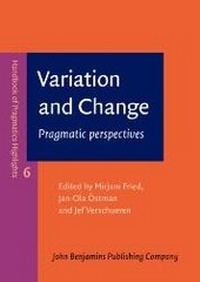
Variation and Change
Pragmatic perspectives
1st Edition
Published on 11. November 2010
X, 275 pages
978-90-272-8917-9 (ISBN)
Description

The ten volumes of the Handbook of Pragmatics Highlights focus on the most salient topics in the field of pragmatics, thus dividing its wide interdisciplinary spectrum in a transparent and manageable way. While the other volumes select specific philosophical, cognitive, grammatical, cultural, interactional, or discursive angles, this sixth volume focuses on the dynamic aspects of language and reviews the relevant developments in variationist and diachronic scholarship. The areas explored in the volume concern several general themes: specific methodological approaches, from comparative reconstruction to evolutionary pragmatics; issues in intra-lingual variation in terms of standard and non-standard varieties; cross-linguistic variation, including its cross-cultural dimension; and the study of diachronic relations across linguistic patterns, including changes in all areas of pragmatic patterns and categories. The contributions document two prominent and interrelated trends that shape contemporary variationist and diachronic research. One, it has moved from situating change within context-independent systems toward incorporating patterns of language use and the speaker's role in language change. And two, it has reoriented its focus away from cataloguing instances of variation and toward seeking theoretically informed accounts that aim at explaining variation and change. On the whole, the volume argues for accepting and developing actively a systematic connection between research in diachrony, synchronic variation, and typology, while also incorporating the socio-cognitive perspective in linguistic analysis as a particularly promising source of useful methodology and explanatory models.
More details
Other editions
Additional editions
Book
11/2010
John Benjamins Publishing Co
€41.34
Shipment within 10-15 days
Persons
Content
- Variation and Change
- Editorial page
- Title page
- LCC data
- Table of contents
- Introduction
- 1. Approaches to variation and change
- 2. Diachronic analysis and 'pathways' of change
- 3. Intra-lingual variation
- 4. Cross-language variation
- 5. Summary and outlook
- References
- Borrowing
- 1. Introduction
- 2. Short historical overview
- 3. Definitions of borrowing: Terminological issues
- 4. Different types/classifications of borrowing
- 5. The integration of borrowings
- 6. Constraints
- 7. Quantitative approaches
- 8. Psycholinguistic approaches
- References
- Contact linguistics
- 1. Introduction
- 2. Contact in relation to classificatory bases in linguistics
- 3. Contact and location
- 4. Direction of interference
- 5. Indirect influence in language contact
- 6. Contact as process: Towards pragmatics
- References
- Creoles and creolization
- References
- Dialect
- 1. Introduction
- 2. Other labels
- 2.1 Variety
- 2.2 Lect
- 2.3 Vernacular
- 2.4 Social dialects
- 3. Dialects as local forms of speech
- 4. Some examples of dialect studies
- 5. Some recent developments in the U.S.
- References
- Dialectology
- 1. Definition
- 2. An outline of history
- 3. Aims of the investigation
- 3.1 The impact of history on the origin and evolution of languages
- 3.2 Linguistic reconstruction
- 3.3 The study of universals of language, especially implicational scales
- 3.4 Sociopragmatic and attitudinal aspects
- 3.5 Communicative aspects
- 4. Dialect atlases
- References
- Evolutionary pragmatics
- 1. Pragmaticism, pragmatics, adaptation and the evolution of language
- 2. Sign-functions and their evolutionary significance
- 2.1 The triad of sign functions
- 2.2 The evolutionary interpretation of the triad of functions
- 2.3 Selective value of communication and symbolic behavior
- 3. Can the pragmatics of tool production and tool-use tell us something about the origin of language?
- 3.1 Instrumentality in higher mammals and man
- 3.2 Is tool-making a pragmatic source of propositional semantics?
- 3.3 Cro-Magnon life space and the pragmatic space of decorated caves
- 4. From ecological to cultural pragmatics
- 5. Conclusions
- References
- Historical linguistics
- 1. Introduction
- 2. HL in pre-generative work
- 3. HL and generative grammar
- 4. New perspectives
- 5. Explicit
- References
- Historical pragmatics
- 1. Introduction
- 2. Origins
- 3. Data problems
- 4. Topics
- 4.1 Discourse markers
- 4.2 Speech acts
- 4.3 Politeness
- 5. New perspectives
- References
- Implicature and language change
- 1. Introduction
- 2. Analyses citing conversational principles
- 3. Implicature and metaphor
- 4. Implicature, metonymy and merger
- 5. Inferences based on lexical concepts
- 6. Summary
- References
- Interlanguage pragmatics
- 1. Definition and scope
- 2. Pragmatic comprehension
- 2.1 Comprehension of nonliteral utterances
- 2.2 Assessment of politeness
- 2.3 Sociopragmatic assessment
- 3. Production of linguistic action
- 4. Development of pragmatic competence
- 4.1 Cross-sectional studies
- 4.2 Longitudinal studies
- 4.3 Theoretical accounts
- 5. Pragmatic transfer
- 5.1 Definition
- 5.2 Positive transfer
- 5.3 Negative transfer
- 5.4 Transferability
- 6. Communicative effect
- 7. Pragmatic norms
- 8. Language teaching
- 9. Research methods
- 10. Further reading
- References
- Jargon
- 1. Introduction
- 2. Studies of delinquent jargon and the introduction of a 'value-giving measure'
- 3. Interpretations of antilanguages and their functions
- 3.1 Halliday: The concept of antilanguage
- 3.2 Sociolinguistic functions of delinquent jargon
- 4. Varieties of jargon
- 5. Conclusions
- References
- Language change
- 1. Introduction
- 2. Issues in language change
- 2.1 Internal and external factors
- 2.2 Simplicity and symmetry
- 2.3 Iconicity and indexicality
- 2.4 Markedness and naturalness
- 2.5 Telic changes and epiphenomena
- 2.6 Mergers and distinctions
- 2.7 Possible changes
- 2.8 Unidirectionality of change
- 2.9 Ebb and flow
- 3. Change and levels of language
- 3.1 Phonological change
- 3.2 Morphological change
- 3.3 Syntactic change
- 4. The study of universal grammar
- 4.1 The principles and parameters model
- 5. Semantic change
- 6. Pragmatic change
- 7. Methodologies
- 7.1 Comparative method
- 7.2 Internal reconstruction
- 7.3 Analogy
- 8. Sociolinguistic investigations
- 8.1 Data collection methods
- 8.2 Genre variation and stylistics
- 9. Pathways of change
- 9.1 Long-term change: Grammaticalization
- 9.2 Large-scale changes: The typological perspective
- 10. Contact accounts
- 11. Language areas (Sprachbünde)
- 12. Conclusion
- References
- Language contact
- 1. Introduction
- 2. Societal multilingualism
- 3. The bilingual individual
- 4. Language mixing in conversation
- 5. Contact-induced language change
- 6. Contact, typology and language classification
- 7. Concluding remarks
- References
- Reconstruction
- References
- Register
- 1. History of the term 'register'
- 2. Systematization of the term
- 3. Perspectives
- 3.1 Functional linguistics à la Ferguson
- 3.2 Intercultural communication
- 3.3 Linguistic pragmatics
- 3.4 Variation linguistics
- References
- Typology
- References
- Variational pragmatics
- 1. Introduction
- 2. Pragmatic coordinates
- 2.1 The scope of pragmatics
- 2.2 The place in pragmatics
- 2.3 Levels of pragmatic analysis
- 3. Variational coordinates
- 3.1 Variation and identity
- 3.2 Pragmatic variation
- 3.3 What is a pragmatic variable?
- 4. Methodological concerns
- 4.1 Some basic principles
- 4.2 Data
- 5. Development
- 5.1 History
- 5.2 Research trends
- 6. Perspectives
- References
- Index
- The series Handbook of Pragmatics Highlights
