

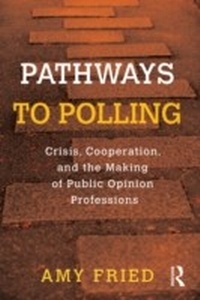
Pathways to Polling
Crisis, Cooperation and the Making of Public Opinion Professions
1st Edition
Published on 1. March 2013
192 pages
978-1-136-71169-5 (ISBN)
Description

In midcentury America, the public opinion polling enterprise faced a crisis of legitimacy. Every major polling firm predicted a win for Thomas Dewey over Harry Truman in the 1948 presidential election-and of course they all got it wrong. This failure generated considerable criticisms of polling and pollsters were forced to defend their craft, the quantitative analysis of public sentiment.
Pathways to Polling argues that early political pollsters, market researchers, and academic and government survey researchers were entrepreneurial figures who interacted through a broad network that was critical to the growth of public opinion enterprises. This network helped polling pioneers gain and maintain concrete, financial support to further their discrete operations. After the Truman-Dewey debacle, such links helped political polling survive when it could have just as easily been totally discredited. Amy Fried demonstrates how interactions between ideas, organizations, and institutions produced changes in the technological, political, and organizational paths of public opinion polling, notably affecting later developments and practice. Public opinion enterprises have changed a good deal, in the intervening half century, even as today's approaches have been deeply imprinted by these early efforts.
Pathways to Polling argues that early political pollsters, market researchers, and academic and government survey researchers were entrepreneurial figures who interacted through a broad network that was critical to the growth of public opinion enterprises. This network helped polling pioneers gain and maintain concrete, financial support to further their discrete operations. After the Truman-Dewey debacle, such links helped political polling survive when it could have just as easily been totally discredited. Amy Fried demonstrates how interactions between ideas, organizations, and institutions produced changes in the technological, political, and organizational paths of public opinion polling, notably affecting later developments and practice. Public opinion enterprises have changed a good deal, in the intervening half century, even as today's approaches have been deeply imprinted by these early efforts.
Reviews / Votes
"Amy Fried's Pathways to Polling: Crisis, Cooperation and the Making of Public Opinion Professions is an impressive example of institutional scholarship, exploring the organizations and social networks that linked market researchers, political pollsters and academic survey researchers beginning in the 1920s. It is also an important contribution to our understanding of the growth of the modern state, which increasingly made use of this new tool, and demonstrates how the shift to scientific polling and survey research represented a shift to a new kind of plebiscitary politics."-Kristi Andersen, Professor of Political Science; Chapple Family Professor of Citizenship and Democracy; Laura J. and L. Douglas Meredith Professor; and Maxwell Professor of Teaching Excellence, Syracuse University
"Amy Fried has done it again, producing a very fine book on the dynamics of American public opinion expression and measurement. Pathways to Polling fills a vacuum in the history of opinion research, analyzing how the survey industry blossomed and how it became central to American politics and culture. Pathways is required reading for anyone interested in the nature of public opinion and the underlying organizational dynamics of the vox populi."
-Susan Herbst, President and Professor of Political Science, University of Connecticut
"Pathways to Polling by Amy Fried is so needed in this ever-changing field because it provides the ideal blend between historical, academic and practical polling issues. In the age of instant and infinite polling data, Pathways to Polling is smart, scholarly and sensible."
-Peter D. Hart, Chairman, Hart Research Associates; Co-Director, NBC/Wall Street Journal Poll; and Visiting Lecturer, University of Pennsylvania and University of California Berkeley
"Pathways to Polling is an excellent account of the early days of polling industry. Fried makes this fascinating history accessible and engaging. Pathways to Polling is a must read for both students and practitioners of public opinion polling."
-Adam J. Berinsky, Massachusetts Institute of Technology
More details
Language
English
Place of publication
London
United Kingdom
Publishing group
Taylor & Francis Ltd
Target group
College/higher education
Product notice
Reflowable
Illustrations
2 s/w Tabellen
2 Tables, black and white
File size
2,33 MB
ISBN-13
978-1-136-71169-5 (9781136711695)
Copyright in bibliographic data and cover images is held by Nielsen Book Services Limited or by the publishers or by their respective licensors: all rights reserved.
Schweitzer Classification
Other editions
Additional editions

Book
08/2011
1st Edition
Routledge
€231.40
Shipment within 15-20 days
Book
08/2011
1st Edition
Routledge
€70.80
Article not available at the moment
Person
Amy Fried is professor of Political Science at the University of Maine. She maintains her own blog on public opinion polling. Please visit http://www.pollways.com for more.
Content
1. Building the Polls 2. Media, Markets and Men from Mars 3. From the Fields of Hunger through the Cauldron of War 4. Pols, Politics and Polls 5. "Survivors of the More Recent Wreck" 6. A Defense Against "Extensive and Unjustified Repercussions" 7. Diverging Paths
