

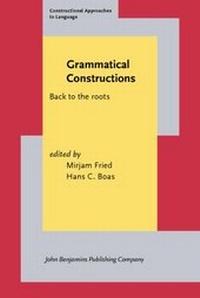
Grammatical Constructions
Back to the roots
1st Edition
Published on 14. December 2005
VIII, 246 pages
978-90-272-9407-4 (ISBN)
Description

This volume brings into focus the conceptual roots of the notion 'grammatical construction' as the theoretical entity that constitutes the backbone of Construction Grammar, a unique grammatical model in which grammatical constructions have the status of elementary building blocks of human language. By exploring the analytic potential and applicability of this notion, the contributions illustrate some of the fundamental concerns of constructional research. These include issues of sentence structure in a model that rejects the autonomy of syntax; the contribution of Frame Semantics in establishing the relationship between syntactic patterning and the lexical meaning of verbs; and the challenge of capturing the dynamic and variable nature of grammatical structure in a systematic way. All the authors share a commitment to studying grammar in its use, which gives the book a rich empirical dimension that draws on authentic data from typologically diverse languages.
More details
Other editions
Additional editions
Book
12/2005
John Benjamins Publishing Co
€121.90
Shipment within 10-15 days
Persons
Content
- Grammatical Constructions
- Editorial page
- Title page
- LCC data
- Table of contents
- Introduction
- Syntactic patterning
- Verbs and constructions
- Language variation and change
- References
- I. Syntactic patterning
- Definite null objects in (spoken) French
- 1. Introduction
- 2. Types of complement instantiation
- 3. Different types of interpretation of null complements
- 3.1. Indefinite Null-instantiation
- 3.2. Definite Null-instantiation
- 3.3. Free Null-instantiation
- 3.4. Summary
- 4. Definite null complements as ratified topics
- 4.1. Morphosyntactic factors
- 4.2. Semantic factors
- 4.3. Pragmatic factors
- 5. Syntactic and methodological implications
- Notes
- References
- From relativization to clause-linkage
- 1. Introduction
- 2. The need to posit two distinct grammatical constructions
- 2.1. The internally headed relativization (IHR) construction
- 2.2. The concessive construction
- 3. IHR vs. concessive clause-linkage
- 3.1. Structural comparison
- 3.2. Semantic comparison
- 3.3. Pragmatic comparison
- 4. From relativization to clause-linkage
- 4.1. The reanalysis hypothesis
- 4.2. Arguments for the reanalysis hypothesis
- 5. Conclusion
- Notes
- References
- Argument structure constructions and the argument-adjunct distinction
- 1. Introduction
- 2. Goldberg's analysis
- 3. Preliminary sketch of the maximal subconstructions
- 3.1. The Intended Recipient (maximal) construction
- 3.2. The Direct Recipient construction
- 3.3. The Modal Recipient construction
- 4. Representation of the RC constructions
- 4.1. The Abstract Recipient construction
- 4.2. The Direct Recipient construction
- 4.3. The Intended Recipient construction
- 4.4. The Modal Recipient construction
- 4.5. Lexical verbs unifying with the Modal RC
- 5. Inherent arguments, added arguments and adjuncts
- 5.1. Caused-motion phenomena
- 5.2. Representing added path argument and setting adjunct ASCs
- 6. Conclusion
- Notes
- References
- II. Syntax and semantics of verbs
- The role of verb meaning in locative alternations
- 1. Introduction
- 2. Analysis of locative alternation
- 2.1. Linking mechanisms
- 2.2. L-meaning/P-meaning distinction
- 2.3. Load
- 3. Comparison with Goldberg (1995)
- 3.1. Fundamental similarities
- 3.2. Verb meanings as scene-based
- 4. Alternations that cannot be attributed to a single scene
- 4.1. Pack
- 4.2. Trim
- 4.3. Roll
- 4.4. Summary
- 5. The significance of verb meaning
- 6. Conclusion
- Notes
- References
- Verbal polysemy and Frame Semantics in Construction Grammar
- 1. Introduction
- 2. Previous studies
- 2.1. The locative alternation
- 2.2. Uses of brush
- 3. Goldberg's (1995, 2002) constructional approach
- 3.1. Goldberg's Construction Grammar framework
- 3.2. Problems with Goldberg's approach
- 4. An alternative constructional analysis
- 4.1. Verb meaning
- 4.2. The interaction between verb uses and constructions
- 4.3. Some solutions to the problems with previous analyses
- 4.4. Idiosyncrasy and generality
- 5. The semantics of the onto- and from-forms
- 6. Conclusion
- Notes
- References
- A constructional approach to mimetic verbs
- 1. Introduction
- 2. Unique properties of mimetic words
- 2.1. Phonological characteristics
- 2.2. Categorial characteristics
- 2.3. Semantic characteristics
- 3. A constructional analysis
- 4. Implications for the two approaches to multiple meaning
- 5. Conclusion
- Note
- References
- III. Language variation and change
- Integration, grammaticization, and constructional meaning
- 1. Introduction
- 2. Comparison
- 3. Basic notions of Cognitive Grammar
- 4. Degree of conceptual integration
- 5. Import for grammaticization
- 6. Conclusion
- Notes
- References
- Constructions and variability
- 1. Introduction and aim
- 2. Variation, variability, and language change
- 3. Variability in Construction Grammar
- 4. Free variation: Constructions and conceptualizations
- 5. Variation across paradigms: Value pools
- 6. Variability through analogy: Metaconstructions
- 7. Conclusion
- Notes
- References
- Construction Grammar as a conceptual framework for linguistic typology
- 1. Introduction
- 1.1. Aim of study
- 1.2. Construction Grammar
- 1.3. Linguistic typology
- 2. Switch-reference as a reference tracking device
- 2.1. Overview
- 2.2. Switch-reference and its treatment
- 2.3. Further cases of interest
- 3. Towards a construction-based account
- 3.1. Proposals
- 3.2. Generalizations over form-meaning pairings
- 3.3. Final remarks
- Notes
- References
- Index
- Index of constructions
- The series Constructional Approaches to Language
