

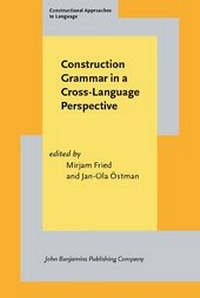
Construction Grammar in a Cross-Language Perspective
1st Edition
Published on 23. December 2004
VI, 209 pages
978-90-272-9496-8 (ISBN)
Description

This volume gives an easily accessible, yet comprehensive, sophisticated, and example-rich introduction to Construction Grammar as it has been developed from the early 1980's by Charles J. Fillmore and his associates. It also provides a succinct account of the historical and intellectual background of the model and shows how Construction Grammar can easily be applied to typologically very different languages and to a variety of language-specific phenomena. All of the contributors to the volume came out of the Fillmorean school at UC-Berkeley and have worked consistently on applying and further developing the model in various domains of linguistic analysis.The 'Thumbnail sketch' by Fried & Östman is the only extensive introduction published so far to Fillmorean Construction Grammar.
More details
Other editions
Additional editions
Mirjam Fried | Jan-Ola OEstman
Construction Grammar in a Cross-Language Perspective
Book
12/2004
John Benjamins Publishing Co
€157.86
Shipment within 3-4 weeks
Mirjam Fried | Jan-Ola OEstman
Construction Grammar in a Cross-Language Perspective
Book
12/2004
John Benjamins Publishing Co
€100.70
Shipment within 10-15 days
Persons
Content
- Construction Grammar in a Cross-Language Perspective
- Editorial page
- Title page
- LCC data
- Table of contents
- 1. Historical and intellectual background of Construction Grammar
- 1. Preamble
- 2. A brief history of Construction Grammar
- 3. Cross-language and universal potential of Construction Grammar
- Notes
- References
- 2. Construction Grammar
- 1. Preamble
- 2. Main features of Construction Grammar
- 2.1. General properties
- 2.2. The Case Grammar connection
- 3. Arguments for Construction Grammar
- 4. The notion grammatical construction
- 5. Defining Construction Grammar
- 6. Working in Construction Grammar
- 6.1. Notational and analytical conventions
- 6.2. Feature structures
- 6.3. Unification in practice
- 6.4. Valence
- 6.5. Linking
- 6.6. Instantiation patterns
- 6.7. Ordering constructions
- 6.8. Unification and Inheritance
- 6.9. External vs. internal properties
- 7. Construction Grammar: Outlook
- Notes
- References
- 3. Predicate semantics and event construal in Czech case marking
- 1. Introduction
- 2. The dative-experiencer pattern
- 3. The accusative-experiencer pattern
- 4. The accusative construction as a grammatical idiom
- 5. Case marking and construction grammar
- 5.1. Constructional representation of DC and AC
- 5.2. Case marking
- 6. Conclusions
- Notes
- References
- 4. Lexically (un)filled constructional schemes and construction types
- 1. Introduction
- 2. Construction types and constructional schemes
- 2.1. Construction types
- 2.2. Constructional schemes
- 3. Data
- 4. Different construction types with a shared modal function
- 4.1. The Bi-Clausal Conditional construction
- 4.2. The Integrated Evaluative Conditional construction
- 4.3. From conditional constructions to the deontic modal function of 'obligation'
- 5. The Reduced Conditional construction
- 6. The source of the Reduced Conditional construction
- 6.1. Possible source 1: Fixed idiomatic expressions
- 6.2. Possible source 2: The Integrated Evaluative construction
- 6.3. Possible source 3: The Full Bi-Clausal Conditional construction
- 6.4. General source: The constructional scheme
- 7. The larger view of the proposed framework
- 7.1. Other linkers in the constructional scheme of 'obligation'
- 7.2. Other constructional schemes
- 8. Conclusions
- Notes
- References
- 5. On the interaction of information structure and formal structure in constructions
- 1. Introduction
- 2. The Preferred-Clause construction and the R-top template
- 3. The Right-Detached comme-N construction
- 3.1. The RDCN construction and the R-TOP template
- 3.2. Syntax and semantics of the RDCN construction
- 3.3. Information structure of the RDCN construction
- 3.4. Summary
- 4. Theoretical implications
- Notes
- References
- Index
- Index of constructions
- The series Constructional Approaches to Language
