

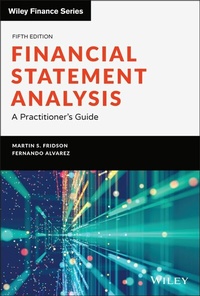
Financial Statement Analysis
Description

In Financial Statement Analysis, 5th Edition, leading investment authority Martin Fridson returns with Fernando Alvarez to provide the analytical framework you need to scrutinize financial statements, whether you're evaluating a company's stock price or determining valuations for a merger or acquisition. Rather than taking financial statements at face value, you'll learn practical and straightforward analytical techniques for uncovering the reality behind the numbers. This fully revised and up-to-date 5th Edition offers fresh information that will help you to evaluate financial statements in today's volatile markets and uncertain economy. The declining connection between GAAP earnings and stock prices has introduced a need to discriminate between instructive and misleading non-GAAP alternatives. This book integrates the alternatives and provides guidance on understanding the extent to which non-GAAP reports, particularly from US companies, may be biased.
Understanding financial statements is an essential skill for business professionals and investors. Most books on the subject proceed from the questionable premise that companies' objective is to present a true picture of their financial condition. A safer assumption is that they seek to minimize the cost of raising capital by portraying themselves in the most favorable light possible. Financial Statement Analysis teaches readers the tricks that companies use to mislead, so readers can more clearly interpret statements.
* Learn how to read and understand financial statements prepared according to GAAP and non-GAAP standards
* Compare CFROI, EVA, Valens, and other non-GAAP methodologies to determine how accurate companies' reports are
* Improve your business decision making, stock valuations, or merger and acquisition strategy
* Develop the essential skill of quickly and accurately gathering and assessing information from financial statements of all types
Professional analysts, investors, and students will gain valuable knowledge from this updated edition of the popular guide. Filled with real-life examples and expert advice, Financial Statement Analysis, 5th Edition, will help you interpret and unpack financial statements.
More details
Other editions
Additional editions
Persons
MARTIN S. FRIDSON is Chief Investment Officer at Lehmann Livian Fridson Advisors, a New York-based investment management firm founded on fundamental security analysis. He is past President of the Fixed Income Analysts Society.
FERNANDO ALVAREZ has been a faculty member at Babson College, Rutgers University School of Business, NYU-Stern, and Columbia Business School. His research interests include the interaction of strategy, financial statement analysis, valuation models, and stock market reactions to business decisions.
Content
Preface to Fifth Edition xi
Acknowledgments xv
Part One
Reading Between the Lines 1
Chapter 1
The Adversarial Nature of Financial Reporting 3
The Purpose of Financial Reporting 4
The Flaws in the Reasoning 8
Small Profits and Big Baths 12
Maximizing Growth Expectations 13
Downplaying Contingencies 20
The Importance of Being Skeptical 23
Conclusion 27
Part Two
The Basic Financial Statements 31
Chapter 2
The Balance Sheet 33
The Value Problem 34
Comparability Problems in the Valuation of Financial Assets 36
Instantaneous Wipeout of Value 38
How Good Is Goodwill? 40
Losing Value the Old-Fashioned Way 44
True Equity Is Elusive 45
Book Value May Overstate Reality 46
Pros and Cons of a Market-Based Equity Figure 49
The Common Form Balance Sheet 51
Conclusion 53
Chapter 3
The Income Statement 55
Making the Numbers Talk 55
How Real Are the Numbers? 61
Conclusion 85
Chapter 4
The Statement of Cash Flows 87
The Cash Flow Statement and the Leveraged Buyout 89
Analytical Applications 95
In Defense of Slack 121
Conclusion 123
Part Three
A Closer Look at Profits 125
Chapter 5
What Is Profit? 127
Bona Fide Profits versus Accounting Profits 127
Which Costs Count? 130
Conclusion 134
Chapter 6
Revenue Recognition 135
Making It Up at Gowex 135
Globo's Foreseen Fall from Grace 139
Channel-Stuffing in the Drug Business 143
A Second Take on Earnings 146
Making the Numbers at M/A-Com 149
Astray on Layaway 151
Recognizing Membership Fees 152
A Potpourri of Liberal Revenue Recognition Techniques 155
Fattening Earnings with Empty Calories 156
Tardy Disclosure at Halliburton 162
Managing Earnings with Rainy Day Reserves 165
Fudging the Numbers: A Systematic Problem 168
Conclusion 171
Chapter 7
Expense Recognition 173
Diamond Foods's Movable Expenses 173
Nortel's Deferred Profit Plan 176
Grasping for Earnings at General Motors 181
Time-Shifting at Freddie Mac 184
Conclusion 186
Chapter 8
The Applications and Limitations of EBITDA 187
EBIT, EBITDA, and Total Enterprise Value 188
The Role of EBITDA in Credit Analysis 193
Abusing EBITDA 196
A More Comprehensive Cash Flow Measure 198
Working Capital Adds Punch to Cash Flow Analysis 201
Conclusion 203
Chapter 9
The Reliability of Disclosure and Audits 205
Where Was the Cash? 206
Sloppiness Can Be a Red Flag 210
How Manipulation Evades Detection 214
Systematic Problems in Auditing 215
Conclusion 220
Chapter 10
Mergers-and-Acquisitions Accounting 221
Goodwill Goes Bad 223
Double Trouble 224
Conclusion 227
Chapter 11
Is Fraud Detectable? 229
Telltale Signs of Manipulation 230
Fraudsters Know Few Limits 233
Enron: A Media Sensation 233
HealthSouth's Excruciating Ordeal 242
Milk and Other Liquid Assets 249
Trouble Was Brewing at Luckin 252
Conclusion 254
Part Four
Forecasts and Security Analysis 255
Chapter 12
Forecasting Financial Statements 257
A Typical One-Year Projection 257
Sensitivity Analysis with Projected Financial Statements 270
Projecting Financial Flexibility 276
Pro Forma Financial Statements 279
Multiyear Projections 285
Conclusion 299
Chapter 13
Credit Analysis 301
Balance Sheet Ratios 302
Income Statement Ratios 311
Statement of Cash Flows Ratios 316
Combination Ratios 318
Relating Ratios to Credit Risk 326
Conclusion 342
Chapter 14
Equity Analysis 343
The Dividend Discount Model 344
The Price-Earnings Ratio 350
The Du Pont Formula 360
Valuation through Restructuring Potential 364
Advanced Equity Analysis 370
Conclusion 373
Notes 375
Glossary 387
Further Reading 405
About the Authors 407
Index 409
Preface to Fifth Edition
This fifth edition of Financial Statement Analysis, like its predecessors, seeks to equip its readers for the practical challenges of contemporary business. Once again, the intention is to acquaint readers who have already acquired basic accounting skills with the complications that arise in applying textbook-derived knowledge to the real world of extending credit and investing in securities. Just as a swiftly changing environment necessitated extensive revisions and additions in the second through fourth editions, new concerns and challenges for users of financial statements have emerged as the third decade of the twenty-first century unfolds.
A fundamental change reflected in the third edition was the shift of corporations' executive compensation plans from a focus on reported earnings toward enhancing shareholder value. Stock options became a major component of corporate leaders' pay. In theory, this new approach aligned the interests of management and shareholders, but the concept had a dark side. Chief executive officers who were under growing pressure to boost their corporations' share prices could no longer increase their bonuses by goosing reported earnings through financial reporting tricks that were transparent to the stock market. Instead, they had to devise more opaque methods that gulled investors into believing that the reported earnings gains were real.
To adapt to the new environment, corporate managers became far more aggressive in misrepresenting their performance. They moved beyond exaggeration to outright fabrication of earnings through the use of derivatives and special purpose vehicles that never showed up in financial statements and had little to do with the production and sale of goods and services. This insidious trend culminated in colossal accounting scandals involving companies such as Enron and WorldCom, which shook confidence not only in financial reporting but also in the securities markets.
Government responded to the outrage over financial frauds by enacting the Sarbanes-Oxley Act of 2002. Under its provisions, a company's chief executive officer and chief financial officer were required to attest to the integrity of the financial statements. They were thereby exposed to greater risk than formerly of prosecution and conviction for misrepresentation. Prior to enactment of this legislation, it was not unheard of for a CEO who stood to profit massively from share price appreciation to escape prosecution by implausibly disavowing knowledge of the fraud and shifting the consequences to an underling whose compensation was not tied in any way to the company's stock price.
Sarbanes-Oxley has had a profound effect. True, the fourth edition of Financial Statement Analysis examined several major financial reporting frauds that came to light later than 2002. Upon close examination, however, those scams turned out to have originated prior to Sarbanes-Oxley's passage, but exposed sometime later. By the 2010s, outright, large-scale financial reporting fraud was rare in the U.S. Compiling this new edition was not hampered, however, by any shortage of case studies involving accounting that deceived investors without breaking the law. In addition, flat-out financial reporting fraud continued to flourish outside the U.S.
Curiously, there have been cases since the enactment of Sarbanes-Oxley in which corporate executives have gone to prison for faking the financials, yet the CEO managed to escape prosecution. This is an outcome that Congress clearly sought to prevent. Financial writer Alison Frankel explained the snag in a July 27, 2012, Reuters article entitled, "Sarbanes-Oxley's Lost Promise: Why CEOs Haven't Been Prosecuted."
According to the legislation, a top corporate executive who knowingly signs off on a false financial report is subject to a 10-year prison term and a fine of up to $1 million. The penalties rise to 20 years and $5 million if the misconduct is willful. In practice, few executives were convicted or even charged with false certification in the first decade after passage of Sarbanes-Oxley.
Federal prosecutors attributed this to the fact that most major corporations responded to the new law by instituting multiple layers of subcertification. They required lower-level officials to affirm the financial statements' accuracy. The subcertifications insulated CEOs and CFOs from charges of false certification, making it difficult to impossible for prosecutors to prove that they signed financial reports they knew to be false.
Frankel noted that the subcertification process has forced corporations to be more vigilant at all levels about financial reporting. That likely accounted for the paucity of major accounting scandals subsequent to 2002. In short, Sarbanes-Oxley has succeeded in deterring untruthful reporting that rises to the level of a felony. As case studies presented in this fifth edition of Financial Statement Analysis demonstrate, however, legal subterfuges continue to expose investors and creditors to highly unpleasant surprises. Sometimes, too, corporate executives still cross the line into criminality. Therefore, users of financial statements still cannot breathe easy.
In a somewhat more favorable development, corporations' passion for granting stock options to senior managers cooled somewhat after the Financial Accounting Standards Board instituted FAS 123R, a 2006 financial accounting standard introduced by the Financial Accounting Standards Board (FASB) requiring annual expensing of equity-based employee compensation amounts. The result was some shift from stock option to restricted stock units (RSUs). Unlike options, which can lose all their value if the company's stock price falls, RSUs retain part of their value if that happens. Emphasizing RSUs rather than options somewhat reduces management's incentive to raise the share price by artificial means.
To help readers avoid being misled by deceptive financial statements, we continue to prescribe a combination of solid understanding of accounting principles with a corporate finance perspective. We facilitate such integration of disciplines throughout the book, making excursions into economics and business management as well. In addition, we encourage analysts to consider the institutional context in which financial reporting occurs. Organizational pressures result in divergences from elegant theories, both in the conduct of financial statement analysis and in auditors' interpretations of accounting principles. The issuers of financial statements also exert a strong influence over the creation of the accounting principles, with powerful politicians sometimes carrying their water.
As in previous editions, we highlight success stories in the critical examination of financial statements. Wherever we can find the necessary documentation, we show not only how a corporate debacle could have been foreseen through application of basis analytical techniques but also how practicing analysts actually did detect the problem before it became widely recognized. Readers will be encouraged by these examples, we hope, to undertake genuine, goal-oriented analysis, instead of simply going through the motions of calculating standard financial ratios. Moreover, the case studies should persuade them to stick to their guns when they spot trouble, despite management's predictable litany. ("Our financial statements are consistent with generally accepted accounting principles. They have been certified by one of the world's premier auditing firms. We will not allow a band of greedy short sellers to destroy the value created by our outstanding employees.") Typically, as the vehemence of management's protests increases, conditions deteriorate further, culminating in revelations that suddenly wipe out substantial shareholder value.
As for the plan of Financial Statement Analysis, readers should not feel compelled to tackle its chapters in the order we have assigned to them. To aid those who want to jump in somewhere in the middle of the book, we provide cross-referencing and a glossary. Words that are defined in the glossary are shown in bold-faced type in the text. Although skipping around will be the most efficient approach for many readers, a logical flow does underlie the sequencing of the material.
In Part One, "Reading Between the Lines," we show that financial statements do not simply represent unbiased portraits of corporations' financial performance and explain why. The section explores the complex motivations of issuing firms and their managers. We also study the distortions produced by the organizational context in which the analyst operates.
Part Two, "The Basic Financial Statements," takes a hard look at the information disclosed in the balance sheet, income statement, and statement of cash flows. Under close scrutiny, terms such as value and income begin to look muddier than they appear when considered in the abstract. Even cash flow, a concept commonly thought to convey redemptive clarification, is vulnerable to stratagems designed to manipulate the perceptions of investors and creditors.
In Part Three, "A Closer Look at Profits," we zero in on the lifeblood of the capitalist system. Our scrutiny of profits highlights the manifold ways in which earnings are exaggerated or even fabricated. By this point in the book, the reader should be amply imbued with the healthy skepticism necessary for a sound, structured...
