

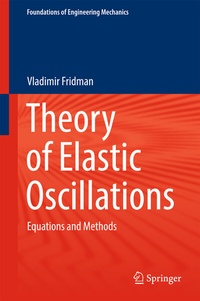
Theory of Elastic Oscillations
Description

This book presents in detail an alternative approach to solving problems involving both linear and nonlinear oscillations of elastic distributed parameter systems. It includes the so-called variational, projection and iterative gradient methods, which, when applied to nonlinear problems, use the procedure of linearization of the original non-linear equations.
These methods are not universal and require a different solution for each problem or class of problems.However, in many cases the combination of the methods shown in this book leads to more efficient algorithms for solving important applied problems.To record these algorithms in a unified form, the first part of the book and its appendix devote considerable attention to compiling the general operator equations, which include (as particular cases) equations for vibrations in rods, plates, shells and three-dimensional bodies. They are mainly considered to be periodic or nearly periodic oscillations, which correspond to stat
ionary or nearly stationary regimes of machinery operation. In turn, the second part of the book presents a number of solutions for selected applications.More details
Other editions
Additional editions
Persons
Sviyazheninov Eugene Dmitrievich was born on April 8, 1957 in Leningrad (St.Petersburg), USSR. In 1979 he graduated from the Physics and Mechanics Department of the Leningrad Polytechnic Institute (LPI). In 1985 he received a PhD degree in Engineering, and in 1970 - Doctor of Sciences in Engineering. Since 1979 to 1986 - Research Fellow of LPI. From 1986 through the present time - Leading Scientist at the Institute for Problems in Mechanical Engineering of the Academy of Sciences of the USSR and Russia. In 2001 he worked as a visiting Scientist at Ford Motor Company, Scientific Research Laboratory, Dearborn, USA. Area of scientific interests: research, development and inventory activities in mechanics, machinery, dynamics, vibration, noise, shock, impact, vibroisolation systems, constructions, automotive, electricity, electrodynamics, microwave electronics, acoustics, mechatronics. In total he has published more than 90 articles and has got more than 20 patents for inventions.
Content
Part 1. Equations and Methods: Oscillation Equations of a Rod with Rectilinear Axis.- Vibrations of Three-Dimensional Body, Plate and Ring.- Spectral Theory.- Variational and Projection Methods for Solving the Vibration Theory Equations.- Harmonic Analysis.- Discontinuous Functions. Complicated Boundary Conditions.- Exact Solutions of Equations of Oscillation Theory.- Nonlinear Periodic Oscillations.- Part 2. Some Applied Problems: Determination of Elastic-Damping Characteristics of Slide Bearings.- Vibrations of Shafts, Blades and Disks.- Stability of The Equilibrium Position of Rotating Shaft Axis.- Vibrations of Internal Combustion Engine.
