

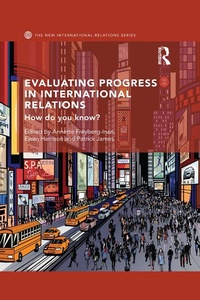
Evaluating Progress in International Relations
How do you know?
Published on 4. October 2016
234 pages
978-1-317-20143-4 (ISBN)
Description

This edited volume offers a systematic evaluation of how knowledge is produced by scholarly research into International Relations. The contributors explore three key questions: To what extent is scientific progress and accumulation of knowledge possible? What are the different accounts of how this process takes place? And what are the dominant critiques of these understandings? It is the first publication to survey the full range of perspectives available for evaluating scientific progress as well as dominant critiques of scientism.
In its second part, the volume applies this range of perspectives to the research program on the democratic peace. It shows what we gain by accommodating and enabling dialogue among the full range of epistemological approaches. The contributors elaborate and defend the epistemological position of sociable pluralism as one that seeks to build bridges between soft positivism, critical theory, and critical realism. The underlying idea is that if the differences between the various approaches used by different communities of researchers can be understood more clearly, this will facilitate meaningful cross-cutting communication, dialogue, and debate and thereby enable us to address real-world problems more effectively.
This timely and original work will be of great interest to advanced-level students and scholars dealing with philosophy of science and methodological questions in International Relations.
In its second part, the volume applies this range of perspectives to the research program on the democratic peace. It shows what we gain by accommodating and enabling dialogue among the full range of epistemological approaches. The contributors elaborate and defend the epistemological position of sociable pluralism as one that seeks to build bridges between soft positivism, critical theory, and critical realism. The underlying idea is that if the differences between the various approaches used by different communities of researchers can be understood more clearly, this will facilitate meaningful cross-cutting communication, dialogue, and debate and thereby enable us to address real-world problems more effectively.
This timely and original work will be of great interest to advanced-level students and scholars dealing with philosophy of science and methodological questions in International Relations.
More details
Series
Language
English
Place of publication
London
United Kingdom
Publishing group
Taylor & Francis Ltd
Target group
College/higher education
Illustrations
7 s/w Tabellen, 3 s/w Photographien bzw. Rasterbilder, 1 s/w Zeichnung
7 Tables, black and white; 1 Line drawings, black and white; 3 Halftones, black and white; 4 Illustrations, black and white
File size
2,90 MB
ISBN-13
978-1-317-20143-4 (9781317201434)
Copyright in bibliographic data and cover images is held by Nielsen Book Services Limited or by the publishers or by their respective licensors: all rights reserved.
Schweitzer Classification
Other editions
Additional editions
Annette Freyberg-Inan | Ewan Harrison | Patrick James
Evaluating Progress in International Relations
How do you know?
Book
08/2020
1st Edition
Routledge
€73.40
Shipment within 15-20 days
Annette Freyberg-Inan | Ewan Harrison | Patrick James
Evaluating Progress in International Relations
How do you know?
Book
10/2016
1st Edition
Routledge
€231.70
Shipment within 10-20 days
Persons
Annette Freyberg-Inan is a lecturer and member of the research program "Political Economy and Transnational Governance" at the Amsterdam Institute for Social Science Research, at the University of Amsterdam, the Netherlands. Among her many publications are the monograph What Moves Man: The Realist Theory of International Relations and Its Judgment of Human Nature (2004) and the edited volume Human Beings in IR Theory (2015). She is co-editor of the Journal of International Relations and Development, a former Vice President of the International Studies Association and the Vice Chair of its Theory Section.
Ewan Harrison is Assistant Professor in Political Science at Rutgers University, USA. He is author of The Post-Cold War International System: Strategies, Institutions and Reflexivity (2004), co-author of The Triumph of Democracy and the Eclipse of the West (2014). He has published in Journal of Peace Research, Review of International Studies, International Studies Review, International Affairs and International Politics.
Patrick James is Dornsife Dean's Professor in the School of International Relations at the University of Southern California, USA. James is the author or editor of 23 books. He served previously as president of the International Council for Canadian Studies, Vice President of the International Studies Association and editor of International Studies Quarterly.
Ewan Harrison is Assistant Professor in Political Science at Rutgers University, USA. He is author of The Post-Cold War International System: Strategies, Institutions and Reflexivity (2004), co-author of The Triumph of Democracy and the Eclipse of the West (2014). He has published in Journal of Peace Research, Review of International Studies, International Studies Review, International Affairs and International Politics.
Patrick James is Dornsife Dean's Professor in the School of International Relations at the University of Southern California, USA. James is the author or editor of 23 books. He served previously as president of the International Council for Canadian Studies, Vice President of the International Studies Association and editor of International Studies Quarterly.
Content
Preface
Introduction : Progress, Consensus and Cumulation in IR Scholarship?
[Ewan Harrison, Annette Freyberg-Inan, and Patrick James]
Part I: Judging Progress in the Study of International Relations
Chapter 1 - The Bias of 'Science': On the Intellectual Appeal of Neopositivism
[Patrick Thaddeus Jackson]
Chapter 2 - Maps, Models and Theories: A Scientific Realist Approach to Validity
[Colin Wight]
Chapter 3 - Substance, Form and Content: Scholarly Communities, Institutions and the Nature of IR
[Torbjorn L. Knutsen]
Chapter 4 - The Role of Theory for Knowledge Creation in IR: A Sociable Pluralist Discussion
[Annette Freyberg-Inan]
Part II: Evaluating Progress in Democratic Peace Research - An Illustrative Case Study
Chapter 5 - Bounded Pluralism and Explanatory Progress in International Relations: What We Can Learn from the Democratic Peace Debate?
[Fred Chernoff]
Chapter 6 - Systemism, Analytic Eclecticism and the Democratic Peace
[Jarrod Hayes and Patrick James]
Chapter 7 - Rethinking the Democratic Peace: Competing Accounts of 'Scientific Progress' in IR
[Ewan Harrison]
Chapter 8 - The Normative Within the Explanatory: A Critical Take at the Democratic Peace Literature
[Piki Ish-Shalom]
Chapter 9 - The Closer You Look, the Less You See: Knowledge Cumulation in IR
[Laura Sjoberg]
Conclusion - Different Standards for Discovery and Confirmation
[Annette Freyberg-Inan, Ewan Harrison, and Patrick James]
Introduction : Progress, Consensus and Cumulation in IR Scholarship?
[Ewan Harrison, Annette Freyberg-Inan, and Patrick James]
Part I: Judging Progress in the Study of International Relations
Chapter 1 - The Bias of 'Science': On the Intellectual Appeal of Neopositivism
[Patrick Thaddeus Jackson]
Chapter 2 - Maps, Models and Theories: A Scientific Realist Approach to Validity
[Colin Wight]
Chapter 3 - Substance, Form and Content: Scholarly Communities, Institutions and the Nature of IR
[Torbjorn L. Knutsen]
Chapter 4 - The Role of Theory for Knowledge Creation in IR: A Sociable Pluralist Discussion
[Annette Freyberg-Inan]
Part II: Evaluating Progress in Democratic Peace Research - An Illustrative Case Study
Chapter 5 - Bounded Pluralism and Explanatory Progress in International Relations: What We Can Learn from the Democratic Peace Debate?
[Fred Chernoff]
Chapter 6 - Systemism, Analytic Eclecticism and the Democratic Peace
[Jarrod Hayes and Patrick James]
Chapter 7 - Rethinking the Democratic Peace: Competing Accounts of 'Scientific Progress' in IR
[Ewan Harrison]
Chapter 8 - The Normative Within the Explanatory: A Critical Take at the Democratic Peace Literature
[Piki Ish-Shalom]
Chapter 9 - The Closer You Look, the Less You See: Knowledge Cumulation in IR
[Laura Sjoberg]
Conclusion - Different Standards for Discovery and Confirmation
[Annette Freyberg-Inan, Ewan Harrison, and Patrick James]
