

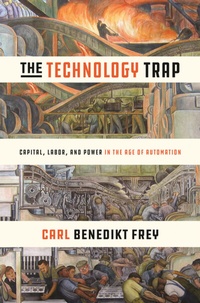
The Technology Trap
Capital, Labor, and Power in the Age of Automation
1st Edition
Published on 20. May 2019
480 pages
978-0-691-19195-9 (ISBN)
Description

"Made me look at the industrial revolution, invention, sleeping beauties, contexts and the forces that shape our societies differently."-David Byrne, New York Times Book Review
How the history of technological revolutions can help us better understand economic and political polarization in the age of automation
From the Industrial Revolution to the age of artificial intelligence, The Technology Trap takes a sweeping look at the history of technological progress and how it has radically shifted the distribution of economic and political power among society's members. As Carl Benedikt Frey shows, the Industrial Revolution created unprecedented wealth and prosperity over the long run, but the immediate consequences of mechanization were devastating for large swaths of the population. Middle-income jobs withered, wages stagnated, the labor share of income fell, profits surged, and economic inequality skyrocketed. These trends, Frey documents, broadly mirror those in our current age of automation, which began with the Computer Revolution.
Just as the Industrial Revolution eventually brought about extraordinary benefits for society, artificial intelligence systems have the potential to do the same. But Frey argues that this depends on how the short term is managed. In the nineteenth century, workers violently expressed their concerns over machines taking their jobs. The Luddite uprisings joined a long wave of machinery riots that swept across Europe and China. Today's despairing middle class has not resorted to physical force, but their frustration has led to rising populism and the increasing fragmentation of society. As middle-class jobs continue to come under pressure, there's no assurance that positive attitudes to technology will persist.
The Industrial Revolution was a defining moment in history, but few grasped its enormous consequences at the time. The Technology Trap demonstrates that in the midst of another technological revolution, the lessons of the past can help us to more effectively face the present.
How the history of technological revolutions can help us better understand economic and political polarization in the age of automation
From the Industrial Revolution to the age of artificial intelligence, The Technology Trap takes a sweeping look at the history of technological progress and how it has radically shifted the distribution of economic and political power among society's members. As Carl Benedikt Frey shows, the Industrial Revolution created unprecedented wealth and prosperity over the long run, but the immediate consequences of mechanization were devastating for large swaths of the population. Middle-income jobs withered, wages stagnated, the labor share of income fell, profits surged, and economic inequality skyrocketed. These trends, Frey documents, broadly mirror those in our current age of automation, which began with the Computer Revolution.
Just as the Industrial Revolution eventually brought about extraordinary benefits for society, artificial intelligence systems have the potential to do the same. But Frey argues that this depends on how the short term is managed. In the nineteenth century, workers violently expressed their concerns over machines taking their jobs. The Luddite uprisings joined a long wave of machinery riots that swept across Europe and China. Today's despairing middle class has not resorted to physical force, but their frustration has led to rising populism and the increasing fragmentation of society. As middle-class jobs continue to come under pressure, there's no assurance that positive attitudes to technology will persist.
The Industrial Revolution was a defining moment in history, but few grasped its enormous consequences at the time. The Technology Trap demonstrates that in the midst of another technological revolution, the lessons of the past can help us to more effectively face the present.
All prices
More details
Other editions
Additional editions
Book
06/2019
Princeton University Press
€31.50
Shipment within 10-20 days
Person
Carl Benedikt Frey is the Oxford Martin Citi Fellow and codirector of the Oxford Martin Programme on Technology and Employment at the Oxford Martin School, University of Oxford. He is also a senior fellow at the Institute for New Economic Thinking at Oxford and in the Department of Economic History at Lund University. Twitter @carlbfrey
Content
- Cover
- Contents
- Preface
- Introduction
- Part I. The Great Stagnation
- 1. A Brief History of Preindustrial Progress
- 2. Preindustrial Prosperity
- 3. Why Mechanization Failed
- Part II. The Great Divergence
- 4. The Factory Arrives
- 5. The Industrial Revolution and Its Discontents
- Part III. The Great Leveling
- 6. From Mass Production to Mass Flourishing
- 7. The Return of the Machinery Question
- 8. The Triumph of the Middle Class
- Part IV. The Great Reversal
- 9. The Descent of the Middle Class
- 10. Forging Ahead, Drifting Apart
- 11. The Politics of Polarization
- Part V. The Future
- 12. Artificial Intelligence
- 13. The Road to Riches
- Acknowledgments
- Appendix
- Notes
- Bibliography
- Index

