

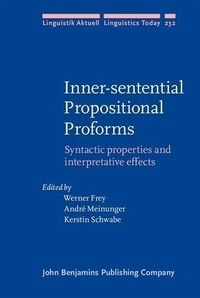
Inner-sentential Propositional Proforms
Syntactic properties and interpretative effects
1st Edition
Published on 26. July 2016
284 pages
978-90-272-6694-1 (ISBN)
Description

This book deals with sentential proforms and their relationship to their associated clauses. Sentential proforms are highly interesting from the point of view of grammatical theory, since their occurrence is determined not only by syntax, but also by prosody and semantics. The present volume contributes to a better understanding of the interfaces between these different levels. By providing syntactic, prosodic, semantic, psycholinguistic and corpus-based support, this book underpins the claim that there exist different sentential proform types in German and Dutch, that these proform types correlate with different verb classes, and that their associated related clauses are located in different syntactic positions. The present volume also looks at a Hungarian sentential proform construction, which is similar to the German(ic) structure, but, at the same time, is different in its licensing conditions.
More details
Other editions
Additional editions
Werner Frey | Andre Meinunger | Kerstin Schwabe
Inner-sentential Propositional Proforms
Syntactic properties and interpretative effects
Book
07/2016
John Benjamins Publishing Co
€123.30
Shipment within 10-15 days
Content
- Intro
- Inner-sentential Propositional Proforms
- Editorial page
- Title page
- LCC data
- Table of contents
- Sentential proforms
- 1. The outset
- 2. Recent approaches to sentential proforms and relating clauses
- 2.1 Es-proforms
- 2.1.1 Hybrid approaches
- 2.1.2 Uniform approaches
- 2.1.3 Relationship between es-items and relating clauses
- 2.2 Prepositional correlates (ProPPs)
- 2.2.1 Hybrid approaches
- 2.2.2 Uniform approaches
- 2.2.3 Relationship between ProPPs and relating clauses
- 3. Longstanding questions and new contributions
- 3.1 Correlates and pro-forms
- 3.2 Complex DP- and PP-shells and the position of the related clause
- 3.3 Missing sentential proforms
- 3.4 Influence of sentential proforms on the sentence meaning
- 3.5 Difference between es- and das-proforms
- 3.6 Proforms and corresponding complex nouns
- 3.7 Lexical entries for sentential proforms
- 3.8 Crosslinguistic variation
- 4. The chapters
- 4.1 Theoretical and empirical arguments in favor of the hybrid approach
- 4.2 Special topics of proform constructions
- References
- Correlates of object clauses in German and Dutch
- 1. Introduction
- 2. Correlate-es in German
- 3. Correlate-es as an expletive?
- 4. Syntactic properties of correlate-es
- 5. Types of matrix verbs
- 6. Information structure
- 7. Dutch
- 8. Summary and open questions
- References
- Correlative es vs. das in German
- 1. Introduction
- 2. The correlative elements es/das in constructions with argument clauses
- 2.1 Grammatical differences between es and das
- 2.2 Verb-class dependency
- 3. Experimental evidence for the distinction between placeholders and pro-forms
- 3.1 Acceptability ratings of es vs. das (Experiment 1)
- 3.1.1 Material
- 3.1.2 Procedure
- 3.1.3 Participants
- 3.1.4 Results and discussion
- 3.2 Es vs. das in a self-paced reading study (Experiment 2)
- 3.2.1 Material
- 3.2.2 Procedure
- 3.2.3 Participants
- 3.2.4 Results and discussion
- 4. The distinction between placeholder-es- and non-placeholder-es-taking verbs: Combining corpus and experimental evidence
- 4.1 Corpus study
- 4.1.1 Procedure
- 4.1.2 Results and discussion
- 4.2 An acceptability rating experiment on the verb-class-dependent use of placeholder es vs. anaphoric es (Experiment 3)
- 4.2.1 Material and procedure
- 4.2.2 Participants
- 4.2.3 Results and discussion
- 5. Summary
- References
- Appendix
- On properties differentiating constructions with inner-sentential pro-forms for clauses
- 1. Various constructions with an inner-sentential clausal pro-form
- 2. The construction of the bedauern-class
- 3. The construction of the behaupten-class
- 4. The constructions with a prepositional adverb
- 5. The construction of the überraschen-class
- 6. Overview of the observed characteristics of the five constructions
- 7. The possibility of root phenomena in the dependent clause
- 8. Summary
- References
- Some distinctions in the right periphery of the German clause*
- 0. Introduction
- 1. A prosodic distinction between extraposition and right dislocation
- 1.1 Default stress in German
- 1.2 The prosodic effects of focus and of givenness
- 1.3 A prosodic distinction between extraposition and right dislocation/afterthought
- 1.4 An information structure distinction between extraposition and right dislocation/afterthought
- 2. On the prosody of correlate constructions in German
- 2.1 PPs with da-
- 2.2 Right dislocation of clauses
- 2.3 Genuine correlates
- 2.4 Coindexed subject expletives
- 3. Analysis of the distinctions in prosody and information structure between extraposition, right dislocation, and afterthought
- 3.1 A deletion account of right dislocation and afterthought
- 3.2 Root sentences, sentence stress, and focus
- 3.3 Analysis of extraposition, RD, and AT
- 3.4 On the interaction of stress-assignment and deletion in RD and AT
- 4. Summary
- References
- Phonological, morphosyntactic and semantic properties of es
- 1. Introduction
- 2. Basic assumptions
- 3. Lexical entries
- 3.1 Positional es
- 3.2 Quasi-argument es
- 3.3 "Anaphoric" pronouns and pro-forms es, dessen, dem, das, da(r)
- Anchor 91
- 3.4 The related item of anaphoric pronouns and pro-forms
- 3.5 The correlate es and its suppletive forms
- 4. Right dislocation vs. extraposition
- 5. Matrix-predicate types
- 6. Complex anaphoric and cataphoric DPs
- 7. Concluding remarks
- References
- On the formation of prepositional adverbs in Modern German
- 1. Introduction
- 2. The adverbial basis
- 3. The prepositional bases
- 3.1 'Below a location (static)'
- 3.2 'Below a location (dynamic)'
- 3.3 'Below a degree (static)'
- 3.4 'Below a degree (dynamic)'
- 3.5 'Identifiable by a linguistic or conceptual unit (static)'
- 3.6 'Identifiable by a linguistic or conceptual unit (dynamic)'
- 3.7 'Under a location (static)'
- 3.8 'Under a location (dynamic)'
- 3.9 'Caused by a burdening state of affairs'
- 3.10 'Among a multitude (static)'
- 3.11 'Among a multitude (dynamic)'
- 4. The prepositional adverbs
- 4.1 'Below a location there (static)'
- 4.2 'Caused by a burdening state of affairs there'
- 4.3 'Among a multitude there (static)'
- 5. Results
- References
- List of sources
- Sentential proforms and argument conditionals
- 1. Introduction
- 2. Syntactic remarks on proforms and argument wenn-clauses
- 2.1 Construction types
- 2.2 Adverbial approach or complement approach
- 2.2.1 Pre-sentential argument wenn-clauses
- 2.2.2 Post-sentential argument wenn-clauses
- 2.2.3 Question-answer pairs and argument wenn-clauses
- 2.3 Proforms of pre- and post-sentential wenn-clauses
- 3. Syntactic structure of constructions with argument wenn-clauses
- 3.1 Pre-sentential argument wenn-clauses
- 3.2 Post-sentential argument wenn-clauses
- 3.3 Missing proforms
- 4. Conclusion
- References
- Rethinking clausal asymmetries
- 1. Introduction
- 2. The data: Propositional pronoun insertion in Hungarian
- 3. The syntax of pronoun insertion
- 3.1 The EF-analysis: The role of SpecCP
- 4. On the notion of predicationality
- 4.1 Predication vs. assertion
- 4.2 Predicational vs. non-predicational complements
- 5. The Predicationality Hypothesis
- 5.1 Pronoun insertion and predicationality
- 5.2 Summary
- 6. Information-structural consequences
- 6.1 Propositional (cataphoric) pronoun - Focusing
- 6.2 Propositional (anaphoric) pronoun - Backgrounding
- 6.3 Summary
- 7. Supporting evidence
- 7.1 Wh-expletives - Asymmetry
- 7.2 Extraction data - No asymmetry
- 8. Concluding remarks
- References
- Name Index
- Subject Index
