

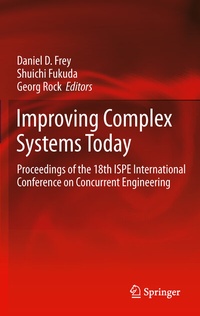
Improving Complex Systems Today
Description

As the main theme of Improving Complex Systems Today implies, this book is intended to provide readers with a new perspective on concurrent engineering from the standpoint of systems engineering. It can serve as a versatile tool to help readers to navigate the ever-changing state of this particular field.
The primary focus of concurrent engineering was, at first, on bringing downstream information as far upstream as possible by introducing parallel processing in order to reduce time to market and to prevent errors at a later stage which would sometimes cause irrevocable damage. Up to now, numerous new concepts, methodologies and tools have been developed, but over concurrent engineering's 20-year history the situation has changed extensively. Now, industry has to work in the global marketplace and to cope with diversifying requirements and increasing complexities. Such globalization and diversification necessitate collaboration across different fields and across national boundaries. Thus, the new concurrent engineering calls for a systems approach to gain global market competitiveness. Improving Complex Systems Today provides a new insight into concurrent engineering today.
More details
Other editions
Additional editions
Persons
Daniel Frey is an associate professor of mechanical engineering and engineering systems at MIT and he is a leading researcher of design theory and methodology, especially in the field of quality technology and robust design. He has had extensive consulting experience with many industries. Therefore, he has a very good sense of proportion between theory and practice, and he received the Junior Bose Award for Excellence in Teaching at MIT. Thus, he is not only conducting cutting-edge research, but he is also very good at making materials comprehensible. He is now co-director of the MIT-Singapore University of Technology and Design Alliance and is making efforts to establish a new direction in research and education in design engineering.
Shuichi Fukuda held a workshop titled "Computer aided Cooperative Product Development" at MIT with Ram Sriram in 1989, at the same time as DARPA started their concurrent engineering "DICE" project. Thus, he is one of the pioneers in this field. He published the outcomes of this workshop with Ram Sriram and Robert Logcher as Lecture Note No.437 from Springer in 1991. He worked for a long time as an executive board member of the Engineering Information Management Systems group, ASME. He is now Chair of the Computers and Information in Engineering Division, ASME, which developed from this group. In addition, he served as Vice President at the IEEE Reliability Society, so his activities extend over wide areas. He is President of ISPE, which hosts the International Conference on Concurrent Engineering.
