

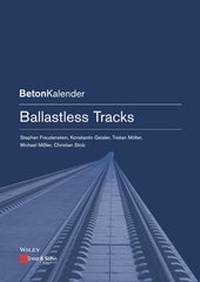
Ballastless Tracks
Description

Following the first trials in the 1970s and more than four decades of R&D work on ballastless track, the level of development is such that it can be confirmed that ballastless track is suitable for use as an alternative to ballasted track. This book makes a contribution to the state of the art of ballastless track by describing the basics for designing the ballastless track. Important advice is provided regarding the construction of ballastless track on earthworks and in tunnels. There is also a description of the technical history of the development of ballastless track on bridges and the ensuing findings for bridge design. The state of the art of ballastless track for switches, important information on details concerning drainage, transitions, accessibility for road vehicles and experience gleaned from maintenance round off the work.
Selected chapters from the German concrete yearbook are now being published in the new English "Beton-Kalender Series" for the benefit of an international audience.
Since it was founded in 1906, the Ernst & Sohn "Beton-Kalender" has been supporting developments in reinforced and prestressed concrete. The aim was to publish a yearbook to reflect progress in "ferro-concrete" structures until - as the book's first editor, Fritz von Emperger (1862-1942), expressed it - the "tempestuous development" in this form of construction came to an end. However, the "Beton-Kalender" quickly became the chosen work of reference for civil and structural engineers, and apart from the years 1945-1950 has been published annually ever since.
More details
Other editions
Additional editions
Persons
Univ.-Prof. Dr.-Ing. Stephan Freudenstein has been a full professor at the Chair and Institute of Road, Railway and Airfield Construction at the Technical University of Munich and director of the test institute of the same name in Pasing, Munich, since 2008. After graduating in civil engineering at TU Munich in 1995 and working at Heilit + Woerner Bau AG, Stephan Freudenstein became a research associate at TU Munich's Chair and Institute of Road, Railway and Airfield Construction in 1997. In 2002 he joined Pfleiderer Infrastrukturtechnik GmbH, now known as RAILONE GmbH, in Neumarkt in der Oberpfalz, Germany. While there, he headed up the technology and development department. He was responsible for prestressed concrete sleepers and the technical side of various ballastless track projects in Germany and farther afield. The main focus of Prof. Freudenstein's research is the structural design of road and rail superstructure systems and aviation surfaces. He is a member of numerous German and European technical standard committees and committees of independent experts.
Dr.-Ing. Konstantin Geisler graduated in civil engineering at TU Munich in 2010. He was awarded his doctorate by that university in 2016 and now works in academic research at TU Munich's Chair and Institute of Road, Railway and Airfield Construction.
Dipl.-Ing. Tristan Mölter studied civil engineering at TU Darmstadt. Since 1999 he has been responsible for noise control, bridge equipment and provisional bridges at the technology and plant management department of Deutsche Bahn DB Netz AG in Munich. He is the chair of the structural engineering commission (FA KIB) at VDEI (association of German railway engineers) and a member of numerous German and European technical standard committees and committees of independent experts.
Dipl.-Ing. Michael Mißler studied civil engineering at TU Darmstadt. As a team leader and project manager he is responsible for the ballastless track technique and track stability at the track technology management dept. of Deutsche Bahn DB Netz AG in Frankfurt on the Main, Germany. He has pushed on the development of ballastless track for Deutsche Bahn since 1999. In the context of his central technical responsibility he is a member of numerous German and European technical standard committees and committees of independent experts.
Dipl.-Ing. Christian Stolz studied civil engineering at Cologne's University of Applied Sciences. Since 2010 he has been responsible for ballastless track engineering in the track technology management department of Deutsche Bahn DB Netz AG in Frankfurt/Main, Germany. He is a member of numerous German and European technical standard committees, e.g. DIN Standards Committee Railway NA 087-00-01 AA "Infrastructure", DIN subcommittee "Ballastless track" and CEN TC 256/SC 1/WG 46 "Ballastless Track".
Content
1.1 Introductory words and definition
1.2 Comparison between ballasted track and ballastless track
1.3 Basic ballastless track types in Germany - the state of the art
1.3.1 Developments in Germany
1.3.2 Sleeper framework on continuously reinforced slab
1.3.3 Continuously reinforced slab with discrete rail seats
1.3.4 Precast concrete slabs
1.3.5 Special systems for tunnels and bridges
1.3.6 Further developments
1.3.7 Conclusion
1.4 Ballastless track systems and developments in other countries (examples)
2 Design
2.1 Basic principles
2.1.1 Regulations
2.1.2 Basic loading assumptions
2.2 Material parameters - assumptions
2.2.1 Subsoil
2.2.2 Unbound base layer
2.2.3 Base layer with hydraulic binder
2.2.4 Slab
2.3 Calculations
2.3.1 General
2.3.2 Calculating the individual rail seat loads
2.3.3 Calculating bending stresses in a system with continuously supported track panel
2.3.4 System with individual rail seats
2.3.5 Example calculation
2.4 Further considerations
2.4.1 Intermediate layers
2.4.2 Temperature effects
2.4.3 Finite element method (FEM)
3 Developing a ballastless track
3.1 General
3.2 Laboratory tests
3.2.1 Rail fastening test
3.2.2 Testing elastic components
3.2.3 Tests on tension clamps
3.3 Lateral forces analysis
4 Ballastless track on bridges
4.1 Introduction and history
4.1.1 Requirements for ballastless track on bridges
4.1.2 System-finding
4.1.2.1 Geometric restraints
4.1.2.2 Acoustics
4.1.2.3 Design
4.1.3 System trials and implications for later installation
4.1.4 Measurements during system trials
4.1.5 Regulations and planning guidance for laying ballastless track on bridges
4.1.6 The Cologne-Rhine/Main and Nuremberg?Ingolstadt lines
4.1.7 VDE 8 - new forms of bridge construction
4.2 Systems for ballastless track on bridges
4.2.1 The principle behind ballastless track on long bridges
4.2.2 Ballastless track components on long bridges
4.2.3 Ballastless track on short bridges
4.2.4 Ballastless track on long bridges
4.2.5 The bridge areas of ballastless tracks
4.2.6 End anchorage
4.3 The challenging transition zone
4.3.1 General
4.3.2 The upper and lower system superstructure way and bridge
4.3.4 General actions and deformations at bridge ends
4.3.5 Summary of actions
4.3.6 Supplementary provisions for ballastless track on bridges and analyses
4.3.7 Measures for complying with limit values
4.3.8 Summary, consequences and outlook
5 Selected topics
5.1 Additional maintenance requirements to be considered in the design
5.2 Switches in ballastless track in the Deutsche Bahn network
5.3 Ballastless track maintenance
5.4 Inspections
5.4.1 General
5.4.2 Cracking and open joints
5.4.3 Anchors for fixing sleepers
5.4.4 Loosening of sleepers
5.4.5 Additional inspections
5.5 Ballastless track repairs
5.5.1 Real examples of repairs
5.5.2 Renewing rail seats
5.5.3 Repairing anchor bolts
5.5.4 Dealing with settlement
5.5.5 Defective sound absorption elements
5.6 Drainage
5.6.1 General
5.6.2 Draining surface water
5.6.3 Drainage between tracks
5.6.4 Strip between tracks
5.6.5 Cover to sides of ballastless track
5.7 Transitions
5.7.1 General
5.7.2 Transitions in substructure and superstructure
5.7.3 Welding and insulated rail joints
5.7.4 Transitions between bridges/tunnels and earthworks
5.7.5 Transitions between ballastless and ballasted track
5.7.6 Transitions between different type of ballastless track
5.8 Accessibility for road vehicles
5.8.1 General
5.8.2 Designing for road vehicles
5.8.3 Designing for road vehicle loads
5.9 Sound absorption elements
5.9.1 General
5.9.2 Construction and acoustic requirements
5.9.3 Special requirements for materials and construction
References
1
Introduction and State of the Art
1.1 Introductory Words and Definition
Following the first trials in the 1970s and more than four decades of R&D work on ballastless track, the level of development is such that it can be confirmed that ballastless track is suitable for use as an alternative to ballasted track. This book is based on the principles of Eisenmann and Leykauf, which were published in Beton-Kalender 2000, and makes a contribution to the state of the art of ballastless track by describing the basics for designing the slab.
A concrete ballastless track is a non-ballasted form of superstructure in which the loadbase function of the ballast is performed by a layer of concrete. Besides the aim of a longest possible service life and at the same time low maintenance requirements, the superstructure should be founded protected against the effects of frost and supported such that deformations are essentially ruled out.
1.2 Comparison Between Ballasted Track and Ballastless Track
One of the advantages of a ballastless track compared with ballasted track is that maintenance requirements are minimized. With ballasted track, tamping and lining works at regular intervals are essential. The critical frequency range for increased wear of the ballast forming the track bed begins at about 30 Hz. This excitation frequency is reached at a speed of about 270 km/h with a bogie wheelbase of 2.50 m and an otherwise ideal wheel-rail contact. However, in addition to train speeds, there are other factors that have an influence on the frequency, e.g. wheel defects or defects in the rail running surface. As train speeds increase, so the ensuing frequencies, with increasing amplitudes and higher dynamic loads, result in the need for shorter intervals between ballast maintenance works [1-3].
Another factor affecting loads on the superstructure is the stiffness; as the stiffness of a track system increases, so do the loads on the ballast. In particular, bridges and tunnels, of which there are numerous examples on new and upgraded lines, lead to a higher system stiffness owing to the hard subsoil (bridge superstructure, tunnel invert) and so the loads on the ballast are very pronounced. The long-term behaviour of the ballast can be improved through suitable measures, e.g. the use of sleepers with enlarged bearing surfaces, elastic or highly elastic rail fastening systems, under-sleeper pads or under-ballast mats [3]. Experience shows that with train speeds exceeding 250 km/h, ballasted track already requires maintenance after about 100 million tonnes of load has passed over it. With 100 high-speed trains per day in each direction, that corresponds to a maintenance interval of only a few years. Therefore, Deutsche Bahn AG started specifying ballastless track as the standard form of superstructure for all new lines with train speeds >250 km/h as early as the mid-1990s.
Besides the wear to and redistribution of the ballast during its lifetime, the quality of the position of the track is an important criterion for ballasted track, as the track position steadily worsens over time. The need for tamping and lining work depends on whether defined guide and limit values for track position parameters have been exceeded. Those guide and limit values should guarantee, primarily, stable wheelset running as well as good ride comfort. In contrast to ballasted track, a ballastless track guarantees that the track remains permanently correctly positioned with a defined track elasticity and eliminates the ballast maintenance measures necessary while ensuring a longer service life. A theoretical service life of 60 years for ballastless track is the aim [4].
The first ballastless track pilot project was carried out at Rheda station in 1972 and so Germany already has more than 40 years of experience with this form of construction. It is therefore clear that a service life of 60 years is certainly practical and, consequently, can be assumed.
Despite the long service life, however, it is necessary to guarantee that individual ballastless track components can be removed and renewed.
It can generally be assumed that the cost of a ballastless track installation on a plain track will be higher than that of the initial installation of a ballasted track with subgrade. However, the maintenance costs of the former lie well those of the latter. It is interesting to note that in tunnels on new lines, ballastless track can be laid more economically than ballasted track with an under-ballast mat.
When considering the economics of ballastless track, it is also necessary to take into account that a ballastless track can be laid with tighter alignment parameters. Better cant deficiency and cants can be achieved with a ballastless track than is the case with ballasted track.
Therefore, for high-speed rail lines, a ballastless track can be built with tighter radii and, if required, steeper gradients for the same design speeds. The outcome of that is a significant economic advantage because savings can be made when building large bridges or tunnels. The savings that can be made during the construction, operation and maintenance of just these complex and expensive engineering structures alone can quickly compensate for the extra cost of ballastless track compared with ballasted track. At the same time, it is possible to route lines alongside motorways and thus keep different modes of transport together.
Another advantage of ballastless track is that it avoids ballast being thrown about - a dangerous phenomenon that is caused by suction forces below a train or ice in winter, which can loosen particles. Loose particles can damage the running surface of the rail or other items in the immediate vicinity. Some countries, e.g. South Korea, are therefore starting to cover whole sections of track with elastomeric sheeting in order to overcome the dangers of flying ballast particles. Furthermore, unrestricted use of eddy current brakes on trains is only possible on ballastless track.
Yet another benefit is the lower construction depth while still maintaining the same cross-section. This is especially interesting for sections of track in tunnels. On the one hand, a smaller tunnel cross-section can be chosen for new lines, which in turn saves costs. On the other hand, on existing lines that, for example, are to be electrified, the installation of ballastless track can avoid having to enlarge a tunnel cross-section in some circumstances. This also means it is easily possible to refurbish old tunnels by installing a new lining.
In recent years there were a number of accidents in tunnels and so new and refurbished tunnels now include vehicular access. Vehicles can drive along a suitably modified ballastless track, so the superstructure can be used by emergency vehicles in order to rescue passengers or recover goods following an incident. As the superstructure is already very stable and firmly positioned, most ballastless track systems can be easily modified to incorporate a flat road surface. Providing access for vehicles across ballasted track is extremely awkward and costly, and it must be remembered that such means of access must be removed to enable the necessary tamping and lining work to be carried out and then reinstalled. Therefore, in future, laying ballasted track in tunnels where access is required for road vehicles as well cannot be justified on economic grounds.
A ballastless track has significant advantages when it comes to the environment as well. In contrast to ballasted track, controlling the growth of plants and weeds by chemical or physical means is unnecessary. That reduces the impact on the environment and, from the economics viewpoint, overcomes the need to apply herbicides and pesticides.
Owing to the reduced maintenance requirements, the distances between transfer points can be increased when building a ballastless track compared with ballasted track - even on busy routes. As that saves on switches and the associated signalling, that is another obvious economic advantage.
For trams and light rail systems in towns and cities, grass can be laid in a ballastless track, which besides the visual and ecological aspects, also improves noise control. In addition, the grass strips can be provided with a permeable base layer to avoid creating an impervious surface. For urban areas in particular, and taking into account the greater incidence of heavy rainfall likely in the future, this is a very significant advantage of ballastless track. When it comes to inter-city rail traffic, the benefits of laying grass between the rails are still being investigated in trials.
Despite all the aforementioned advantages of ballastless track, it should not be forgotten that, on the whole, laying a ballastless track involves a higher capital outlay, and the costs of potential renewal, modernization or modifications are much higher than those of ballasted track. Therefore, it is enormously important that a ballastless track installation be well thought out, properly engineered according to acknowledged codes of practice and always accompanied by scientific studies. In particular, the design of a ballastless track should not be carried out exclusively according to economic criteria. Instead, the design must always be backed up by a certain amount of experience.
1.3 Basic Ballastless Track Types in Germany - the State of the Art
There are essentially two types of ballastless track:
- - With discrete rail seats,
- - With continuous support.
There are also several special types of ballastless track, such as...
