

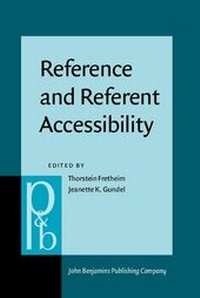
Reference and Referent Accessibility
1st Edition
Published on 26. June 1996
XII, 312 pages
978-90-272-8269-9 (ISBN)
Description

The papers in this volume are concerned with the question of how a speaker's intended referent is interpreted by the addressee. Topics include the interpretation of coreferential vs. disjoint reference, the role of intonation, syntactic form and animacy in reference understanding, and the way in which general principles of utterance interpretation constrain possible interpretations of referring expressions. The collection arises from a workshop on reference and referent accessibility which was held at the 4th International Pragmatics Conference in Kobe, Japan, July 25-30, 1993.
More details
Other editions
Additional editions
Thorstein Fretheim | Jeanette K. Gundel
Reference and Referent Accessibility
Book
06/1996
John Benjamins Publishing Co
€121.90
Shipment within 10-15 days
Persons
Content
- REFERENCE AND REFERENT ACCESSIBILITY
- Editorial page
- Title page
- Copyright page
- Table of contents
- Introduction
- References
- Referring Expressionsand the +/- Coreference Distinction
- 1. On distinguishing between coreference and disjointness
- 2. Wrong predictions concerning coreference and disjointness
- 2.1 Coreference -& Disjointness
- 2.2 Disjointness -& Coreference
- 3. Referring as marking degree of accessibility
- 4. On the non-contrast between coreference and disjointness markingand interpretation
- 4.1 The non-specialization of referring expressions as to +/- coreference
- Notes
- References
- Inferring Identifiability and Accessibility
- 1. Identifiability
- 2. Accessibility
- 3. Two kinds of inference
- References
- Animacy in grammar and discourse
- 1. Introduction
- 2. Animacy and syntactic function
- 2.1. The role of animacy in the grammaticalization of syntactic functions
- 2.2. Corpus data
- 2.2.1. Syntactic function
- 2.2.2. Hierarchical relations between NPs
- 3. Animacy, gender and number
- 4. Animacy and pronominalization
- 4.1. Pronominalization propensity and long-scope pronominalization
- 4.2. 'Identity of sense ' anaphora
- 5. Animacy and semantic roles
- 6. Point of view
- 7. Notes on the animacy hierarchy
- 8. Conclusion
- References
- Cognitive Ontology and NP Form
- 1. Introduction
- 2. Background
- 2.1. Animacy and individuation
- 2.2. First-mention definites and relationality
- 3. A simple cognitive ontology
- 3.1. Individuals, Functionals, and Instances
- 3.2. Identification of referents, relations and types
- 4. Elaborations
- 4.1. Indefinite NPs and Functionals
- 4.2 Inherent properties and temporary perspectives
- 4.3. Degrees of individuation
- 4.4. Proper names and sub-classe s of Individuals
- 5. Conclusion
- Notes
- References
- Accessing Contexts With Intonation
- 1. Introduction
- 2. Intonation and relevance
- 2.1. Topic continuity and discontinuity
- 2.2. East Norwegian intonation
- 3. Accessing explicatures and implicatures with intonation
- 4. Look for the right context to resolve referential ambiguities
- 4.1. 'SI because S2'
- 4.2. 'S1 and S2'
- 4.3 The results of the reference assignment test
- 4.4. Discussion
- 5. Conclusion
- Notes
- References
- Written Discourse Segmentation:The Function of Unstressed Pronouns in Mandarin Chinese
- 1. Introduction
- 2. Discourse segment
- 2.1 Discourse Topic mention as a boundary marker
- 2.2 A propositional view of Discourse Topic
- 3. The function of pronouns in Mandarin
- 4. Conclusions
- References
- Relevance Theory Meets the Givenness Hierarchy An Account of Inferrables
- 1. Introduction
- 2. The GHZ Framework
- 3. Relevance Theory and the Givenness Hierarchy
- 4. Conclusion
- Notes
- References
- On Accessibility and Coreference
- 1. Introduction
- 1.1 The NP Accessibility Hierarchy
- 1.2 The Referential Accessibility Hierarchy
- 1.3 Bringing the two hierarchies together
- 2. The accessibility of antecedents
- 2.1 Anaphoric relations in a selected set of Finnish sentences
- 2.1.1 Subject - Direct Object
- 2.1.2 Subject - Direct Object - 'Indirect object'10
- 2.1.3 Subject - Direct Object - 'Indirect Object' - (Non-allative) Oblique
- 2.1.4 Subject - 'Indirect Object' - Genitive17
- 2.1.5 Subject - Object of Comparison
- 2.2 The balance between the two hierarchies
- 3. Grammatical relations and the choice of referential expressions
- 3.1 Data
- 3.2 Type of anaphor and the grammatical role of the antecedent
- 4. Conclusion
- Notes
- References
- Word Order and Cognitive Status in Mandarin
- 1. Cognitive Status and Referring Forms in English
- 2. Cognitive Status and Referring Forms in Five Languages
- 3. Uniquely Identifiable nèi N
- 4. Activated zhè N
- Notes
- References
- The 'O Price Tag' on Knowledge Activation in Discourse Processing
- 1. Introduction
- 2. How inferred is an inferrable?
- 3. The 'cost' of knowledge activation in discourse processing theories
- 3.1. Propositional theories
- 3.2. Model-based theories
- 4. What constitutes a discourse inference?
- 4.1. Explicit and implicit inferences
- 4.2. Implicit inferences and spreading activation
- 5. Methodological problems
- 5.1. How do we decide between explicit and implicit inferences?
- 5.2. How do we differ between implicit inferences and spreading activation?
- 5.3. Are inferences always full-blown?
- 6. Conclusion
- Notes
- References
- Generic Sentences Are Topic Constructions
- Notes
- References
- Prosodic Cues to Accessibility
- 1. Noun phrases representing new referents
- 2. Noun phrases representing accessible referents
- 3. Noun phrases representing given referents
- 4. Conclusion
- References
- The Game of the Name
- 1. Introduction
- 2. The Givenness Hierarchy
- 3. Full Names
- 4. Single names
- 5. The distribution and selection of names
- 5.1. Distribution
- 5.2. Selection
- 6. Conclusion
- Notes
- References
- The Interpretation of Empty Pronouns in Vietnamese
- 1. Introduction
- 2. Relational givenness
- 3. Interpreting empty pronouns
- 4. Conclusion
- References
- The Effect of Genre on Referential Choice
- 1. Introduction
- 2. Background
- 3. Methodology
- 3.1 Data Selection
- 3.2 Accessibility
- 3.3 Statistical Tests
- 4. Results and discussion
- 4.1. Results
- 4.2 Problematical areas
- 4.2.1 Low Accessibility Markers
- 4.2.2 High Accessibility Markers
- 5. Conclusion
- Notes
- References
- A Bilateral Approach to Givenness: A Hearer-Status Algorithm and a Centering Algorithm
- 0. Introduction
- 1. Hearer-status
- 2. Discourse-status: Centering Algorithm
- 2.1. Centering Rules and Constraints
- 2.2. Ranking of the Forward-looking centers
- 2.3. Centering Algorithm
- 3. Centering Algorithm in natural discourse
- 4. Conclusion
- Notes
- References
- Index of Subjects
- Index of Names
