

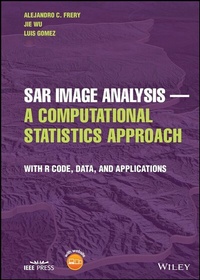
SAR Image Analysis - A Computational Statistics Approach
Description

Discover how to use statistics to extract information from SAR imagery
In SAR Image Analysis -- A Computational Statistics Approach, an accomplished team of researchers delivers a practical exploration of how to use statistics to extract information from SAR imagery. The authors discuss various models, supply sample data and code, and explain theoretical aspects of SAR image analysis that are highly relevant to practitioners and students.
The book offers the theoretical properties of models, estimators, interpretation, data visualization, and advanced techniques, along with the data and code samples, that students require to learn effectively and efficiently.
SAR Image Analysis -- A Computational Statistics Approach provides various exercises throughout the book to help readers reinforce and retain the extensive information on parameter estimation, applications, reproducibility, replicability, and advanced topics, like robust estimators and stochastic distances, contained within.
The book also includes:
* Thorough introductions to data acquisition and the elements of data analysis and image processing with R, including useful R packages, preprocessing SAR data, and visualization
* Comprehensive explorations of intensity SAR data and the multiplicative model, including the (SAR) gamma distribution, the K distribution, the G° distribution, and more general distributions under the multiplicative model
* Practical discussions of parameter estimations, including the Bernoulli distribution, the negative binomial distribution, and the uniform distribution
* In-depth examinations of applications, including statistical filters and classification
Perfect for undergraduate and graduate students studying remote sensing, data analysis, and statistics, SAR Image Analysis -- A Computational Statistics Approach is also an indispensable resource for researchers, practitioners, and professionals seeking a one-stop resource on how to use statistics to extract information from SAR imagery.
More details
Other editions
Additional editions
Persons
Alejandro C. Frery, PhD, is Professor of Statistics and Data Science at the School of Mathematics and Statistics at Victoria University at Wellington, New Zealand. He earned his doctorate in Applied Computing at the National Institute for Space Research in Brazil.
Jie Wu, PhD, is Associate Professor at the School of Computer Science, Shaanxi Normal University, China. He received his doctorate in Computer Science and Technology from Xidian University in China.
Luis Gomez, PhD, is Associate Professor at the School of Telecommunications and Electronics Engineering, University of Las Palmas de Gran Canaria, Spain. He received his doctorate in Telecommunication Engineering from the Universidad de Las Palmas de Gran Canaria.
Content
Foreword xiii
Preface xvii
Acknowledgments xxvii
Acronyms xxxi
Introduction xxxiii
I.1 SAR xxxiii
I.2 Statistics for SAR xxxiv
I.3 The Book xxxv
I.4 Commitment to Reproducibility and Replicability xxxix
1 Data Acquisition 1
1.1 Introduction 1
1.2 SAR 3
1.2.1 The radar 4
1.2.2 What is SAR? 6
1.2.3 SAR systems 10
1.2.4 The synthetic antenna 16
1.3 Spatial resolution 20
1.4 SAR Imaging Techniques 23
1.5 The Return Signal: backscatter and speckle 28
1.5.1 Backscatter 28
1.5.2 Speckle 31
1.5.3 SAR geometric distortions 39
1.6 SAR Satellites 44
1.7 Preprocessing SAR data 53
1.8 Copernicus Open Access Hub 53
1.9 NASA Earth Data Open Data 56
1.10 Actual SAR Data Examples 57
1.10.1 Hawaii's Big Island 57
1.10.2 Other examples 60
Exercises 60
2 Elements of Data Analysis and Image Processing with R 73
2.1 Useful R Packages 73
2.1.1 Data loading 74
2.1.2 Data manipulation 76
2.2 Descriptive Statistics 78
2.2.1 Center tendency of data 78
2.2.2 Dispersion of data 81
2.2.3 Shape of data 84
2.3 Visualization 86
2.3.1 Rug and box plots 87
2.3.2 Histogram 88
2.3.3 Scattering Diagram 92
2.4 Statistics and Image Processing 94
2.4.1 Histogram based Image Transformation 94
2.4.2 Scattering based Analysis 98
2.5 The imagematrix package 101
3 Intensity SAR Data and the Multiplicative Model 105
3.1 The K distribution 115
3.2 The G0 distribution 117
3.3 The GH distribution 121
3.4 Connection between Models 122
Exercises 123
4 Parameter Estimation 127
4.1 Models 128
4.1.1 The Bernoulli distribution 128
4.1.2 The Binomial distribution 128
4.1.3 The Negative Binomial distribution 129
4.1.4 The Uniform distribution 129
4.1.5 Beta distribution 130
4.1.6 The Gaussian distribution 131
4.1.7 Mixture of Gaussian distributions 131
4.1.8 The (SAR) Gamma distribution 132
4.1.9 The Reciprocal Gamma distribution 132
4.1.10 The G0I distribution 133
4.2 Inference by analogy 134
4.2.1 The Uniform distribution 134
4.2.2 The Gaussian distribution 135
4.2.3 Mixture of Gaussian distributions 135
4.2.4 The (SAR) Gamma distribution 136
4.3 Inference by maximum likelihood 136
4.3.1 The Uniform distribution 137
4.3.2 The Gaussian distribution 137
4.3.3 Mixture of Gaussian distributions 138
4.3.4 The (SAR) Gamma distribution 139
4.3.5 The G0 distribution 140
4.4 Analogy vs. Maximum Likelihood 141
4.5 Improvement by bootstrap 142
4.6 Comparison of estimators 143
4.7 An example 144
4.8 The same example, revisited 150
4.9 Another example 152
Exercises 157
5 Applications 159
5.1 Statistical filters: Mean, Median, Lee 160
5.1.1 Mean filter 160
5.1.2 Median filter 164
5.1.3 Lee filter 167
5.2 Advanced filters: MAP and Nonlocal Means 175
5.2.1 MAP Filters 175
5.2.2 Nonlocal Means Filter 177
5.2.3 Statistical NLM filters 183
5.2.4 The statistical test 189
5.3 Implementation Details 191
5.4 Results 193
5.5 Classification 198
5.5.1 The image space of the SAR data 205
5.5.2 The feature space 207
5.5.3 Similarity criterion 210
5.6 Supervised Image Classification of SAR Data 212
5.6.1 The nearest neighbor classifier 214
5.6.2 The K-nn method 219
5.7 Maximum Likelihood Classifier 223
5.8 Unsupervised Image Classification of SAR Data: The K-means classifier 232
5.9 Assessment of Classification Results 236
Exercises 242
6 Advanced Topics 249
6.1 Assessment of Despeckling Filters 249
6.2 Standard Metrics 249
6.2.1 Advanced Metrics for SAR Despeckling Assessment 253
6.2.2 Completing the Assessment 259
6.3 Robustness 259
6.3.1 Robust inference 260
6.3.2 The mean and the median 261
6.3.3 Empirical Stylized Influence Function 266
6.4 Rejoinder and Recommendations 269
7 Reproducibility and Replicability 273
7.1 What Is Reproducibility? 273
7.2 What Is Replicability? 274
7.3 Reproducibility and Replicability: Benefits for the Remote Sensing Community 277
7.4 Recommendations for making "good science" 278
7.5 Conclusions 283
Index 301
Introduction
The book describes, in a practical manner, how to use statistics to extract information from SAR imagery. It covers models, supplies data and code, and discusses theoretical aspects, which are relevant to practitioners. It provides a unified vision of the field.
This book does not cover complex signal processing methods and hardware issues involved in SAR, although a brief introduction is provided in Chapter 1, "Data Acquisition". As practical users of SAR data, we deal with final products: SAR images.
In this chapter, we provide a brief introduction to statistical analysis of SAR (Synthetic Aperture Radar) images. Then, the organization of the book is presented.
I.1 SAR
Synthetic Aperture Radar (SAR) sensors have a prominent role in remote sensing with microwaves. They can provide images with high resolution (up to centimeters on the ground), information about de dielectric and textural properties of the target, they operate without need of sunlight, and are almost immune to adverse visibility conditions (clouds, rain, fog, etc.). The capabilities of SAR to monitoring the Earth's surface are unique, providing remote sensing data at low-high spatial resolution 24 hours, 365 days a year. Such capabilities are not offered by other systems. That is possible because SAR systems use active sensors to illuminate the area under observation (as a difference with optical sensors, that use passive sensors and also are affected by the atmospheric conditions). Other remote sensing systems that use active sensors, for instance LIDAR (Light Detection and Ranging o Laser Imaging Detection and Ranging) are also very useful, but SAR systems employ sophisticated signal processing techniques that allow to getting precious information from the scanned area and targets.
The first SAR system on a space mission was aboard of the Seasat satellite launched in 1978. This first SAR observational system scanned along 126 million square kilometers of the Earth's surface from an altitude of 800 km. The captured data resolution was 25 m. Modern SAR systems provide data at resolutions of 20 cm.
Therefore, SAR systems provide invaluable information for capturing data in a global scale. SAR data provides information for applications such as monitoring agricultural uses, observing landslide and changes in the land and uses, tracking oil spills, analysis of temperatures changes (land, water, oceans,.), surveillance, military applications. Its role in the studio of climate change consequences, among other challenging problems of interest for humankind, makes SAR systems irreplaceable.
I.2 Statistics for SAR
The data from SAR sensors suffer from an interference pattern called speckle that requires specific models and tools. Analyzing SAR data is both challenging, because usual models should not be applied, and rewarding, as their statistical properties reveal relevant features of the scene.
The area of statistical modeling of speckle began in the middle of the past century, with the pioneering works by N. R. Goodman who studied optical speckle. His work, in a nutshell, proved that the simplest intensity model is the Exponential law. A second milestone in the field was set by E. Jakeman and R. J. A. Tough, in 1987, when they derived the K distribution. These models share a common property: they are parametric, and the estimation of the parameters plays a central role in the extraction of information. Models commonly used in SAR image processing, and state-of-the art models and statistical techniques constitute the central core of this book.
In a different line of research, Deep Learning is gaining space in making these tasks more automatic. Nevertheless, the classical approach that we adopt in this book is likely to continue being the touchstone of the area, because of the connection of the statistical models with the physical properties of the scene.
Essentially, the reader will learn specific concepts of non-Gaussian data analysis, as applied to speckled data. This departure from the classical approach to data analysis is a valuable difference from standard textbooks and courses, as it prepares both the researcher and the practitioner to face practical challenges that appear in real-world applications.
I.3 The Book
This book brings a fresh view to this field, by gathering the theoretical properties of adequate models, estimators, interpretation, data visualization, and advanced techniques, along with data and code snippets. Many of those contents are scattered in specialized literature, aimed solely at researchers and practitioners of microwave remote sensing. This work, besides making a unified presentation, offers a wealth of information in such a way that can be used in Data Analysis and Statistics courses, as valuable examples in which classical techniques should not be applied.
The knowledge and tools conveyed by the book are scattered in the scientific literature and, to the best of our understanding, there are only a few examples of works that provide a comprehensive view of the theory, of the algorithms, of their implementation, of the application of the tools and, ultimately, of the assimilation of the information extracted from the data.
The targeted audience consists of both researchers and students in Remote Sensing, Data Analysis, and Statistics. The book can be both seen as at intermediate level and advanced. Practitioners may skip the theoretical parts, and jump to the applications, while advanced students and researchers will benefit from the in-depth theoretical contents. The book includes exercises and research topics.
The organization of this book is as follows,
Chapter 1, Data Acquisition, provides an introduction to SAR systems and how data are acquired, whereas the main parameters related to SAR systems such as azimuth resolution and range resolution and the main acquisition modes are introduced. A simple introduction to radar systems is included to better deal with the interaction of the radar emitted and transmitted signals with targets. We pay special attention to signal backscatter due to its relation to speckle. A brief description of the currently deployed satellite providing SAR data and useful tools to deal with freely accessible SAR data is also provided. Therefore, Chapter 1 is just an Introduction of SAR avoiding getting into too technical complex details.
In the Chapter 2, Elements of Data Analysis and Image Processing with R, some fundamental knowledge and tools about the data analysis will be discussed, as the statistical properties of SAR data are extremely important for SAR image processing. Additionally, due to the spatial property of SAR images, some operations about image processing are also introduced. To make a further understanding of the content of this chapter, corresponding codes based on R are given. The concepts covered in Chapter 2 will ease readers of this book to easily execute all R scripts available at www.wiley.com/go/frery/sarimageanalysis.
The material in Chapter 3, Intensity SAR Data and the Multiplicative Model, provides the reader's first exposure to the statistical modelling of SAR data. In this chapter, the basic properties of SAR data, starting from the complex scattering vector and then reaching the Exponential and Gamma distributions are derived. With this, what many authors call fully developed speckle, or speckle for textureless targets is covered. The models discussed will be generalized later for other situations of great interest (both theoretical and practical).
The discussion in Chapter 4, Parameter Estimation, brings out the key role played by estimation in the statistical modelling of data. At this point of the book, we have data and models: We will explore ways of using the former to make inferences about the latter.
With all this sound theoretical background, it is time to use them in practical SAR image processing matters.
Chapter 5, Applications, is devoted to applying what has been learned in previous chapters. Despeckling filters based on statistical methods for SAR imagery have been chosen to put into practice the statistical models studied due to their relevance in the analysis and interpretation of SAR images. Image classification has been also addressed through the standard (classical) elemental machine learning methods. The mean, median, and the Lee filters must appear in SAR books dealing with speckle. Then, the Maximum a posteriori (MAP) filter and, the non-local approach are discussed (the original and the state-of-the art statistical non-local filters using stochastic distances and hypothesis test). These despeckling filters are commonly used in SAR despeckling, providing excellent results. For each filter, a brief introduction is first addressed, and then, some applications for both, simulated and actual SAR data are given. Many examples are shown and also, all the codes are available at www.wiley.com/go/frery/sarimageanalysis.
In Chapter 6, Advanced Topics, we get back to theoretical issues of relevance in SAR and in statistical modelling. The first topic deals with the assessment of despeckling filters, which is not a trivial issue. It resembles a multifaceted problem where many aspects must be considered. A set of well-established image-quality indices (metrics) are first introduced....
