

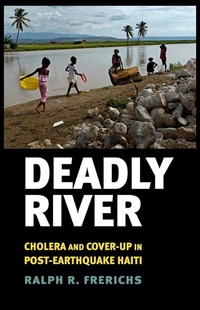
Deadly River
Cholera and Cover-Up in Post-Earthquake Haiti
Published on 1. May 2016
320 pages
978-1-5017-0362-1 (ISBN)
Description

In October 2010, nine months after the massive earthquake that devastated Haiti, a second disaster began to unfold-soon to become the world's largest cholera epidemic in modern times. In a country that had never before reported cholera, the epidemic mysteriously and simultaneously appeared in river communities of central Haiti, eventually triggering nearly 800,000 cases and 9,000 deaths. What had caused the first cases of cholera in Haiti in recorded history? Who or what was the deadly agent of origin? Why did it explode in the agricultural-rich delta of the Artibonite River? When answers were few, rumors spread, causing social and political consequences of their own. Wanting insight, the Haitian government and French embassy requested epidemiological assistance from France. A few weeks into the epidemic, physician and infectious disease specialist Renaud Piarroux arrived in Haiti.
In Deadly River, Ralph R. Frerichs tells the story of the epidemic, of a French disease detective determined to trace its origins so that he could help contain the spread and possibly eliminate the disease, and the political intrigue that has made that effort so difficult. The story involves political maneuvering by powerful organizations such as the United Nations and its peacekeeping troops in Haiti, as well as by the World Health Organization and the U.S. Centers for Disease Control. Frerichs explores a quest for scientific truth and dissects a scientific disagreement involving world-renowned cholera experts who find themselves embroiled in intellectual and political turmoil in a poverty-stricken country.
Frerichs's narrative highlights how the world's wealthy nations, nongovernmental agencies, and international institutions respond when their interests clash with the needs of the world's most vulnerable people. The story poses big social questions and offers insights not only on how to eliminate cholera in Haiti but also how nations, NGOs, and international organizations such as the UN and CDC deal with catastrophic infectious disease epidemics. Learn more at http://www.deadlyriver.com
In Deadly River, Ralph R. Frerichs tells the story of the epidemic, of a French disease detective determined to trace its origins so that he could help contain the spread and possibly eliminate the disease, and the political intrigue that has made that effort so difficult. The story involves political maneuvering by powerful organizations such as the United Nations and its peacekeeping troops in Haiti, as well as by the World Health Organization and the U.S. Centers for Disease Control. Frerichs explores a quest for scientific truth and dissects a scientific disagreement involving world-renowned cholera experts who find themselves embroiled in intellectual and political turmoil in a poverty-stricken country.
Frerichs's narrative highlights how the world's wealthy nations, nongovernmental agencies, and international institutions respond when their interests clash with the needs of the world's most vulnerable people. The story poses big social questions and offers insights not only on how to eliminate cholera in Haiti but also how nations, NGOs, and international organizations such as the UN and CDC deal with catastrophic infectious disease epidemics. Learn more at http://www.deadlyriver.com
Reviews / Votes
All public health students should read this book for two reasons: first, for the in-depth story of the scientific investigation of the source of the epidemic; and second, for the story of the political resistance and barriers, both powerful and subtle,that Piarroux encountered.... The description of Piarroux's investigation is fascinating.- Laura Price (International Quarterly of Community Health Education) The CDC discouraged journalists from asking about the epidemic's origin, telling them that pinpointing the source was 'not productive,' 'not central,' and would likely never happen. Its epidemiologists did provide a key detail early on, when they identified the strain in Haiti as having a recent South Asian origin-meaning it could have come from Nepal and not from South America, Africa, or anywhere else cholera was circulating at the time. The CDC refused to take environmental samples from around the [UN Peacekeepers] base or test the soldiers during the small window when doing either would have been worthwhile. All of this detailed in a damning new book by Ralph R. Frerichs called Deadly River..
- Jonathan M. Katz (Slate) Frerichs, a retired epidemiologist and professor emeritus of epidemiology at the University of California, Los Angeles, has written a damning account of the political and health professional response to the cholera epidemic that broke out in Haiti in October 2010... He does so from an epidemiologist's perspective and with a clear focus on the Haiti case. Yet, his account is written for and accessible to a wider readership and also highly relevant for students of global (health) politics.
- Tine Hanrieder, Dr rer pol, University of Bremen (Cambridge Review of International Affairs) Ralph Frerichs's Deadly River is, in no small part, an object lesson on the manner in which maps make sense of chaos in the midst of complex world events.... Frerichs's focus, and indeed his passion, lies with the microbial world and its periodic attacks on humankind.
(Cartographic Perspectives) Ralph R. Frerichs' compelling Deadly River tells the story of Haiti's 2010 cholera epidemic, the worst in recent history. The book is a detective story that documents how epidemiologists and others sought to quantify, decode, and combat cholera, and provides a firsthand look at the politics of medical humanitarianism.
(PoLAR)
More details
Series
Language
English
Place of publication
New York
United States
Publishing group
Cornell University Press
Target group
College/higher education
Professional and scholarly
Product notice
Reflowable
Illustrations
1 halftone, 10 maps, 5 charts - 6 Illustrations, black and white
ISBN-13
978-1-5017-0362-1 (9781501703621)
Copyright in bibliographic data and cover images is held by Nielsen Book Services Limited or by the publishers or by their respective licensors: all rights reserved.
Schweitzer Classification
Other editions
Additional editions
Book
06/2017
ILR Press
€49.75
Shipment within 15-20 days
Book
05/2016
ILR Press
€59.68
Shipment within 15-20 days
Person
Ralph R. Frerichs is Professor Emeritus of Epidemiology at UCLA.
Content
Preface
Introduction
1. Upheaval
2. Vibrio Cholerae
3. Rumors
4. Stealth
5. Hypotheses
6. Maps
7. Altered Reality
8. Journalists
9. Secrecy
10. Obfuscation
11. Speculation
12. Pandemics and South Asia
13. Report
14. Vodou and Cholera
15. Inquiry
16. Politics before Science
17. Nepal
18. Concealed in the Field
19. Quarantine and Isolation
20. The Wall Cracks
21. Answers
22. Sanitation, Water, and Vaccination
23. Struggles and Elimination
24. Rapprochement
Epilogue
Introduction
1. Upheaval
2. Vibrio Cholerae
3. Rumors
4. Stealth
5. Hypotheses
6. Maps
7. Altered Reality
8. Journalists
9. Secrecy
10. Obfuscation
11. Speculation
12. Pandemics and South Asia
13. Report
14. Vodou and Cholera
15. Inquiry
16. Politics before Science
17. Nepal
18. Concealed in the Field
19. Quarantine and Isolation
20. The Wall Cracks
21. Answers
22. Sanitation, Water, and Vaccination
23. Struggles and Elimination
24. Rapprochement
Epilogue
