

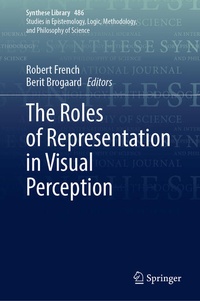
The Roles of Representation in Visual Perception
Description

Among these issues is the one concerning the nature of the perceptual state itself - e. g. on the issue of whether the perceptual state, like its distal objects, is structured, for instance by possessing a spatial character. Other issues include those of whether at least aspects of the distal object are presented immediately to us visually, whether representation plays any (interesting) role in disjunctivist and naïve realist accounts of visual experience and the relationship among visual perception, attention and representation.
The anthology includes a wide variety of positions on the subject of the roles of representations in visual perception, which would help to close the literature gap and will be of interest to scholars from all schools and trends of philosophy of mind.
More details
Other editions
Additional editions
Persons
Robert French is a philosopher with degrees from Dartmouth College and Boston University. He has taught at a variety of colleges and universities in the Detroit, Michigan area. His research interests include work in the philosophy of perception (in particular on how events in the phenomenal space of visual experience are reconstructed from neural events in the brain) and work in developing a physically realist interpretation of quantum mechanics. Among other publications he is co-editor with John Smythies of D irect versus Indirect Realism: A Neurophilosophical Debate published by Elsevier.
Berit Brogaard is Professor of Philosophy and Cooper Fellow at the University of Miami. Her areas of research include philosophy of perception, philosophy of emotions, and philosophy of language. She is the author of Transient Truths (Oxford University Press, 2012), On Romantic Love (Oxford University Press, 2015), The Superhuman Mind (Penguin, 2015), Seeing & Saying (Oxford University Press, 2018), and Hatred: Understanding our Most Dangerous Emotion (Oxford University Press, 2020).
