

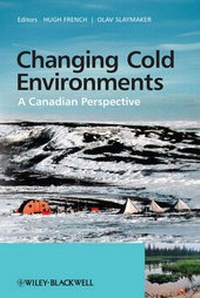
Changing Cold Environments
Description

Reviews / Votes
"I would use this book in upper-level EnvironmentalScience courses, as it presently is the most comprehensive book toinclude alpine and arctic regions, climatic, cryospheric,ecological and geomorphological aspects as well as humandimensions. It is wide enough in scope to use in an entire course,and yet has enough depth." (The Holocene, 24 January 2013) "It will also be useful to North American scientistsworking in the North for its comprehensive coverage and itsreferences. The editors and authors deserve thanks for a usefulcontribution." (Artic, Antarctic, and AlpineResearch, 1 November 2012) "Plentiful information presented in the book represent anoverall view on past development, recent status and the prospectiveof Canadian Arctic from the global to regional point of view.Therefore, the book could be recommended to specialist in the fieldand also university students interested in climate change impact onpolar ecosystems." (Czech Polar Reports, 1October 2012) "I highly recommend the research based and well structured bookChanging Cold Environments: A Canadian Perspective edited by HughFrench and Olav Slaymaker, to any undergraduate students,journalists, policy makers, business leaders, and engineers seekinga complete overview of the impact of environmental change on coldclimates. This book forms a solid knowledge base that has realvalue beyond the classroom, and into the boardrooms of business andthe halls of government." (Blog Business World, 9 February2012)More details
Other editions
Additional editions
Persons
Content
Preface xiii
Glossary xv
PART ONE SPATIAL AND TEMPORAL VARIABILITY OF CANADA'S COLD ENVIRONMENTS 1
1 Cold Canada and the Changing Cryosphere 3
Hugh French and Olav Slaymaker
1.1 Introduction 3
1.2 The Cryosphere 4
1.3 Cold Canada 10
1.4 Cold Climates 15
1.5 Arctic and Alpine Considerations 19
1.6 Canada's Physical Geography 21
2 The Late Quaternary Glaciation of Northern Canada 26
David Evans
2.1 Introduction 26
2.2 Landforms and the Late Quaternary Glaciations 26
2.3 Late Quaternary Sea level Change and its Relationship to Glaciation History 39
2.4 Late Quaternary Glaciation and Deglacial History 39
2.5 Wider Implications of Canadian Arctic Ice Sheet Dynamics 42
2.6 Holocene Glacial Events 44
3 The Evolution of Polar Desert and Tundra Ecosystems 48
Konrad Gajewski
3.1 Introduction 48
3.2 The Nature of the Environment 49
3.3 Ecology of Arctic Plants 51
3.4 Vegetation Zonation 53
3.5 Arctic Oases 55
3.6 Long term Evolution of Canadian Arctic Ecosystems 56
3.7 The Quaternary 58
3.8 Postglacial Climate and Vegetation Change in Arctic Canada 59
4 Remote Sensing and Canadian Snow Climatology 66
Richard Kelly
4.1 Introduction 66
4.2 The Importance of Snow in the Earth System 66
4.3 Snow Measurements in Canada 67
4.4 Remote Sensing of Snow 70
4.5 Snow Variations Inferred from Remote Sensing Observations 77
4.6 Discussion 82
4.7 Conclusion 82
PART TWO THE CHANGING CRYOSPHERE 87
5 The Changing Climates 89
Roger Barry and Mark Serreze
5.1 Introduction 89
5.2 Late Pliocene 89
5.3 Quaternary History 90
5.4 Postglacial Conditions 91
5.5 The Last Two Millennia 92
5.6 Recent Changes 94
5.7 The Future 96
6 Snow and Runoff: Processes, Sensitivity and Vulnerability 105
Ming-Ko Woo and John Pomeroy
6.1 Introduction 105
6.2 Snow Accumulation 107
6.3 Land Cover 109
6.4 Snow Ablation 111
6.5 Snowmelt Runoff Processes 113
6.6 Streamflow 117
6.7 Snowmelt Floods in Large Basins 118
6.8 Snow Vulnerability 122
7 Permafrost Distribution and Stability 126
Chris Burn
7.1 Introduction 126
7.2 Distribution of Permafrost 130
7.3 Thermal Regime of Permafrost 134
7.4 Permafrost and Climate Change 136
7.5 Conclusions 143
8 Sea Ice in Canada 147
David Barber and Jennifer Lukovich
8.1 Introduction 147
8.2 What is Sea Ice? 147
8.3 The Physical Nature of Sea Ice 148
8.4 Spatial and Temporal Distribution of Sea Ice 150
8.5 Sea Ice and Climate Change 158
8.6 Implications for Northern Communities, Economic Development and the Environment 160
9 Lake and River Ice in Canada 163
Terry Prowse
9.1 Introduction 163
9.2 Role in the Climate System 168
9.3 Climatic Controls 168
9.4 Historical Trends and Linkages to Climate 169
9.5 Future Ice Regime Projections 172
9.6 Implications of Ice Regime Changes 173
PART THREE THE EVER-CHANGING SCENERY 183
10 Climate Change and the Central Canadian Treeline 185
Glen MacDonald
10.1 Introduction 185
10.2 The Central Canadian Treeline Zone Today 186
10.3 Current Warming at the Central Canadian Treeline 188
10.4 Response of the Central Canadian Treeline to Warming Temperatures 191
11 Geomorphic Change in Northern Canada 200
Hugh French
11.1 Introduction 200
11.2 Lessons from the Past 202
11.3 Freezing, Thawing and Bedrock Instability 205
11.4 Warming Permafrost 205
11.5 Changes in Azonal Processes 213
11.6 Geotechnical Implications of Warming Permafrost 216
11.7 Conclusions 217
12 Geomorphic Change in Canada's Temperate Mountains 222
Olav Slaymaker
12.1 Introduction 222
12.2 Present Morphology 223
12.3 Spatial Variability of Ecology and Morphology 224
12.4 Hydroclimate and Cryospheric Phenomena 228
12.5 Rates and Kinds of Geomorphic Processes 234
12.6 Disturbances Regimes and Landscape Transitions 240
12.7 Conclusions 242
13 Risk from Cold-climate Hazards in the Canadian Cordillera 247
Jim Gardner
13.1 Introduction 247
13.2 Cold-climate Hazards 247
13.3 Risk and Climate Variability 249
13.4 Conclusions 264
14 Societal Aspects of Changing Cold Environments 267
Gita Laidler
14.1 Introduction 267
14.2 Cultural Pursuits and Indigenous Rights 268
14.3 Local and Broader Implications of Changing Sea Ice 281
14.4 Northern Governance 292
14.5 Conclusions 294
15 The Changing Canadian Cryosphere, Globalization and Global Environmental Change 301
Olav Slaymaker and Hugh French
15.1 Introduction 301
15.2 The Question of Scale 302
15.3 Adaptive Management 308
15.4 Globalization 310
15.5 Conclusion 310
References 311
Discussion Questions 312
Some Useful Internet Sources 312
Index 313
Glossary
Active layer The layer of ground above permafrost that freezes and thaws each year. Albedo The reflectivity of an entity. An albedo of 0 (1) indicates that all solar energy is absorbed (reflected). Alp A shoulder high on the side of a glacial trough. Arctic (1) Geographic definition: the area north of the Arctic Circle (latitude 66° 33′N); (2) Climatic definition: the region where the warmest monthly mean air temperature does not exceed 10 °C and the coldest is below 0 °C. AVHRR (Airborne Very High Resolution Radiometer). A sensor system deployed on NOAA satellites that returns 1.1 km resolution images of the Earth. Bubnov A unit for quantifying rates of slope retreat or ground loss. Co-management A co-management agreement is a management plan that specifies the objectives, partners to the agreement, and rights and responsibilities of the partners. Community-based research A participatory approach to research in resource and environmental management. Comprehensive land claims Aboriginal title to land. Cryosphere Ice sheets, glaciers, sea ice, river and lake ice, snow, and both seasonally and perennially frozen ground. Debris flow A form of mass movement of a mixture of water, rocks, fine sediments and/or organic debris. Degree days (1) Growing degree-days (GDD) are usually measured from a threshold value of 5.5 °C and defined as Σ(Ta − 5.5) °C where Ta is mean air temperature for the day and Σ indicates that successive daily values are summed. (2) Freezing degree-days (FDD) are the summation of the daily temperatures that are below 0 °C. Disjunc (as used in ecology) An organism that is found in two locations that is separated by more than the usual dispersal distance. ELA (Equilibrium Line Altitude) A notional altitudinal line on a glacier where ablation balances accumulation. First year sea ice Sea ice that has not yet survived a winter, with thicknesses ranging from 30 cm at the beginning of the season to 2 m near the end of the season. Flaw lead A linear crack in sea ice created by divergent winds and/or shear zones. Frazil ice Small spicules of ice that nucleate in river flow under a slight amount of supercooling. Freshet The rise in spring river flow, typically due to snowmelt. Geopolitics An area of geographical enquiry which considers space to be important in understanding the constitution of international relations. Governance (1) the nature of organizations and (2) the nature of the relations between organizations. Ground ice Ice formed in freezing and frozen ground. Ground ice may constitute between 40–60% by volume of the upper 10 m of permafrost. Ground temperature envelope The graphical representation of the annual range in ground temperature with depth. Ice jam An accumulation of fragmented ice floes that constricts the flow of water. Jokulhlaup Catastrophic drainage of a subglacial or ice-dammed lake. Krummholz The shrub form of trees, such as spruce, which are typically found in stressed environments. Latent heat of fusion The heat given off or taken in by a material during a change of phase between liquid and solid states. Milankovitch effects Periodicities in the Earth's orbit due to changes in eccentricity (100 000 y), axial tilt (41 000 y) and precession of the spring equinox (23 000 y). MYI (Multi-year sea ice) Ice that has survived a summer melt season, with thicknesses ranging from 2–4 m as ice grows beneath the ice sheet. Natural hazard The coincidence in space or time of extreme geophysical events and human use systems. Neoglaciation A local scale glacial advance that occurred during the Holocene Epoch. Nival regime streamflow The discharge pattern of a stream that results from the melt of seasonal snow and ice. Nordicité A concept coined by the Québec geographer Louis-Edmond Hamelin to quantify what is understood by the term ‘northern’. NDVI (Normalized Difference Vegetation Index) A numerical indicator applied to remote sensing data that compares visible light and near infrared reflectance from the Earth's surface to determine vegetation density and health. Pancake ice Circular disks resulting from the accumulation of frazil ice crystals with a range in size from a few centimeters to 3–5 metres in diameter. Paraglacial Non-glacial processes conditioned by glaciation. Passive microwave radiation Naturally emitted radiation that can be observed by a radiometer. Periglacial An environment with permafrost and intense frost activity. Permafrost Ground (soil or rock) that remains at or below 0 °C for at least two years. Phylogeography The distribution of organisms using molecular data. Phytogeography The distribution and abundance of plants. Polar amplification Amplified temperature trends over the Arctic Ocean compared with the rest of the hemisphere. Polynya A region of open water, where sea ice would normally be expected to occur, established by persistent divergent winds or upwelling of warm water. Proxy records Sources such as tree rings, pollen, ice and sediment cores that allow past climatic conditions to be inferred. Quaternary Period The last 2.6 million years (approximately) during which time many major glaciations occurred. Relict (as used in ecology). A taxon surviving in a region after being eliminated from most of its original distribution. Sea ice An entity of frozen water that floats on the surface of the ocean. Sea ice concentration anomaly Departures in sea ice concentration from a climatological mean. Sea ice dynamics Sea ice motion and circulation that is driven by atmospheric circulation and winds and/or ocean currents. Sea ice extent A measurement defined as the area with at least 15% ice concentration that is used to monitor the edge of sea ice. Seasonally frozen ground Ground that remains frozen for part of the year. Sediment cascade The sequence of sediment production, transport and deposition. Snow albedo feedback The effect of changing the land surface from a snow-covered surface (high albedo) to a snow free surface (low albedo). SCA (Snowcover area) The extent of snow cover within a given area. Snow stratigraphy The configuration of layering in the snow pack and variations in snow properties through the vertical profile. Snow sublimation The process by which snow evaporates. SWE (Snow-water equivalent). The amount of melted water from a column of snow. Socioecological system A system viewed with the understanding that what matters to humans is the environment as filtered through culture-specific perception and behaviour. Spectral...