

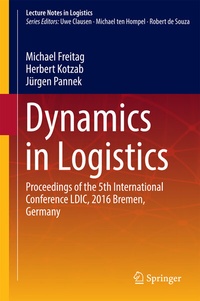
Dynamics in Logistics
Proceedings of the 5th International Conference LDIC, 2016 Bremen, Germany
1st Edition
Published on 15. September 2016
XI, 502 pages
978-3-319-45117-6 (ISBN)
Description

These proceedings contain research papers presented at the 5th International Conference on Dynamics in Logistics, held in Bremen, Germany, February 2016. The conference is concerned with dynamic aspects of logistic processes and networks. The spectrum of topics reaches from modeling, planning and control of processes over supply chain management and maritime logistics to innovative technologies and robotic applications for cyber-physical production and logistic systems. The growing dynamic confronts the area of logistics with completely new challenges: it must become possible to describe, identify and analyze the process changes. Moreover, logistic processes and networks must be redevised to be rapidly and flexibly adaptable to continuously changing conditions. The book primarily addresses researchers and practitioners from the field of industrial engineering and logistics, but it may also be beneficial for graduate students.
More details
Series
Language
English
Place of publication
Cham
Switzerland
Publishing group
Springer International Publishing
Target group
Professional and scholarly
Product notice
Reflowable
Illustrations
XI, 502 p. 125 illus., 70 illus. in color.
File size
11,15 MB
ISBN-13
978-3-319-45117-6 (9783319451176)
DOI
10.1007/978-3-319-45117-6
Schweitzer Classification
Other editions
Additional editions
Michael Freitag | Herbert Kotzab | Jürgen Pannek
Dynamics in Logistics
Proceedings of the 5th International Conference LDIC, 2016 Bremen, Germany
Book
09/2016
Springer
€213.99
Shipment within 10-15 days
Content
- Intro
- Preface
- Contents
- Distributed and Collaborative Planning and Control
- 1 Model-Based Specification and Refinement for Cyber-Physical Systems
- 1.1 Introduction
- 1.2 Introducing the FSL
- 1.2.1 Semantics
- 1.2.2 Verification Properties
- 1.3 Refinement in the FSL
- 1.3.1 Data Refinement
- 1.3.2 Operation Refinement
- 1.4 Refinement from the FSL to the ESL
- 1.5 Conclusions and Outlook
- References
- 2 Routing and Scheduling Transporters in a Rail-Guided Container Transport System
- Abstract
- 2.1 Introduction
- 2.2 Problem Definition and a Scheduling Algorithm
- 2.2.1 Constructing a State-Feasible Graph
- 2.2.2 Free-Time-Window Graph
- 2.2.3 Propagation Process
- 2.2.4 Constructing a Shortest-Time Route for an FC
- 2.2.5 A Heuristic Method for Reducing the Computational Time
- 2.3 Conclusions
- Acknowledgments
- References
- 3 The Influence of Manufacturing System Characteristics on the Emergence of Logistics Synchronization: A Simulation Study
- Abstract
- 3.1 Introduction
- 3.2 Synchronization in Manufacturing Systems
- 3.3 Methodology
- 3.3.1 Simulation Model
- 3.3.2 Experiment Setup
- 3.4 Results and Discussion
- 3.5 Conclusion
- References
- 4 Safety Requirements in Collaborative Human-Robot Cyber-Physical System
- Abstract
- 4.1 Introduction
- 4.2 Collaboration Classification
- 4.3 Sensors Catalogue
- 4.4 Collaboration Case Study
- 4.5 Guideline for Industrial Scenarios
- 4.6 Conclusion
- Acknowledgments
- References
- 5 A Trust Framework for Agents' Interactions in Collaborative Logistics
- Abstract
- 5.1 Introduction
- 5.2 Trust in Collaborative Networked Organizations
- 5.2.1 Building Trust in Cloud-Enabled Collaborative Environments
- 5.2.2 Collaborative Logistics and Transportation
- 5.3 Research Methodology
- 5.4 Conception of the Trust Framework
- 5.4.1 Selection and Front-End Agreement
- 5.4.2 Engagement and Order Forecast
- 5.4.3 Physical Distribution
- 5.5 Conclusions, Implications and Outlook
- Acknowledgments
- References
- 6 Quality-Aware Predictive Scheduling of Raw Perishable Material Transports
- 6.1 Introduction
- 6.2 System Design for Perishable Material Distribution
- 6.2.1 Assumptions
- 6.2.2 System Dynamics
- 6.2.3 Constraints
- 6.3 Controller Design
- 6.3.1 Quality-Unaware Controller
- 6.3.2 Quality-Aware Controller
- 6.3.3 Predictive Quality-Aware Controller
- 6.4 Experiments
- 6.4.1 Simulation Setup
- 6.4.2 Results
- 6.5 Conclusions and Future Research
- References
- 7 Process Maintenance of Heterogeneous Logistic Systems-A Process Mining Approach
- Abstract
- 7.1 Introduction
- 7.2 Toward Business Process Management Systems in Logistics
- 7.3 Process Mining-BPM Is Getting Smart
- 7.4 Requirements of Process Maintenance in Logistics
- 7.5 Toward a Process Maintenance System for Logistics
- 7.6 Demonstration of a Process Mining Case in Logistics
- 7.7 Conclusion and Outlook
- References
- 8 A Synergistic Effect in Logistics Network
- Abstract
- 8.1 Introduction
- 8.2 Notation
- 8.3 Effects of Speed Increasing
- 8.4 Pallet System Adjustments
- 8.5 Synergistic Effect
- 8.6 Influence of Saved Time on the Probability of Getting New Customers
- 8.7 Conclusion
- Acknowledgments
- References
- 9 A Step Toward Automated Simulation in Industry
- 9.1 Introduction
- 9.2 Background and Related Work
- 9.3 Proposed Approach
- 9.4 Challenges
- 9.5 Conclusion and Future Work
- References
- Predictive Analytics and Internet of Things and Services
- 10 Application Potential of Multidimensional Scaling for the Design of DSS in Transport Insurance
- Abstract
- 10.1 Introduction
- 10.2 Overview of Existing Methods to Evaluate and Forecast Transportation Risk in Insurance
- 10.3 Applying MDS to Transport Insurance Claims
- 10.4 Results
- 10.5 Discussion, Further Development and Conclusion
- References
- 11 Methodological Demonstration of a Text Analytics Approach to Country Logistics System Assessments
- Abstract
- 11.1 Introduction
- 11.2 The Assessment of Country Logistics Systems
- 11.3 Methodology
- 11.3.1 Text Mining
- 11.4 Keyword Analysis
- 11.5 Word Frequency Analysis
- 11.5.1 Collocation Analysis
- 11.5.2 Machine Learning and Text Classification
- 11.6 Illustrative Results
- 11.7 Discussion and Conclusion
- References
- 12 Big Data Analytics in the Maintenance of Off-Shore Wind Turbines: A Study on Data Characteristics
- Abstract
- 12.1 Introduction
- 12.2 Big Data Technology and the Place of Data Analytics
- 12.3 Data Analytics and Predictive Maintenance
- 12.4 Big Data Analytics in Wind Maintenance: Review of the Literature
- 12.5 Research Methodology
- 12.6 Technical Characteristics of Input Data for Predictive Maintenance in the Era of Big Data
- 12.7 Conclusion
- References
- 13 Mitigating Supply Chain Tardiness Risks in OEM Milk-Run Operations
- Abstract
- 13.1 Introduction
- 13.2 Literature Background
- 13.3 The Mathematical Model
- 13.3.1 Tardiness Tolerance Strategy
- 13.3.2 Cumulative Delays Along the Milk-Run Route
- 13.4 Numerical Application
- 13.5 Dynamic Aspects and Research Prospects
- 13.6 Conclusions
- Acknowledgments
- References
- 14 What Hinders the Implementation of the Supply Chain Risk Management Process into Practice Organizations?
- Abstract
- 14.1 Introduction
- 14.2 Literature Review
- 14.3 Analytical Framework for Implementing Supply Chain Risk Management in Organizations
- 14.4 Methodology
- 14.4.1 Case Study Approach
- 14.4.2 General Presentation of the Case Company
- 14.4.3 Design and Objectives of the Case Study
- 14.5 Hindrances for SCRMP: Findings and Discussion
- 14.6 Conclusion and Future Directions
- References
- 15 The Fashion Trend Concept and Its Applicability to Fashion Markets and Supply Chains
- Abstract
- 15.1 Introduction
- 15.2 Fashion Levels
- 15.3 Fashion Trend Concept
- 15.4 Social Media and Fashion
- 15.5 Fast Fashion Retailing
- 15.5.1 The Case of Zara
- 15.6 Luxury Markets
- 15.7 Fast Fashion Versus Absolute Luxury
- 15.8 Hypothesis
- 15.9 Conclusion and Future Work
- References
- 16 Intelligent Packaging and the Internet of Things in Brazilian Food Supply Chains: The Current State and Challenges
- Abstract
- 16.1 Introduction
- 16.2 Intelligent Packaging in Logistics
- 16.3 The Internet of Things-IoT in Logistics
- 16.4 Methodology
- 16.5 Results
- 16.5.1 Intelligent Packaging
- 16.5.2 The Internet of Things (IoT)
- 16.6 Conclusion
- Acknowledgments
- References
- 17 Methodology for Development of Logistics Information and Safety System Using Vehicular Adhoc Networks
- 17.1 Introduction
- 17.2 State of the Art
- 17.3 Evaluation of VANET for Safety Applications
- 17.3.1 Goodput and Delay
- 17.3.2 Beacon Dissemination and Transmission Range
- 17.4 Methodology
- 17.4.1 Objectives and Planning
- 17.4.2 Strategies and Measures
- 17.4.3 Proposed Strategy
- 17.5 Acknowledgment
- 17.6 Conclusion
- References
- 18 Power Management of Smartphones Based on Device Usage Patterns
- Abstract
- 18.1 Introduction
- 18.2 Background
- 18.3 Methodology
- 18.3.1 Data Collection and Analysis
- 18.3.2 Decision Maker
- 18.4 Results
- 18.5 Conclusion
- Acknowledgements
- References
- 19 Integration of Wireless Sensor Networks into Industrial Control Systems
- Abstract
- 19.1 Introduction
- 19.2 Overall Structure
- 19.3 Raspberry Pi as an Industrial Gateway
- 19.3.1 Communication Protocol
- 19.3.2 UART
- 19.4 Sensor Module
- 19.4.1 WizziMote
- 19.4.2 WizziBase
- 19.4.3 Sensors
- 19.5 Software Design
- 19.5.1 Raspberry Pi
- 19.5.2 PLC (Programmable Logic Controller)
- 19.5.3 HMI (Human Machine Interface)
- 19.5.4 Temperature and Humidity Sensor Values
- 19.5.5 Data Logging
- 19.5.6 Sensor Value Trends
- 19.6 Limitations of Wireless Control Applications
- 19.7 Summary and Conclusions
- Acknowledgments
- References
- 20 Advantages of Sub-GHz Communication in Food Logistics and DASH7 Implementation
- 20.1 Introduction
- 20.2 Field Tests
- 20.2.1 Sensor Hard- and Software
- 20.2.2 Stowage Schema and Sensor Positions
- 20.2.3 Model for Signal Attenuation
- 20.2.4 Results
- 20.3 433 MHz Band and Open Source Stack for DASH7 Alliance Protocol (OSS-7)
- 20.4 Multi-sensor, Multipurpose DASH7 Tag
- 20.5 Conclusion
- References
- Transport, Maritime and Humanitarian Logistics
- 21 Pre-selection Strategies for the Collaborative Vehicle Routing Problem with Time Windows
- Abstract
- 21.1 Introduction
- 21.2 Literature Review
- 21.3 Pre-selection of Own Request Pool
- 21.4 Solution Procedure
- 21.4.1 General Framework
- 21.4.2 Pre-selection Strategies
- 21.5 Computational Study
- 21.6 Conclusion
- Acknowledgments
- References
- 22 Transportation Planning with Forwarding Limitations
- Abstract
- 22.1 Introduction
- 22.2 Transportation Planning with Forwarding Limitations
- 22.3 Solution Approach
- 22.4 Computational Study
- 22.5 Conclusion and Outlook
- Acknowledgments
- References
- 23 Sustainable Urban Freight Transport: Analysis of Factors Affecting the Employment of Electric Commercial Vehicles
- Abstract
- 23.1 Introduction
- 23.2 State of the Art
- 23.3 Method
- 23.4 Analysis of Factors
- 23.4.1 Economic Dimension
- 23.4.2 Social Dimension
- 23.4.3 Environmental Dimension
- 23.4.4 Technological Dimension
- 23.5 Conclusion
- References
- 24 Evaluation of Practically Oriented Approaches for Operational Transportation Planning
- Abstract
- 24.1 Introduction
- 24.2 Fulfillment Modes of IOTP
- 24.3 Commonly Used Planning Strategies for IOTP
- 24.4 Mathematical Models for Common Planning Strategies and for Simultaneous Planning
- 24.5 Computational Experiments
- 24.6 Future Research/Conclusions
- Acknowledgments
- References
- 25 Intelligent Transport Systems for Road Freight Transport-An Overview
- Abstract
- 25.1 Problem Background and Research Questions
- 25.2 Fundamentals on ITS
- 25.3 ITS for Road Freight Transport
- 25.4 Selected ITS Application Areas in Road Freight Transport
- 25.5 Critical Evaluation of ITS from the Perspective of Different Actors of a Transport Chain
- 25.5.1 A Transport Provider's View on Using ITS
- 25.5.2 A Professional Truck Driver's View on Using ITS
- 25.5.3 A Traffic Control Center's View on the Use of ITS
- 25.5.4 A Client's/Receiver's View on the Use of ITS
- 25.5.5 A Public Authority's View on the Use of ITS
- 25.5.6 A Programmer's View on ITS
- 25.6 Conclusion
- References
- Personal Interviews
- 26 Imposing Emission Trading Scheme on Supply Chain
- Abstract
- 26.1 Introduction
- 26.2 ETS
- 26.2.1 Working Principle
- 26.2.2 ETS in Practice
- 26.3 ETS in Line with SC
- 26.3.1 Imposing ETS on SC-Intentions
- 26.3.2 SC Design Under ETS-Mathematical Models
- 26.4 Discussion
- 26.5 Conclusion
- References
- Journal Article
- 27 Planning of Maintenance Resources for the Service of Offshore Wind Turbines by Means of Simulation
- Abstract
- 27.1 Introduction and Problem Description
- 27.2 State of the Art
- 27.3 Simulation Model and Performance Measures
- 27.4 Simulation Results and Discussion
- 27.5 Conclusion
- Acknowledgments
- References
- 28 Shopper Logistics Processes in a Store-Based Grocery-Shopping Environment
- Abstract
- 28.1 Introduction
- 28.2 Conceptualizing Shopper Logistics
- 28.3 Methodology
- 28.4 Results
- 28.4.1 Four Areas Determine Shopper Logistics
- 28.4.2 Planning and Execution of Shopper Logistics
- 28.4.3 Simultaneous Planning and Execution of Shopper Logistics
- 28.4.4 Deriving a Different Model of Consumer Logistics
- 28.5 Conclusions and Outlook for Further Research
- References
- 29 Empty Container Repositioning from a Theoretical Point of View
- Abstract
- 29.1 Introduction
- 29.2 Typical Example in Empty Container Repositioning and Main Actors in the Supply Chain
- 29.3 The Theory Applied to the Repositioning Problem
- 29.3.1 The Principal Agent Theory
- 29.3.2 The Transaction Cost Theory
- 29.3.3 Analysis of the Repositioning Problem
- 29.3.3.1 Scenario Applied to the Principal Agent Theory
- 29.3.3.2 Scenario Applied to the Transaction Cost Theory
- 29.4 Conclusion and Managerial Implications
- References
- 30 Frugal and Lean Engineering: A Critical Comparison and Implications for Logistics Processes
- Abstract
- 30.1 Introduction
- 30.2 Frugal Engineering: Meaning and Principles
- 30.3 Lean Engineering
- 30.4 Lean and Frugal Engineering: A Critical Comparison
- 30.5 Synthesis: Implications for Logistics Processes
- 30.6 Conclusion
- References
- 31 Logistics Dynamics and Demographic Change
- Abstract
- 31.1 Introduction
- 31.2 Trend Analysis: Research Approach
- 31.3 Findings and Discussion
- 31.3.1 Business Process Management
- 31.3.2 Network Structure
- 31.3.3 Strategic Management
- 31.3.4 Competitive Management
- 31.4 Trend Interaction: Demographic Change
- 31.5 Conclusion
- Acknowledgments
- References
- New Business Models
- 32 Future Logistics: What to Expect, How to Adapt
- Abstract
- 32.1 Introduction
- 32.2 Literature Review: Logistics Trends
- 32.3 Current Trends and Historic Development
- 32.4 What to Expect: Technology and the Future of Supply Chains
- 32.5 How to Adapt: Logistics Training and Knowledge Management
- 32.6 Conclusion
- References
- 33 Concept and Diffusion-Factors of Industry 4.0 in the Supply Chain
- Abstract
- 33.1 Introduction
- 33.2 Methodology and Contribution
- 33.3 Characterizing the Term "Industry 4.0"
- 33.4 Diffusion-Factors of Industry 4.0
- 33.5 Conclusion
- References
- 34 On Upper Bound for the Bottleneck Product Rate Variation Problem
- 34.1 Introduction
- 34.2 Problem Formulation
- 34.3 Bounds
- 34.3.1 Level Curve
- 34.3.2 Lower Bound
- 34.3.3 Upper Bound
- 34.4 Concluding Remarks
- References
- 35 Crowdsourcing in Logistics: An Evaluation Scheme
- Abstract
- 35.1 Introduction
- 35.2 Conceptual Framework
- 35.3 Case Study E-Mobility
- 35.4 Application Area Logistics Training and Knowledge Management
- 35.5 Outlook: Humanitarian Logistics
- 35.6 Conclusions
- References
- 36 Modularization of Logistics Services-An Investigation of the Status Quo
- Abstract
- 36.1 Introduction
- 36.2 Research Background
- 36.2.1 Concept of Modularity
- 36.2.2 Service Modularization
- 36.2.3 Modularization in Logistics
- 36.3 Data Collection and Analysis
- 36.4 Results
- 36.4.1 Status Quo of Modularization in Service Sales
- 36.4.2 Status Quo of Modularization in Service Provision
- 36.5 Discussion and Conclusions
- Acknowledgments
- References
- Frameworks, Methodologies and Tools
- 37 Toward a Unified Logistics Modeling Language: Constraints and Objectives
- Abstract
- 37.1 Introduction
- 37.2 Levels of Concern
- 37.3 Compositionality and Interoperability
- 37.4 Domain-Specific Views
- 37.5 Model Transformation
- 37.6 Conclusion
- References
- 38 Potential of Improving Truck-Based Drayage Operations of Marine Terminals Through Street Turns
- 38.1 Introduction
- 38.2 Vehicle Routing with Empty and Loaded Containers
- 38.2.1 The Pickup and Delivery Problem with Partially Specified Requests
- 38.2.2 Literature Review
- 38.3 A Three-Phase Heuristic
- 38.4 Discussion and Results of a Computational Experiment
- 38.4.1 Used Test Instances and Parameters of the Heuristic
- 38.4.2 Effect of Different Mixtures of Container Sizes
- 38.5 Conclusion and Outlook
- References
- 39 Inventory Routing Problem for Perishable Products by Considering Customer Satisfaction and Green Criteria
- Abstract
- 39.1 Introduction
- 39.2 Literature Review
- 39.3 Problem Description
- 39.4 Resolution Approach
- 39.4.1 Experimental Results
- 39.5 Conclusion
- Acknowledgment
- References
- 40 Decentralized Routing of Automated Guided Vehicles by Means of Graph-Transformational Swarms
- 40.1 Introduction
- 40.2 Basics of Graph-Transformational Swarms
- 40.2.1 Basic Concepts of Graph Transformation
- 40.2.2 Graph-Transformational Swarms
- 40.3 Routing of AGVs as Graph-Transformational Swarms
- 40.3.1 The Routing Swarm
- 40.3.2 Layout Preparation
- 40.3.3 Assignment and Navigation
- 40.4 Conclusion
- References
- 41 Interoperability of Logistics Artifacts: An Approach for Information Exchange Through Transformation Mechanisms
- Abstract
- 41.1 Introduction
- 41.2 Current Initial Situation for Interoperability in Logistics
- 41.3 Approach
- 41.4 Application Example
- 41.5 Summary and Outlook
- Acknowledgments
- References
- 42 Airflow Behavior Under Different Loading Schemes and Its Correspondence to Temperature in Perishables Transported in Refrigerated Containers
- Abstract
- 42.1 Introduction
- 42.2 Field Tests
- 42.2.1 Wireless Airflow Sensor
- 42.2.2 Test Cases
- 42.3 Results
- 42.3.1 Test Case 1: Pallet-Wall Gap
- 42.3.2 Test Case 2: Pallet-Pallet Gap Around Container Mid-Section
- 42.3.3 Test Case 3: Airflow Versus Temperature
- 42.4 Conclusion
- Acknowledgments
- References
- 43 VANET Security Analysis on the Basis of Attacks in Authentication
- 43.1 Introduction
- 43.2 State of the Art
- 43.3 Security Requirements of VANET
- 43.4 Protocols Reasoning of Attacks in Authentication
- 43.5 Conclusion and Future Work
- References
