

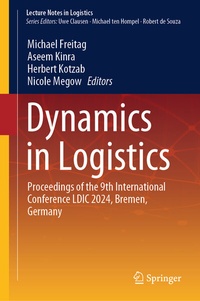
Dynamics in Logistics
Proceedings of the 9th International Conference LDIC 2024, Bremen, Germany
1st Edition
Published on 2. April 2024
X, 492 pages
978-3-031-56826-8 (ISBN)
Description

This book reports on interdisciplinary research and developments in logistics. It describes cutting-edge methods from business economics, operations research, computer science, and electrical and production engineering, applied to solve current problems in logistics. It includes empirical, theoretical, methodological, and practice-oriented contributions addressing the modeling, planning, optimization, and control of processes in supply chains, logistic networks, production systems, and material flow systems and facilities. Gathering peer-reviewed papers presented at the 9th International Conference on Dynamics in Logistics (LDIC 2024), held on February 14-16, 2024, in Bremen, Germany, and continuing the tradition of previous volumes, this book offers extensive information to both researchers and professionals in logistics. Moreover, it emphasizes current challenges such as those related to sustainable business development and digitalization, proposing novel, effective solutions to cope with current issues in different types of industry.
More details
Series
Language
English
Place of publication
Cham
Switzerland
Publishing group
Springer International Publishing
Target group
Professional and scholarly
Product notice
Reflowable
Illustrations
X, 492 p. 127 illus., 72 illus. in color.
File size
41,54 MB
ISBN-13
978-3-031-56826-8 (9783031568268)
DOI
10.1007/978-3-031-56826-8
Schweitzer Classification
Other editions
Additional editions
Michael Freitag | Aseem Kinra | Herbert Kotzab
Dynamics in Logistics
Proceedings of the 9th International Conference LDIC 2024, Bremen, Germany
Book
04/2024
Springer
€299.59
Shipment within 15-20 days
Persons
Content
- Intro
- Preface
- Contents
- Supply Chain Management
- Power and Digitalization Within the Supply Chain - An Examination of Power Structures Under the Influence of Digitalization and Digital Transformation
- 1 Introduction
- 2 Power in SCM - A Theoretical Framework
- 3 Influences of Digitalization on Power Structures in SCM
- 4 Evaluation by Practical Examples
- 5 Conclusion
- References
- Streamlining Global Logistics and Supply Chain Operations: A Process Standardization Framework
- 1 Introduction
- 2 Approach for Developing the Global Logistics Standardization Framework
- 2.1 Theoretical Foundations for Developing a Process Standardization Framework
- 2.2 Action Research Using a Case Company
- 2.3 Data Collection- Framework Development and Application Assessment
- 3 Findings and Discussion
- 3.1 Global Process Standardization Framework
- 3.2 Application Assessment of the Standardization Framework
- 4 Conclusion and Future Research
- References
- Understanding Disruption in the Upstream Segment of the Mineral Supply Chain
- 1 Introduction
- 2 Characterizing the MiSC's Upstream Segment
- 3 Methodology
- 3.1 Case - Chilean MiSC's Upstream Segment
- 3.2 Data Collection
- 3.3 Data Analysis
- 4 Findings
- 5 Discussion
- 6 Conclusion
- Appendix 1. Interview Protocol
- Appendix 2. Example of Disruption Impact Fine Coding Based on the Data Analyze Procedure
- Appendix 3. Examples of Events and Their Impacts on the MiSC's Upstream Segment Referred by Interviewees.
- References
- Assessing the COVID-19 Vaccine Distribution in Germany
- 1 Introduction
- 2 Potential Analysis of COVID-19 Vaccine Distribution in Germany
- 2.1 Analyzing the Requirements
- 2.2 Performance Analysis
- 2.3 Process Analysis
- 2.4 Structure Analysis
- 2.5 Benchmarking
- 3 Conclusion
- References
- Conceptualizing Humanitarian Logistics and Supply Chain Management
- 1 Introduction
- 2 Humanitarian Logistics and Supply Chain Challenges
- 2.1 HLSC vs Commercial Logistics and Supply Chains
- 2.2 Unique Supply Chain Challenges in HLSC Management and Its Empirical Foundations
- 3 Empirical Validation
- 3.1 Methodological Considerations
- 3.2 Results
- 3.3 Discussion
- 4 Conclusion
- References
- Challenges in Food Supply Chain Management: Findings from Literature Review and Expert Survey
- 1 Introduction
- 2 Literature Review
- 3 Qualitative Data Analysis
- 3.1 Political Crises and Disruptions
- 3.2 Sustainability
- 3.3 Supplier-Buyer Relationship
- 4 Discussion and Conclusion
- References
- Urban Logistics
- Continuous Approximation Approach to Determine the Optimal Service Area for a Drone Port in Urban Air Logistics
- 1 Introduction
- 1.1 Research Objectives
- 2 Literature Review
- 2.1 Urban Freight Logistics
- 2.2 Cargo Handling Concepts
- 2.3 Challenges in Drone Operations
- 3 Research Methodology
- 3.1 Average Distance Calculation
- 3.2 Model for Drone Port Related Total Cost of Delivery Operation
- 3.3 Model Constraints
- 3.4 Model Optimization
- 4 Analysis and Findings
- 4.1 Scenario 1 AS & A* & Ag
- 4.2 Scenario 2 A* & AS & Ag
- 5 Conclusion
- References
- Online Assignment of a Heterogeneous Fleet in Urban Delivery
- 1 Introduction
- 2 Literature Review
- 3 Problem Description
- 3.1 Service Area
- 3.2 Fleet Composition
- 3.3 Demand Patterns
- 3.4 Delivery Fulfillment
- 4 Assignment Policies
- 4.1 Policy Function Approximation
- 4.2 Value Function Approximation
- 5 Computational Study
- 6 Conclusion
- References
- Agent-Based Regional Delivery Model for Optimising Electric Commercial Vehicle Concepts
- 1 Introduction
- 2 Related Work
- 3 The Freight Distribution Model
- 3.1 Vehicle Agents
- 3.2 Route Optimisation
- 4 Optimising Vehicle Concepts
- 5 Conclusion
- References
- Shortest-Path-Based Resilience Analysis of Urban Road Networks
- 1 Introduction
- 2 Resilience Analysis of Road Networks: Related Work
- 3 Robustness of Accessibility in Urban Road Networks
- 4 Network Resilience Against Flooding: A Case Study
- 4.1 Implementation and Case Study Setup
- 4.2 Results and Discussion
- 5 Conclusions
- References
- Maritime Logistics and Port Operations
- Approach for Decentralized Information Systems in Maritime Logistics
- 1 Introduction
- 2 Information Systems in Maritime Logistics
- 2.1 Process Overview
- 2.2 Barriers for Adoption
- 3 Methodology
- 4 Results
- 4.1 Use Cases
- 4.2 Design Requirements and Principles
- 4.3 System Design
- 5 Conclusion
- References
- Towards Vessel Arrival Time Prediction Through a Deep Neural Network Cluster
- 1 Introduction
- 2 Related Works
- 3 Methodology and Material
- 3.1 Data Acquisition
- 3.2 Data Preprocessing
- 4 Prediction Models
- 4.1 Results
- 5 Conclusion and Discussion
- References
- On Estimating the Required Yard Capacity for Container Terminals
- 1 Introduction
- 2 Method
- 3 Results and Discussion
- 4 Outlook
- References
- Application of Pre-gate Parking by a Use Case Study in RoPax Port of Turku
- 1 Introduction
- 2 Literature Review
- 3 Methodology
- 4 Simulation Modelling Turku RoPax Terminal
- 4.1 Pre-gate Concept
- 4.2 Just-in-Sequence Concept
- 4.3 Simulation Scenarios
- 4.4 Key Indicators
- 4.5 Input-Output and Control Model
- 5 Simulation Execution and Results
- 5.1 Vehicle Travel Time
- 5.2 Vehicle Arrival Time at Terminal
- 5.3 Queue Length at Raisio Junction
- 6 Discussion
- 7 Conclusion
- References
- Framework for the Development of Small Multimodal Inland Waterway Ports for a New Decentralized Inland Port Network
- 1 Introduction
- 2 MicroPorts Framework
- 3 Use Case
- 4 Conclusion and Outlook
- References
- Smart Production and Material Flow System
- From Traditional to Transformable Production Logistics - Measures for Successful Transformation
- 1 Turbulence and Complexity as Challenges of Production Logistics
- 2 Transformability in Science and Practice in Production Logistics
- 2.1 Existing Design Approaches to the Transformability in Production Logistics
- 2.2 Research Gap and Need for Action
- 3 Design Framework for Transformation Measures
- 3.1 System Model of Production Logistics: Design Fields
- 3.2 Structure of a Change Enabler Hierarchy
- 3.3 Identification of Production Logistics-Specific Change Enabler
- 3.4 Transformation Measures and Design Principles
- 4 Application Area of Production Logistics
- 5 Summary and Further Research
- References
- Robust Human-Centered Assembly Line Scheduling with Reinforcement Learning
- 1 Introduction
- 1.1 Robust Human-Centered Assembly Line Scheduling
- 1.2 Reinforcement Learning in Production Scheduling
- 1.3 Research Gap, Use Case and Contribution
- 2 Problem Formulation
- 3 RL Approach
- 3.1 Action Space
- 3.2 Reward Design
- 3.3 State Space
- 3.4 Implementation
- 4 Numerical Experiments
- 4.1 Test Instances
- 4.2 PPO RL Training Performance
- 4.3 Algorithm Benchmark (PPO RL vs. SA)
- 5 Conclusion and Research Perspectives
- References
- Sensor-Based Analysis of Manual Processes in Production and Logistics: Motion-Mining versus Lean Tools
- 1 Introduction
- 2 Research Background
- 2.1 Systematic Literature Review
- 2.2 State of the Research
- 3 Methodology
- 3.1 Overview
- 3.2 Expert Interviews
- 3.3 Case Studies
- 4 Results
- 4.1 Expert Interviews
- 4.2 Case Studies
- 5 Limitations
- 6 Conclusions and Future Research
- Appendix
- References
- The Impact of AGVs and Priority Rules in a Real Production Setup - A Simulation Study
- 1 Introduction
- 2 State of the Art
- 2.1 Production Planning and Control
- 2.2 Sequencing Rules
- 2.3 Application of AGVs in Intralogistics
- 2.4 Summary
- 3 Scenario Description and Methodology
- 3.1 Simulation Setup and Basic Scenario
- 3.2 Implementation of AGVs
- 3.3 Implementation of Different Dispatching Rules
- 3.4 Methodology
- 4 Results and Discussion
- 4.1 Basic Scenario - Scenario 1
- 4.2 Implementation of AGVs - Scenario 2
- 4.3 Implementation of Different Dispatching Rules
- 4.4 Summary and Discussion of the Results
- 5 Conclusion and Outlook
- References
- Predicting Steel Grade Based on Electric Arc Furnace End Point Parameters
- 1 Introduction
- 2 Literature Review
- 3 Model Development
- 4 Results
- 4.1 Accuracy
- 4.2 Confusion Matrix
- 5 Conclusion
- References
- Assessing the Value of Real-Time Data for the Dynamic Scheduling of In-Plant Logistics Activities
- 1 Introduction
- 2 System Description
- 3 Simulation Model Description
- 3.1 Assumptions
- 3.2 Simulation Model Structure
- 4 Industrial Application
- 4.1 Industrial Setting and Model Application
- 4.2 Tested Scheduling Systems
- 4.3 Numerical Experiments and Results
- 5 Conclusions
- References
- Proper Integration of AGV/AMR Systems: A Design Model for the Loading/Unloading Points
- 1 Introduction
- 2 Mathematical Model
- 2.1 Case A: Completely Manual Case
- 2.2 Case B: Manual Buffer Case
- 2.3 Case C: Automatic Buffer Case
- 2.4 Case D: AGV/AMR Parked at the Machine Case
- 3 Numerical Analysis
- 3.1 AGVs Solution
- 3.2 AMRs Solution
- 3.3 Comparison Between AGVs and AMRs
- 4 Conclusions
- References
- A Portable Localization System for Dynamic AGV Positioning in Indoor Warehouses
- 1 Introduction
- 2 State of the Art in Indoor Localization
- 2.1 Indoor-Localization Using FTM
- 2.2 Alternative Indoor Localization Methods
- 3 Proposed Indoor Localization System
- 3.1 Description of the Use Case
- 3.2 Overview and Description of the Localization System
- 3.3 Evaluation Methodology and Experimental Setup
- 4 Results
- 4.1 Results and Performance of the Indoor Localization System
- 5 Discussion and Limitations
- 6 Conclusion and Future Work
- References
- Sustainable and Green Logistics
- Comprehensive Sustainability Evaluation Concept for Offshore Green Hydrogen from Wind Farms
- 1 Introduction
- 2 Concept Description
- 2.1 Green Hydrogen Production from Offshore Wind Farms
- 2.2 Green Hydrogen Transport Originating at Offshore Wind Farms
- 3 Sustainability Evaluation Methodology
- 3.1 Life Cycle Assessment (LCA)
- 3.2 Social Life Cycle Assessment (SLCA)
- 4 Discussion and Recommendations for Sustainability Evaluation for Offshore Green Hydrogen Supply Chains
- 4.1 Ecologic Sustainability
- 4.2 Social Sustainability
- 4.3 Comprehensive Evaluation Scheme
- 5 Conclusions
- References
- Literature Review-Based Synthesis of a Framework for Evaluating Transformation of Hydrogen-Based Logistics
- 1 Introduction
- 2 Background
- 3 Development of the Framework
- 3.1 Methodology
- 3.2 Initial Problem Analysis and Formulation of Critical Research Areas
- 3.3 Literature Review
- 3.4 Resulting Framework
- 4 Summary and Outlook
- References
- Simulation-Based CO2e Footprint Analysis of Electric Trucks in the Animal Feed Distribution
- 1 Introduction
- 2 System Description
- 2.1 Market Characteristics and Research Gap
- 2.2 Simulation Model
- 3 Calculation of CO2e for Animal Feed Logistics
- 4 Simulation Experiment
- 5 Conclusion and Future Work
- References
- Cumulative and Congruent Capabilities Under Uncertainty: Conceptual Model for Integrating Sustainable Resilience
- 1 Introduction
- 2 Literature Review
- 3 Model and Hypothesis Development
- 3.1 Formation of Constructs
- 3.2 Hypotheses Development and Conceptual Model
- 4 Planned Methodology
- 4.1 Data Collection
- 4.2 Measures
- 4.3 Structural Equation Modelling and Sequence Testing
- 5 Expected Contribution and Conclusion
- References
- A Roadmap for Improving Warehouse Environmental Sustainability: The Case of a Conditioned Logistics Facility for Medical Devices
- 1 Introduction
- 2 Background Literature
- 2.1 Smart Lighting Systems
- 2.2 On-Site Renewable Generation Units
- 3 Methodology
- 4 Scenario Design and Simulation Procedures
- 4.1 Base Case Scenario
- 4.2 Scenario A: Smart Lighting System
- 4.3 Scenario B: On-Site Renewable Generation
- 5 Results and Discussion
- 6 Conclusions
- References
- Human-Centered and Socially Sustainable Warehousing Processes: How Workload-Related Experience Can Mitigate the Negative Performance Effects of Work Intensity
- 1 Introduction
- 2 Related Literature and Hypotheses Development
- 3 Empirical Setting
- 4 Variables Description and Econometric Model
- 4.1 Dependent Variable
- 4.2 Independent Variables
- 4.3 Control Variables
- 4.4 Multicollinearity and Descriptive Statistics
- 4.5 Mixed-Effects Model
- 5 Empirical Results
- 6 Conclusion
- References
- Efficient Warehouse and Inventory Management: The Modified ABC XYZ Analysis as a Framework to Integrate Demand Forecasting and Inventory Control
- 1 Introduction
- 2 Theoretical Background
- 2.1 The Modified ABC XYZ Analysis
- 2.2 Forecasting Methods
- 2.3 Integrated Framework
- 3 Methodology
- 4 Application Example
- 5 Discussion
- 5.1 Management Implications
- 5.2 Limitations and Future Research
- Appendix
- References
- Digitalization, Cyber-Physical System, and Digital Twins
- Enhancing Product Development Through Industry 4.0 Requirements: Willingness to Pay Considerations in a Case Study in Food Processing Machine
- 1 Introduction
- 2 Product
- 3 Specifications Based on Industry 4.0 Technologies
- 4 Methodology
- 4.1 Analyzed Variables
- 4.2 Questionnaire and Sample
- 4.3 Data Analysis
- 5 Results
- 6 Conclusions
- References
- Streamlining Manufacturing Resource Digitization for Digital Twins Through Ontologies and Object Detection Techniques
- 1 Introduction
- 2 Related Works
- 3 Methodology
- 3.1 Overview of the Methodology
- 3.2 Object Detection
- 3.3 Mapping Objects to Ontology
- 4 Results
- 5 Discussion
- 6 Conclusions and Outlook
- References
- Investigation of the Digital Twin Concept to Improve the Value Stream Methodology
- 1 Value Stream Management in Volatile Environments
- 2 State of Research and Research Goal
- 3 Applied Procedure
- 4 Conceptual Delimitation in the Context of the Present Study
- 4.1 Conventional Value Stream Management
- 4.2 Digital Model, Digital Shadow (DS) and Digital Twin (DT)
- 5 Exposition of the Business Scenario
- 6 Concept of a Digital Value Stream Twin
- 6.1 Digital Shadows in the Manufacturing Process
- 6.2 Consolidation of the Digital Shadows into One Digital Value Stream Shadow
- 6.3 Extension to a Digital Twin of the Value Stream
- 6.4 Conception of a Layered Architecture Model for the Data Processing
- 7 Critical Discussion and Outlook
- References
- Mobile Outdoor AR Assistance Systems - Insights from a Practical Application
- 1 Introduction
- 2 State of the Art
- 2.1 Application Scenarios of Outdoor AR
- 2.2 Requirements from Literature and Application Areas
- 2.3 Technical Approaches and Limitations for Outdoor AR Systems
- 3 Prototype
- 4 Evaluation and Discussion
- 4.1 Insights
- 4.2 Discussion
- 5 Conclusion
- References
- Intelligent Pointer Unit to Speed Up the Shelf Replenishment Process in Retail Stores
- 1 Introduction
- 2 Related Work
- 3 Methodology
- 3.1 Data Provision
- 3.2 Pointer Unit Localization
- 3.3 User Interaction
- 4 Experiments
- 4.1 Setup
- 4.2 Execution
- 4.3 Results
- 5 Discussion
- 6 Conclusion and Outlook
- References
- Multi-modal Transportation Networks
- Analysis of Machine Learning Approaches to Predict Disruptions in Truck Appointment Systems
- 1 Introduction
- 2 Related Work and Contributions
- 3 Methodology
- 3.1 Problem Description
- 3.2 Method Description
- 4 Results and Discussion
- 4.1 Dataset Description
- 4.2 Use Case: Experiments
- 4.3 Comparison of Methods
- 5 Conclusions and Outlook
- References
- Information Integration Framework of International Rail Freight Transport
- 1 Introduction
- 2 Existing Research on Information Integration in Rail Transport
- 3 Information Integration in International Rail Freight Transport
- 3.1 Information Quality
- 3.2 Information Integration Phases
- 3.3 Information Evolution
- 4 Hierarchical Information Integration in Rail Planning
- 5 Discussion
- 6 Summary
- References
- Author Index
