

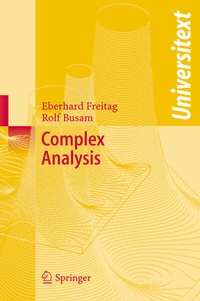
Complex Analysis
1st Edition
Published on 17. January 2006
X, 552 pages
978-3-540-30823-2 (ISBN)
Description

This book is a translation of the forthcoming fourth edition of our German A book "Funktionentheorie I" (Springer 2005). The translation and the LT X E ?les have been produced by Dan Fulea. He also made a lot of suggestions for improvement which in?uenced the English version of the book. It is a pleasure for us to express to him our thanks. We also want to thank our colleagues Diarmuid Crowley, Winfried Kohnen and J¨ org Sixt for useful suggestions c- cerning the translation. Over the years, a great number of students, friends, and colleagues have c- tributed many suggestions and have helped to detect errors and to clear the text. The many new applications and exercises were completed in the last decade to also allow a partial parallel approach using computer algebra systems and graphictools,whichmayhaveafruitful,powerfulimpactespeciallyincomplex analysis. Last but not least, we are indebted to Clemens Heine (Springer, Heidelberg), who revived our translation project initially started by Springer, New York, and brought it to its ?nal stage.
Reviews / Votes
From the reviews:"The guiding principle of the presentation of classical complex analysis is to proceed as quickly as possible to the central results while using a small number of notions and concepts from other fields. Thus the prerequisites for understanding this book are minimal; only elementary facts of calculus and algebra are required. . Motivating introductions, more than four hundred exercises of all levels of difficulty with hints or solutions, historical annotations, and over 120 figures make the overall presentation very attractive." (L'Enseignement Mathematique, Vol. 52 (2), 2006)"The first four chapters cover the essential core of complex analysis . . The second part of the book is devoted to an extensive representation of the theory of elliptic functions . . Interesting introductions, over four hundred exercises with hints or solutions, historical remarks, and over 120 figures make this book very appropriate and attractive for students at all levels." (F. Haslinger, Monatshefte für Mathematik, Vol. 149 (3), 2006)"It is, in fact, a massive introduction to complex analysis, covering a very wide range of topics. . This is the material that I like to cover in an undergraduate course. . Theorems and proofs are clearly delimited, which many students find helpful. . There are problems at the end of each section, and sketches of solutions are given . . Overall, this is quite an attractive book." (Fernando Q. Gouvêa, MathDL, February, 2006)"This book gives an extensive presentation of the theory of classical complex analysis. . The book is richly illustrated with a lot of exercises (more than 400), including solutions . with a wide range of levels of difficulties. The historical annotations, the large amount of figures and the helpful abstracts at the beginning of each chapter make this book very attractive. . recommended to graduated (or advanced undergraduated) students who wish toproceed quickly to the main results of complex analysis." (Samuel Nicolay, Bulletin of the Belgian Mathematical Society, Vol. 15 (1), 2008)More details
Series
Language
English
Place of publication
Berlin
Germany
Publishing group
Springer Berlin
Target group
Primary & secondary/elementary & high school
Illustrations
X, 552 p. 112 illus., 2 illus. in color.
File size
4,55 MB
ISBN-13
978-3-540-30823-2 (9783540308232)
DOI
10.1007/3-540-30823-7
Schweitzer Classification
Other editions
New editions
Eberhard Freitag | Rolf Busam
Complex Analysis
E-Book
04/2009
2nd Edition
Springer
€80.24
Available for download
Additional editions
Eberhard Freitag | Rolf Busam
Complex Analysis
Book
11/2005
Springer
€48.10
Article exhausted; check for reprint
Persons
Content
Differential Calculus in the Complex Plane ?.- Integral Calculus in the Complex Plane ?.- Sequences and Series of Analytic Functions, the Residue Theorem.- Construction of Analytic Functions.- Elliptic Functions.- Elliptic Modular Forms.- Analytic Number Theory.- Solutions to the Exercises.
