

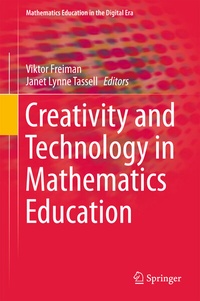
Creativity and Technology in Mathematics Education
Description

This volume provides new insights on creativity while focusing on innovative methodological approaches in research and practice of integrating technological tools and environments in mathematics teaching and learning. This work is being built on the discussions at the mini-symposium on Creativity and Technology at the International Conference on Mathematical Creativity and Giftedness (ICMCG) in Denver, USA (2014), and other contributions to the topic. The book emphasizes a diversity of views, a variety of contexts, angles and cultures of thought, as well as mathematical and educational practices. The authors of each chapter explore the potential of technology to foster creative and divergent mathematical thinking, problem solving and problem posing, creative use of dynamic, multimodal and interactive software by teachers and learners, as well as other digital media and tools while widening and enriching transdisciplinary and interdisciplinary connections in mathematics classroom. Along with ground-breaking innovative approaches, the book aims to provide researchers and practitioners with new paths for diversification of opportunities for all students to become more creative and innovative mathematics learners. A framework for dynamic learning conditions of leveraging mathematical creativity with technology is an outcome of the book as well.
More details
Other editions
Additional editions
Persons
Viktor Freiman, Ph. D. in teaching computer science is Full Professor at the Université de Moncton, Canada. His main research interests, besides creativity and technology, focuses on innovations in teaching and learning, STEAM-education, mathematical giftedness, problem solving, virtual learning communities, as well as digital literacy. He is director of the CompéTICA Partnership Network, funded by the Social Sciences and Humanities Research Council of Canada (2014-2017) investigate digital competence development in the life-long perspective. He is also co-editor of the book Series Mathematics Education in the Digital Era (since 2014).
Janet Lynne Tassell, PhD, is an associate professor at Western Kentucky University, where she teaches elementary mathematics methods and directs the Elementary Mathematics Specialist Endorsement program. Dr. Tassell also teaches identification and current issues courses for the university's gifted and talented master's program. Shetaught a semester abroad at Harlaxton College in England.
Dr. Tassell has taught mathematics at the middle school and high school levels. She spent fourteen years as a gifted education coordinator and director of learning and assessment, working with K-12 teachers in curriculum and professional development. She was co-director of the Toyota Math and Technology Leadership Academy and professional development coordinator for the Javits grant Project GEMS (Gifted Education for Math and Science) initiative for grades 3-6 teachers/students. She led a team of fourteen authors to design and write six books for grades 1-6 students to delve deeper into the Common Core mathematics standards. She has published two books with colleagues for elementary and secondary level -- Real-world learning framework: Digital tools and practical strategies for successful implementation . Her research interests expand into math anxiety, mindfulness, and video gaming impact on mathematics achievement.
Janet received a bachelor's degree in secondary mathematics education, and both a master's and a doctorate degree in curriculum and instruction with a mathematics education major and gifted education minor from Indiana University.