

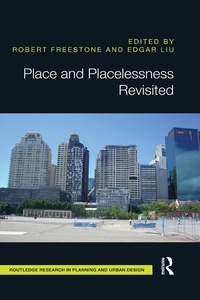
Place and Placelessness Revisited
Published on 15. July 2016
296 pages
978-1-317-38522-6 (ISBN)
Description

Since its publication in 1976, Ted Relph's Place and Placelessness has been an influential text in thinking about cities and city life across disciplines, including human geography, sociology, architecture, planning, and urban design. For four decades, ideas put forward by this seminal work have continued to spark debates, from the concept of placelessness itself through how it plays out in our societies to how city designers might respond to its challenge in practice.
Drawing on evidence from Australian, British, Japanese, and North and South American urban settings, Place and Placelessness Revisited is a collection of cutting edge empirical research and theoretical discussions of contemporary applications and interpretations of place and placelessness. It takes a multi-disciplinary approach, including contributions from across the breadth of disciplines in the built environment - architecture, environmental psychology, geography, landscape architecture, planning, sociology, and urban design - in critically re-visiting placelessness in theory and its relevance for twenty-first century contexts.
Drawing on evidence from Australian, British, Japanese, and North and South American urban settings, Place and Placelessness Revisited is a collection of cutting edge empirical research and theoretical discussions of contemporary applications and interpretations of place and placelessness. It takes a multi-disciplinary approach, including contributions from across the breadth of disciplines in the built environment - architecture, environmental psychology, geography, landscape architecture, planning, sociology, and urban design - in critically re-visiting placelessness in theory and its relevance for twenty-first century contexts.
Reviews / Votes
Ted Relph's notion of placelessness opened up many new possibilities of how we understand the slippery notion of place. Many of them are realized in this multidisciplinary collection. With case studies that range from graffiti to malls and airports and with examples from Detroit to Melbourne and Seoul, it is a welcome contribution that explores how the social constructions of space create different places.John Rennie Short is the author of Human Geography: A Short Introduction.Relph's "Place and Placelessness" Is the one seminal work that gave rise to a whole literature on the subject of place. It's about time that we look back to our original source of inspiration.
Yi-Fu Tuan, University of Wisconsin-Madison
As claims to 'place-making' proliferate in these neo-liberal times, the wide-ranging essays in this 40th anniversary homage to Place and Placelessness update both theory and practice in a global context.Professor John Punter, Cardiff University
Awarded a commendation in the 'Cutting Edge Research and Teaching' category of the 2016 Awards for Planning Excellence from the Planning Institue of Australia (NSW Chapter).
More details
Series
Language
English
Place of publication
London
United Kingdom
Publishing group
Taylor & Francis Ltd
Target group
College/higher education
Illustrations
2 s/w Tabellen, 53 s/w Photographien bzw. Rasterbilder
2 Tables, black and white; 53 Halftones, black and white
File size
5,56 MB
ISBN-13
978-1-317-38522-6 (9781317385226)
Copyright in bibliographic data and cover images is held by Nielsen Book Services Limited or by the publishers or by their respective licensors: all rights reserved.
Schweitzer Classification
Other editions
Additional editions
Robert Freestone | Edgar Liu
Place and Placelessness Revisited
Book
11/2017
1st Edition
Routledge
€81.99
Shipment within 15-20 days
Robert Freestone | Edgar Liu
Place and Placelessness Revisited
Book
05/2016
1st Edition
Routledge
€226.50
Shipment within 10-20 days
Persons
Robert Freestone is Professor of Planning in the Faculty of Built Environment at UNSW Australia. He joined UNSW in 1991 after six years with Design Collaborative, a Sydney planning, research, and heritage consultancy. He has also held appointments at the University of Melbourne, University of Sydney, and the Australian National University. His books include The Planning Imagination (co-editor, 2014), Urban Nation (2012), and Designing Australian Cities (2004).
Edgar Liu is a Research Fellow at City Futures Research Centre in the Faculty of Built Environment at UNSW Australia. He has academic backgrounds in economic and cultural geography, and his research interests include social aspects of public estate renewals, housing as social welfare, and the conceptualization of human identities.
Edgar Liu is a Research Fellow at City Futures Research Centre in the Faculty of Built Environment at UNSW Australia. He has academic backgrounds in economic and cultural geography, and his research interests include social aspects of public estate renewals, housing as social welfare, and the conceptualization of human identities.
Content
Foreword -Tim Cresswell
Revisiting Place and Placelessness -Edgar Liu and Robert Freestone
1. The Paradox of Place and the Evolution of Placelessness -Ted Relph
Part 1. Place/lessness in Design
2. An Urban Designer's Perspective: Paradigms, Places and People -Jon Lang
3. Theory's Role in Placelessness -Lucy Montague
4. Reclaiming and Making and Places of Distinction through Landscape Architecture -Linda Corkery
5. Regulating Place Distinctiveness: A Critique of Approaches to the Protection of 'Neighborhood Character' in Melbourne -Gethin Davison
Part 2. Place/lessness in Experience
6. Insideness in an Age of Mobilities -John Tomaney
7. Losing Control at Home? -Hazel Easthope
8. Tuning In and Out of Place -Rachel Cogger
9. The Risk of Placelessness for Children and Young People in the 21st Century Cities of Western Societies -Kate Bishop
Part 3. Place/lessmess in Practice
10. Examining Place-making in Practice: Observations from the Revitalization of Downtown Detroit -Laura Crommelin
11. Place-making in the Rise of the Airport City -Robert Freestone and Ilan Wiesel
12. Urban Squares: A Place for Social Life -Nancy Marshall
13. Placelessness and the Rigid Perception of Place Identities: Public Toilets as Multi-functional Places -Edgar Liu
Part 4. Place/lessness in Question
14. Extraordinary Ordinaryness: An Outsider's Perspective on Place and Placelessness in the Japanese City -Matthew Carmona
15. Extending Place: The Global South and Informal Urbanisms -Aseem Inam
16. Place as Multiplicity -Kim Dovey
Afterword -Ted Relph
Revisiting Place and Placelessness -Edgar Liu and Robert Freestone
1. The Paradox of Place and the Evolution of Placelessness -Ted Relph
Part 1. Place/lessness in Design
2. An Urban Designer's Perspective: Paradigms, Places and People -Jon Lang
3. Theory's Role in Placelessness -Lucy Montague
4. Reclaiming and Making and Places of Distinction through Landscape Architecture -Linda Corkery
5. Regulating Place Distinctiveness: A Critique of Approaches to the Protection of 'Neighborhood Character' in Melbourne -Gethin Davison
Part 2. Place/lessness in Experience
6. Insideness in an Age of Mobilities -John Tomaney
7. Losing Control at Home? -Hazel Easthope
8. Tuning In and Out of Place -Rachel Cogger
9. The Risk of Placelessness for Children and Young People in the 21st Century Cities of Western Societies -Kate Bishop
Part 3. Place/lessmess in Practice
10. Examining Place-making in Practice: Observations from the Revitalization of Downtown Detroit -Laura Crommelin
11. Place-making in the Rise of the Airport City -Robert Freestone and Ilan Wiesel
12. Urban Squares: A Place for Social Life -Nancy Marshall
13. Placelessness and the Rigid Perception of Place Identities: Public Toilets as Multi-functional Places -Edgar Liu
Part 4. Place/lessness in Question
14. Extraordinary Ordinaryness: An Outsider's Perspective on Place and Placelessness in the Japanese City -Matthew Carmona
15. Extending Place: The Global South and Informal Urbanisms -Aseem Inam
16. Place as Multiplicity -Kim Dovey
Afterword -Ted Relph
