

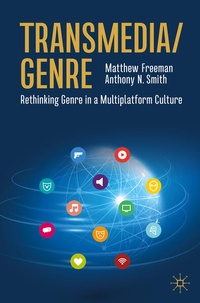
Transmedia/Genre
Description

This book brings genre back to the forefront of the current transmedia trend. Genres are perhaps the most innately transmedial of media constructs, formed as they are from all kinds of industrial, technological and discursive phenomena. Yet, few have considered how genre works in a multiplatform context. This book does precisely that, making a uniquely transmedial contribution to the study of genre in the age of media convergence. The book interrogates how industrial, technological and participatory transformations of digital platforms and emerging technologies reshape workings of genre. The authors consider franchises such as Star Wars , streaming platforms such as Netflix, catch-up services such as ITV Hub, creative technologies such as virtual reality, and beyond. In setting the stage for the revival of genre theory in contemporary transmedia scholarship, this book pushes forward understandings of multiplatform media and the emerging form and function of genre across contemporary culture.
Reviews / Votes
"Each case study offers internal sections with a historical overview of the genre or the platform, as well as new terminology to encapsulate the genre phenomena taking place, making them valuable to both scholars and students. Although the chapters can be read autonomously, the connections between them create a kaleidoscope of ideas that support in greater depth the final findings. The result is a text that is rich in approaches, consistent in aims, and well-developed throughout." (Marta F Suarez, Critical Studies in Television, Vol. 19 (4), December, 2024)
More details
Other editions
Additional editions
Persons
Matthew Freeman
is Reader in Multiplatform Media at Bath Spa University, UK, where he is Research Lead for Film & Media and Course Leader for BA (Hons) Media Communications. He is the author/editor of eight books on topics such as transmedia and media industries. Beyond academia, he is the Founder of Immersive Promotion Design, a marketing consultancy for the immersive sector.
Anthony N. Smith is Lecturer in Television Theory at the University of Salford, UK. He has published articles in New Media & Society , Critical Studies in Television and beyond. He is also co-editor of Storytelling in the Media Convergence Age: Exploring Screen Narratives (Palgrave Macmillan, 2014) and author of Storytelling Industries: Narrative Production in the 21 st Century (Palgrave Macmillan, 2018).
