

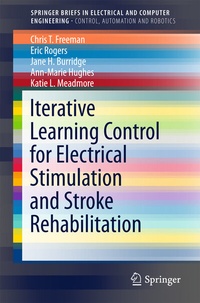
Iterative Learning Control for Electrical Stimulation and Stroke Rehabilitation
Description

Regaining upper limb movement is an important step in a return to independence after stroke, but the prognosis for such recovery has remained poor. Rehabilitation robotics provides the opportunity for repetitive task-oriented movement practice reflecting the importance of such intense practice demonstrated by conventional therapeutic research and motor learning theory. Until now this technique has not allowed feedback from one practice repetition to influence the next, also implicated as an important factor in therapy. The authors demonstrate how ILC can be used to adjust external functional electrical stimulation of patients' muscles while they are repeatedly performing a task in response to the known effects of stimulation in previous repetitions. As the motor nerves and muscles of the arm reaquire the ability to convert an intention to move into a motion of accurate trajectory, force and rapidity, initially intense external stimulation can now be scaled back progressively until the fullest possible independence of movement is achieved.
Reviews / Votes
"This is a unique and relatively short description of the development and testing of an innovative approach to stroke rehabilitation. . Figures and tables are clear and are used to enhance the readability. This book is particularly useful for engineers and investigators with an interest in motor control. . book is clearly and succinctly written and is well organized, with a sound and systematic, step-by-step description of the development of the technology and the studies used to test its applications." (Elliot J. Roth, Doody's Book Reviews, September, 2015)
More details
Other editions
Additional editions
Persons
Content
Iterative Learning Control: An Overview.- Technology Transfer to Stroke Rehabilitation.- ILC based Upper-Limb Rehabilitation- Planar Tasks.- Iterative Learning Control of the Unconstrained Upper Limb.- Goal-oriented Stroke Rehabilitation
