

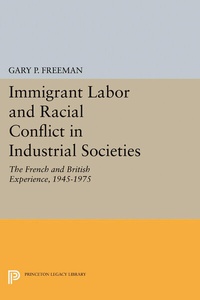
Immigrant Labor and Racial Conflict in Industrial Societies
The French and British Experience, 1945-1975
1st Edition
Published on 19. May 2015
378 pages
978-1-4008-6905-3 (ISBN)
Description

In order to describe how the elites in two political systems grappled with the potentially explosive influx of foreign labor, Gary Freeman analyzes and compares the ways in which the British and the French governments responded to immigration and racial conflict over a thirty-year period during the post-war era. In addition to comparing the policy records of the two countries, the author focuses on the process by which political and social phenomena become defined as public problems and how alternative responses to these problems are generated. His broader aim is to provide a standpoint from which to evaluate the more general problem-solving capability of the political systems under consideration.
Professor Freeman finds that by 1975 both Britain and France had instituted tightly controlled, racially discriminatory, temporary contract-labor systems. Despite this basic similarity, however, he notes three distinctions between the two cases: while the French attempted to adapt immigration to their economic needs, the British failed to seize this opportunity; while the British moved toward an elaborate race relations structure, the French relied on criminal law and the economic self-interest of the worker to prevent outbreaks of racial violence; and the British were much more affected than the French by fears of immigration and racial conflict.
Originally published in 1979.
The Princeton Legacy Library uses the latest print-on-demand technology to again make available previously out-of-print books from the distinguished backlist of Princeton University Press. These editions preserve the original texts of these important books while presenting them in durable paperback and hardcover editions. The goal of the Princeton Legacy Library is to vastly increase access to the rich scholarly heritage found in the thousands of books published by Princeton University Press since its founding in 1905.
Professor Freeman finds that by 1975 both Britain and France had instituted tightly controlled, racially discriminatory, temporary contract-labor systems. Despite this basic similarity, however, he notes three distinctions between the two cases: while the French attempted to adapt immigration to their economic needs, the British failed to seize this opportunity; while the British moved toward an elaborate race relations structure, the French relied on criminal law and the economic self-interest of the worker to prevent outbreaks of racial violence; and the British were much more affected than the French by fears of immigration and racial conflict.
Originally published in 1979.
The Princeton Legacy Library uses the latest print-on-demand technology to again make available previously out-of-print books from the distinguished backlist of Princeton University Press. These editions preserve the original texts of these important books while presenting them in durable paperback and hardcover editions. The goal of the Princeton Legacy Library is to vastly increase access to the rich scholarly heritage found in the thousands of books published by Princeton University Press since its founding in 1905.
More details
Other editions
Additional editions
Gary P. Freeman
Immigrant Labor and Racial Conflict in Industrial Societies
The French and British Experience, 1945-1975
Book
04/2016
Princeton University Press
€125.50
Article not available at the moment
Gary P. Freeman
Immigrant Labor and Racial Conflict in Industrial Societies
The French and British Experience, 1945-1975
Book
03/2015
Princeton University Press
€48.00
Article not available at the moment

Gary P. Freeman
Immigrant Labor and Racial Conflict in Industrial Societies
The French and British Experience, 1945-1975
Book
05/1979
Princeton University Press
€55.71
Article exhausted; check different version
Person
Gary P. Freeman
Content
Frontmatter, pg. i
Contents, pg. vii
List of Tables, pg. ix
Preface, pg. xi
CHAPTER 1. Introduction, pg. 1
CHAPTER 2. Labor Migration and the Colonial Legacy, pg. 20
CHAPTER 3. The Evolution of Immigration Policy since World War II, pg. 43
CHAPTER 4. Elites, Consensus, and the Depoliticization of Race, pg. 99
CHAPTER 5. Immigration, Race Relations, and Welfare, pg. 131
CHAPTER 6. The Economic Context of Immigration Policy, pg. 173
CHAPTER 7. The Dilemma of Organized Labor and the Left, pg. 216
CHAPTER 8. Racism, Nationalism, and the Mass Public, pg. 259
CHAPTER 9. Conclusion, pg. 308
Works Cited, pg. 330
Index, pg. 349
Contents, pg. vii
List of Tables, pg. ix
Preface, pg. xi
CHAPTER 1. Introduction, pg. 1
CHAPTER 2. Labor Migration and the Colonial Legacy, pg. 20
CHAPTER 3. The Evolution of Immigration Policy since World War II, pg. 43
CHAPTER 4. Elites, Consensus, and the Depoliticization of Race, pg. 99
CHAPTER 5. Immigration, Race Relations, and Welfare, pg. 131
CHAPTER 6. The Economic Context of Immigration Policy, pg. 173
CHAPTER 7. The Dilemma of Organized Labor and the Left, pg. 216
CHAPTER 8. Racism, Nationalism, and the Mass Public, pg. 259
CHAPTER 9. Conclusion, pg. 308
Works Cited, pg. 330
Index, pg. 349
